

Global employee engagement fell to just 20% in 2025 — its lowest point since 2020 — according to Gallup’s State of the Global Workplace 2026 report.
Recognition is one of the few levers that moves that number. Gallup found that employees who feel recognized and included are three times more likely to call their workplace fun — a small phrase for a large effect on retention.
Positive awards for employees are structured recognition initiatives that celebrate real behaviors, effort, and values, not just tenure or sales totals. This guide covers what makes them work, 30+ specific award ideas, and how to design a program employees actually notice.
What Are Positive Awards for Employees?
Positive awards for employees are recognition programs built around behavior and values, not just outcomes.
They celebrate the how, not only the what. A traditional award might reward a closed deal. A positive award recognizes the collaboration, persistence, or creativity that got someone there.
Positive awards for employees: structured recognition that reinforces specific behaviors, values, and contributions in a way that feels personal, timely, and earned — as distinct from generic, tenure-based, or purely metric-driven awards.
Positive awards for employees typically fall into a few overlapping types:
- Peer-nominated recognition
- Value-based awards tied to company culture
- Growth and development milestones
- Non-monetary appreciation (shout-outs, badges, notes)
The distinction matters because intent drives design. If the goal is repeating a behavior, the award has to name that behavior specifically — not just hand out a generic trophy.
A quick example: a customer support team struggling with slow escalations doesn’t need a generic “Great Job” award.
It needs an award named around the specific behavior — fast, accurate escalation — so the team understands exactly what’s being reinforced and why.
That level of specificity is what separates a positive award program from a trophy cabinet nobody remembers filling.
Related reading: Designing Positive Awards for Employees That Maximize Impact.
Recognition vs. Reward: What’s the Difference?
Recognition and rewards get used interchangeably, but they solve different problems.
Recognition is an acknowledgment — a public shout-out, a note, a mention in a team meeting. It costs little or nothing and works because it’s personal and specific.
A reward is tangible — a gift card, a bonus, extra time off. Rewards work well for milestones and results; recognition works better for reinforcing everyday behavior.
Recognition answers “I see what you did.” A reward answers “here’s something for doing it.” The strongest programs use both, deliberately, rather than defaulting to one.
Positive recognition, specifically, sits closer to the acknowledgment side — it’s about making someone feel seen, which is why timing and specificity matter more than monetary value.
Consider two managers responding to the same missed-deadline recovery. One says “good job this week” in passing. The other says “the way you flagged the delay early and re-planned the sprint kept us on track — that’s exactly the ownership we want.”
Both are recognition. Only the second one is positive recognition in the sense that matters here: specific enough that the employee knows exactly what to repeat.
That specificity is also what separates a real award from a participation trophy — the reward is optional, but the specific acknowledgment isn’t.
Why Do Positive Employee Awards Improve Engagement and Retention?
Recognition works because it meets three needs at once: belonging, progress, and purpose.
When someone is recognized for a specific action, their brain treats it as confirmation that the behavior mattered. That confirmation is what drives them to repeat it.
Gallup’s 2026 report found engaged employees perform 20% better and are 87% less likely to leave than disengaged peers — recognition is one of the clearest levers HR has to move that number.
Organizations that build genuine recognition cultures typically see:
- Higher discretionary effort and morale
- Lower burnout and absenteeism
- Stronger day-to-day alignment with stated values
From working with HR teams on recognition rollouts, the pattern is consistent: teams that recognize effort — not only results — see broader participation, because more people have a realistic shot at being noticed.
Positive awards for employees work best when they’re timely and visible, not saved for an annual ceremony. See why timely recognition matters for a deeper breakdown.
Feature: Timely recognition ties an award directly to the moment it was earned.
How it works: A shout-out posted the same day a behavior happens keeps the connection between action and acknowledgment intact.
Outcome: Employees are more likely to repeat the behavior, because the feedback loop is still fresh.
A once-a-year ceremony can’t reproduce that loop — by the time recognition arrives, the employee may not even remember the specific ction clearly enough to connect it to the award.
What Makes an Employee Award Truly Meaningful?
Not every award lands. Generic, delayed, or one-size-fits-all recognition gets ignored — or worse, resented.
Four traits separate a meaningful award from a forgettable one:
| Principle | Why it matters | Example |
|---|---|---|
| Personalization | Builds an emotional connection | Role-specific recognition, not a form letter |
| Relevance | Reinforces a specific value | Culture-aligned awards tied to a named behavior |
| Timeliness | Strengthens the behavior while it’s fresh | Recognition within days, not at year-end |
| Visibility | Scales the culture beyond one manager | Peer shout-outs visible to the whole team |
Personalized recognition creates a memory. Generic recognition creates paperwork. The difference is whether the employee understands specifically why they were recognized.
A useful test before handing out any award: could you explain, in one sentence, exactly what behavior earned it?
If the answer is “they’ve been here a while” or “they’re just solid,” the award needs sharper criteria before it goes out. If the answer names a specific action or value, it’s ready.
Teams that run this test consistently tend to retire vague categories like “Team Player” in favor of more specific ones, such as naming the exact collaborative behavior they want repeated.
30+ Positive Award Ideas for Employees, by Category
Most recognition programs stall because they run out of ideas after “Employee of the Month.” A wider, categorized list keeps recognition specific instead of repetitive.

Performance-based awards
- Project Excellence Award — for a specific delivered outcome
- Customer Impact Award — for measurable client or user impact
- Revenue Contribution Award — for a clear, attributable business result
- Quality Excellence Award — for consistent, error-free work
- Process Improvement Award — for a specific efficiency gain
Values-based (symbolic) awards
- Culture Champion Award — for consistently living a named value
- Integrity in Action Award — for transparency under pressure
- Inclusion Advocate Award — for building belonging on a team
- Sustainability Award — for environmental or community initiative
- Safety Champion Award — for consistently protecting a safe workplace
Peer-to-peer awards
- Team Kudos Award — peer-nominated, given weekly or monthly
- People’s Choice Award — voted on by colleagues, not managers
- Unsung Hero Award — for consistently overlooked contributions
- Collaboration Champion Award — for cross-team teamwork
- Above and Beyond Award — for going past the job description
Growth and learning awards
- Rising Star Award — for emerging talent early in tenure
- Most Improved Award — for measurable skill growth
- Continuous Learner Award — for certifications or new skills
- Leadership Potential Award — for early leadership behaviors
Milestone and tenure awards
- Work Anniversary Award — personalized by year, not generic
- Years of Service Award — for long-term contribution
- Legacy Builder Award — for impact that outlasts the role
- Rookie of the Year Award — for standout first-year performance
EQ and mentorship awards
A newer category worth adding: awards for the interpersonal skills that don’t show up in a performance dashboard.
- Mentorship Award — for developing others, not just self
- Empathetic Leader Award — for managers who lead with emotional intelligence
- Exceptional Listener Award — for building trust through active listening
These categories map directly to what BRAVO’s awards and nomination feature is built to run — structured categories, peer or manager nomination, and visibility across the team, without a spreadsheet behind it.
Peer Recognition Awards vs. Top-Down Recognition
Peer recognition awards and manager-led recognition solve different problems, and most programs need both.
Top-down recognition — a manager naming someone for an award — carries weight because it’s tied to authority and performance review. It works well for results-based, milestone, or promotion-adjacent recognition.
Peer recognition awards work differently: they surface contributions a manager never sees — the colleague who helped someone hit a deadline, or explained something patiently twice.
Peer-driven recognition programs typically see broader participation than manager-only programs, because more employees are eligible to give recognition, not just receive it.
A practical split many teams use:
- Reserve top-down awards for performance milestones and promotions
- Open peer-to-peer awards for day-to-day collaboration and values
- Let both feed the same visible recognition feed, not two separate systems
BRAVO’s social recognition feature is built around this split — peer shout-outs and manager-led awards live in the same feed, so recognition doesn’t fragment across tools.
There’s a fairness angle too. Manager-only recognition tends to cluster around employees who work closely with leadership — often the most visible, not necessarily the most deserving.
Opening a peer-nominated channel spreads recognition across the org chart, catching contributions from people who rarely interact with a manager directly, like night-shift staff or fully remote teammates.
Monetary vs. Non-Monetary Employee Recognition Awards
Not every positive award needs a budget line. The two types work best combined, not chosen exclusively.
| Monetary awards | Non-monetary awards | |
|---|---|---|
| Examples | Bonuses, gift cards, extra PTO | Shout-outs, badges, handwritten notes |
| Best for | Milestones, results, promotions | Day-to-day behavior, values, effort |
| Cost to scale | Rises with team size | Stays flat regardless of headcount |
| Emotional impact | Strong, short-lived | Often longer-lasting when specific |
Non-monetary recognition often outperforms cash on emotional impact, largely because it requires more thought — a specific note takes effort a generic bonus doesn’t.
The two aren’t in competition. A milestone might warrant a bonus and a public shout-out; a small daily win usually only needs the second one.
Positive awards for employees that lean too heavily on monetary rewards tend to feel transactional over time — recognition starts to feel like a payroll line item rather than genuine appreciation.
A useful rule of thumb: use non-monetary recognition as the default, and reserve monetary rewards for moments that genuinely warrant them.
That keeps the budget sustainable as headcount grows, while making the monetary awards feel like a real event rather than a routine bonus cycle everyone expects.
Employees consistently report remembering why they received non-monetary recognition longer than they remember the dollar amount of a bonus — the specificity outlasts the cash value.
Read – What Are Monetary Incentives? Types, Examples
How Often Should You Give Employee Recognition Awards?
Recognition loses impact the longer it waits. Frequency matters as much as the award itself.
A simple cadence framework:
- Daily/weekly: peer shout-outs, small wins, effort-based recognition
- Monthly: team-nominated awards (Employee of the Month, Team Kudos)
- Quarterly: performance-based and values-based awards tied to review cycles
- Annually: milestone and tenure awards (anniversaries, Years of Service)
Waiting until an annual ceremony to recognize a behavior that happened in March disconnects the recognition from the action — the employee has to be reminded what it was even for.
The fix isn’t more awards; it’s matching cadence to award type, so daily effort gets daily acknowledgment and only genuine milestones wait for a bigger moment.
Feature: A tiered cadence separates fast, frequent recognition from slower, bigger awards.
How it works: Peer shout-outs post instantly; milestone and performance awards route through a scheduled monthly or quarterly cycle.
Outcome: Employees get acknowledged constantly, while the larger awards keep their significance instead of feeling routine.
Teams that skip the daily/weekly layer entirely and rely only on quarterly or annual awards tend to see recognition treated as an HR event, not a culture — the fix is almost always adding the fast layer back in, not removing the slow one.
How Do You Design Personalized Employee Recognition Awards?
Designing effective positive awards for employees starts with understanding people, not writing policy.
Best practices that consistently work:
- Map each award category to a specific, named company value
- Offer more than one path to recognition (peer, manager, self-nominated)
- Let both peers and managers participate, not just leadership
- Avoid one-size-fits-all awards across very different roles
Programs that collect regular employee feedback and adjust their award categories see meaningfully higher participation than programs that set categories once and never revisit them.
A short, anonymous pulse survey asking “which award category feels most relevant to your work” surfaces gaps faster than waiting for participation numbers to quietly decline.
A quarterly ten-minute review of which award categories are actually being used — and which are sitting empty — tells you more about program health than any survey.
An empty category is a signal, not a coincidence. If nobody’s nominated anyone for “Innovation Champion” in six months, either the criteria are unclear or the behavior isn’t happening — worth finding out which before quietly dropping the category.
Involving both peers and managers in that quarterly review also surfaces blind spots faster than a manager-only audit ever will, since each group notices different gaps in who’s getting recognized.
How Does Technology Improve Employee Recognition Programs?
Manual recognition breaks down as headcount grows. Missed moments and inconsistent awards quietly erode trust in the program.
Feature: A recognition platform centralizes nominations, approvals, and visibility in one system.
How it works: Employees or managers submit a nomination, it’s tagged to a category and value, and it appears in a shared feed instantly.
Outcome: Recognition becomes consistent and visible instead of dependent on one manager remembering.
Technology solves three specific failure points: missed moments, inconsistent criteria, and invisible recognition that only the recipient ever sees.
- Real-time recognition instead of quarterly batches
- Analytics on who’s being recognized — and who isn’t
- Fair, auditable award distribution across teams
- Recognition embedded in daily tools, not a separate login
Spreadsheet-based recognition tends to work fine at 20 employees and quietly collapses at 200 — nominations get lost, categories drift, and the person tracking it becomes a bottleneck.
The analytics piece matters more than it sounds. Without it, HR teams typically can’t answer a basic question: is recognition distributed fairly across departments, tenure levels, and demographics, or clustered around a handful of visible employees?
A platform that tracks nomination patterns surfaces that imbalance automatically, instead of leaving it to be discovered in an engagement survey a year later.
How BRAVO Automates Positive Employee Recognition
BRAVO, an AI-powered employee recognition platform, is built to keep recognition consistent without making it feel automated.
With BRAVO, teams can launch value-based award categories, enable peer-to-peer nominations, and track participation across the organization — all from one employee recognition platform.

Feature: BRAVO’s nomination workflow routes peer and manager nominations into shared award categories.
How it works: Anyone can nominate a colleague against a named value; approvals and visibility happen automatically.
Outcome: Recognition programs run continuously instead of only during scheduled review cycles.
Instead of isolated award ceremonies, BRAVO creates a continuous feed of positive employee recognition that scales with headcount rather than breaking under it. See how teams structure this inside BRAVO’s employee reward program.
For teams that also want tenure and milestone tracking built in, BRAVO’s employee milestones feature flags upcoming anniversaries automatically, so milestone awards go out on time instead of a manager remembering manually.
The result HR teams typically report: fewer missed recognition moments, and a visible record of who’s been recognized for what, without anyone maintaining a spreadsheet on the side.
That visibility also makes recognition self-reinforcing. Employees who see peers being recognized regularly are more likely to give recognition themselves, which is how a program grows participation without a top-down mandate.
Common Mistakes to Avoid in Employee Awards Programs
Even well-intentioned recognition programs fail in predictable, specific ways.
- Over-indexing on monetary rewards — recognition starts to feel like compensation, not appreciation
- Delaying recognition — praise given weeks later loses its connection to the original action
- Ignoring peer contributions — manager-only recognition misses most of what actually happens day to day
- Vague award criteria — “Employee of the Month” with no stated reason breeds resentment, not motivation
- Recognizing only top performers — narrow eligibility discourages the majority who could realistically win
- Launching and forgetting — programs without a review cadence quietly go stale within a year
The common thread: positive awards for employees fail when they feel automatic or arbitrary, not when the budget is too small. See five specific mistakes teams make with employee rewards for a closer breakdown of the budget-related failure modes.
Most of these mistakes compound each other. A program with vague criteria and no review cadence usually ends up over-relying on monetary rewards too, because cash is easier to hand out than a specific, well-reasoned explanation.
Fixing the criteria and the cadence tends to fix the budget problem on its own, without cutting spend directly.
How Can You Measure the Impact of Recognition Programs?
Recognition programs should be measured like any other retention initiative — not treated as a soft, unmeasurable perk.
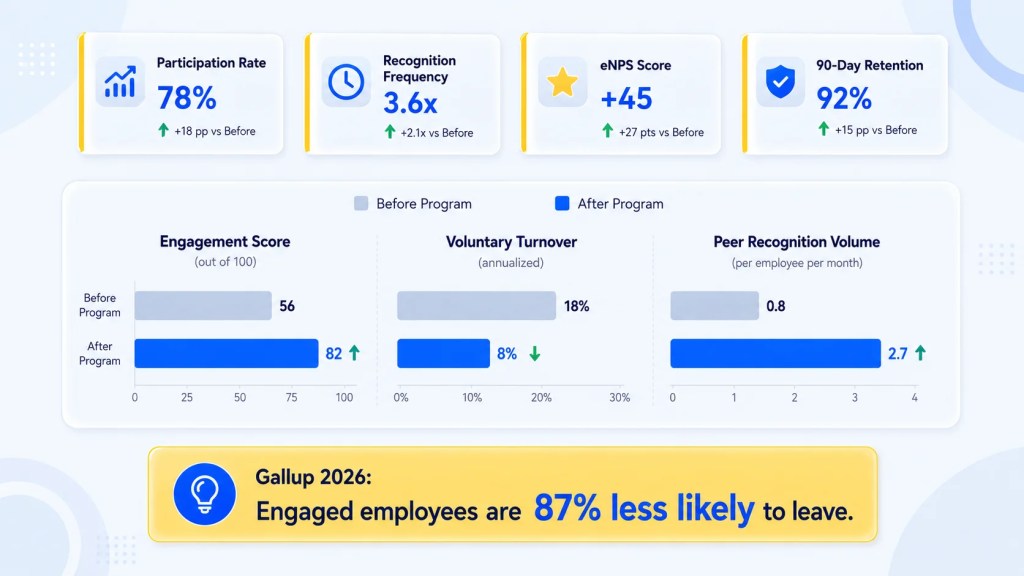
Key metrics worth tracking on a quarterly basis:
- Participation rate — % of employees giving or receiving recognition
- Recognition frequency — average time between an action and its recognition
- Engagement survey movement, specifically on belonging and recognition questions
- Voluntary turnover, tracked against recognition frequency by team
Platforms like BRAVO surface these metrics directly through meaningful, actionable reporting, so recognition impact shows up next to the retention numbers leadership already tracks.
Conclusion
Positive awards for employees work when they’re specific, timely, and tied to a named behavior — not when they’re expensive.
The programs that hold up over time combine peer and manager recognition, mix monetary and non-monetary awards, and get reviewed on a real cadence instead of running unchanged for years.
If you’re ready to put recognition into practice, book a free BRAVO demo and see how your team can get started in minutes.
Frequently Asked Questions
Positive awards for employees recognize specific behaviors, values, and contributions in a personalized way, distinct from generic or purely tenure-based recognition. They work best when tied to a named value or action, not a vague category.
Recognition increases feelings of belonging and progress, which directly reduces voluntary turnover. Gallup’s 2026 report found engaged employees are 87% less likely to leave than disengaged peers, and recognition is one of the clearest drivers of engagement.
Peer recognition awards are given by colleagues and surface day-to-day contributions managers rarely see. Manager-led awards carry more formal weight and suit performance milestones. Strong programs use both rather than choosing one.
Yes. Non-monetary recognition — shout-outs, specific notes, public praise — often creates stronger emotional impact than cash because it requires more thought to deliver well. It works best for everyday behavior, while monetary rewards suit larger milestones.
Recognition should be continuous, not limited to an annual ceremony. A practical cadence pairs daily or weekly peer shout-outs with monthly team awards and reserves quarterly or annual awards for larger performance and tenure milestones.
The most common mistake is over-indexing on monetary rewards while ignoring timing and specificity. A delayed or vague award loses its connection to the action it was meant to recognize, regardless of its dollar value.
BRAVO is an AI-powered employee recognition platform that centralizes peer and manager nominations, tracks participation, and keeps recognition consistent as teams scale. It runs value-based award categories inside one shared, visible feed.

He is an SEO strategist and content writer focused on employee engagement and SaaS marketing. He creates data-driven content that ranks on Google and AI search while helping businesses improve motivation, productivity, and retention.


