

Gallup’s State of the Global Workplace 2026 report puts global employee engagement at 20% for 2025. That is the lowest level since 2020.
An employee pulse survey shows that drop in your own team before it turns into resignations. The hard part is choosing software that people will actually answer.
I compared eight tools on cadence, anonymity thresholds, Slack and Teams delivery, and price by team size. One of them is BRAVO, an AI-powered employee recognition and engagement platform by WorkHub. I state its limits plainly.
My sources are vendor documentation and published pricing. I did not run a live trial of every tool.
How did I compare employee pulse survey software?
I compared eight tools on five criteria. Each one decides whether a pulse program survives past its first quarter.
- Cadence: how often surveys run, and whether questions repeat so results trend.
- Anonymity threshold: the minimum group size before a team’s results appear.
- Delivery: whether employees answer in Slack, Teams, email or a browser.
- Action workflow: what managers do once results arrive.
- Price: published per-user rates with a date, or quote-only.
My sources are vendor help centers, vendor pricing pages and review listings, checked in October 2026. Where a vendor publishes no price, I say so instead of quoting a third-party estimate. Treat feature notes as documented behavior, not tested behavior.
The list covers four buyer types. BRAVO Voice and Vantage Pulse are recognition-led, while Lattice and 15Five are performance-led.
Culture Amp and Officevibe are specialist survey tools. Workday Peakon and Qualtrics EmployeeXM serve large enterprises.
I left out generic form builders. They send questions, but they do not trend answers, segment teams or hand managers a next step. For wording ideas, see these engagement survey question examples.
What should an employee pulse survey tool do?
A good employee pulse survey tool repeats a few questions on a schedule. It also protects who answered what, meets people in the apps they already use, and gives managers a next step.

How often should the survey run?
Monthly suits most teams. It leaves two to three weeks to act on results before the next round.
Weekly cadences work for small teams with one rotating question. Anything slower than quarterly stops being a pulse.
What anonymity threshold should the tool enforce?
Five respondents is the common default. Lattice defaults its anonymity threshold to five. 15Five does the same, and admins can lower it to three or four.
Lowering the number raises the risk that people in small teams identify each other.
Where do employees answer?
Every login between a notification and an answer costs responses. Tools that let people answer inside Slack or Teams remove that step. Tools that link out to a browser keep it.
What happens after the results arrive?
A pulse without a manager step is data nobody uses. Look for team-level dashboards, action plans and prompts for one-on-ones.
If the tool stops at a score, your managers will stop at it too. A broader employee satisfaction survey can set the yearly baseline, while the pulse tracks change between rounds.
Which tools lead on anonymity and Slack or Teams delivery?
Lattice and 15Five publish the clearest anonymity rules, and Lattice documents Slack and Teams notifications. The other tools list integrations, but I found fewer published details. “Not verified” in the table means I found no vendor-published figure.
| Tool | Best for | Anonymity threshold | Slack or Teams | Price |
|---|---|---|---|---|
| BRAVO Voice | Recognition-first teams adding pulses | Not verified | Not verified | Pricing page |
| Lattice | Performance and engagement in one suite | Default 5, never below 3 | Slack, Teams and email notifications | $4 per user per month, annual billing |
| 15Five | Manager coaching plus engagement | Default 5, adjustable to 3 or 4 | Integrations listed | $4 per user per month (Engage), annual billing |
| Culture Amp | Benchmarks and survey science | Minimum group size, number not verified | Integrations listed | No published price |
| Workleap Officevibe | Small and mid-size teams | Not verified | Integrations listed | Confirm on Workleap’s pricing page |
| Vantage Pulse | Pulses inside a rewards suite | Not verified | Not verified | Not verified |
| Workday Peakon | Workday customers | Not verified | Not verified | No published price |
| Qualtrics EmployeeXM | Large enterprise programs | Not verified | Not verified | No published price |
The 8 best employee pulse survey tools
The eight tools below fit different buyers, so none is best for everyone. Jump to the one that matches your situation:
1. BRAVO Voice – EMPLOYEES SURVEY
- Best for: teams that already recognize people and want pulse results beside that activity.
- Pricing: Check pricing on the pricing page.
- Anonymity and delivery: not verified; ask in a demo.
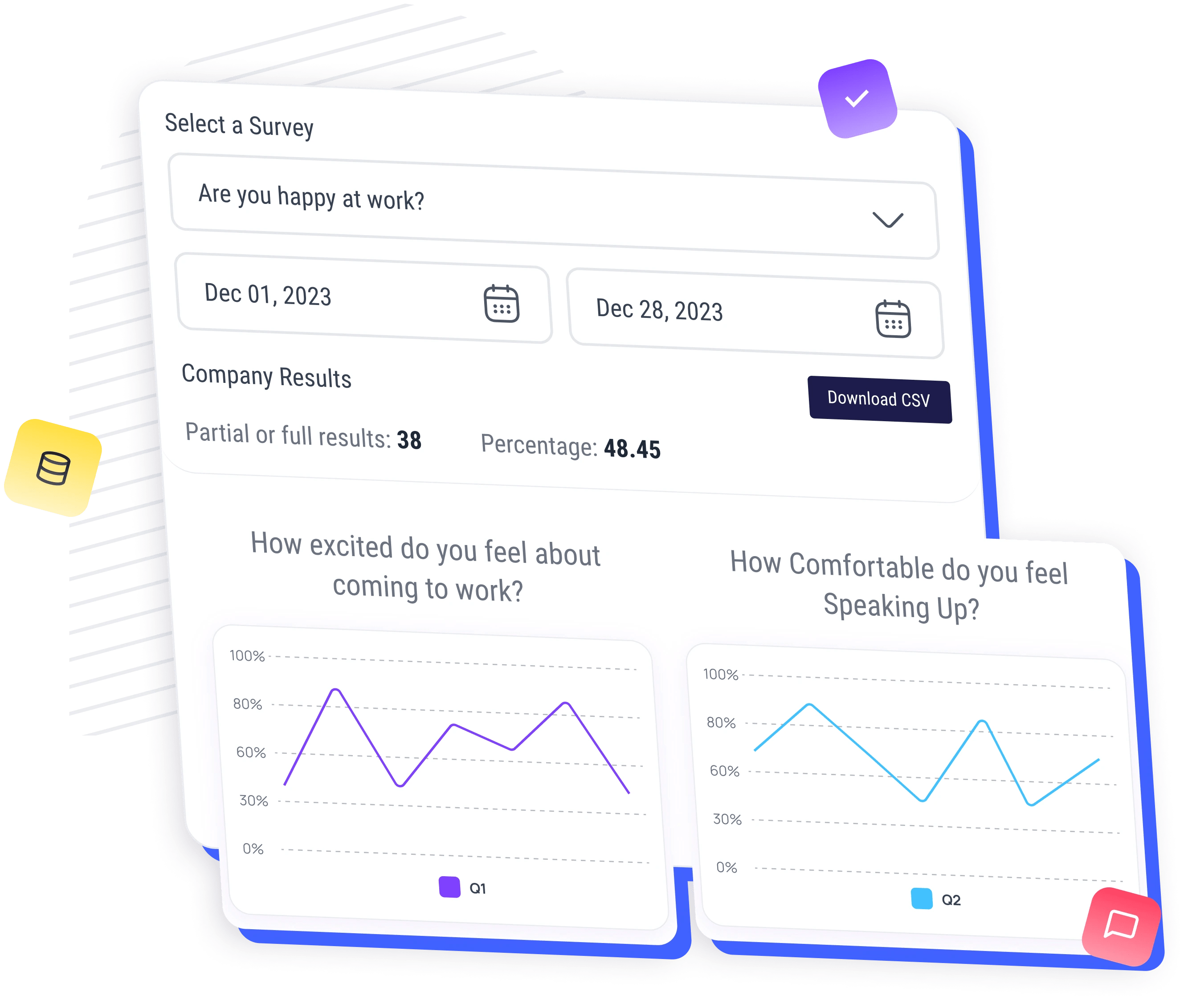
BRAVO Voice is the survey module inside BRAVO, next to BRAVO Points. Review listings describe recurring or one-time surveys, targeting by team or department, and a question library. A pulse and a recognition program then share one platform and one admin.
Where BRAVO Voice shines:
- Recurring or one-time surveys: schedule a pulse once, or send a single check-in.
- Team and department targeting: send different questions to different groups.
- Recognition context: pulse answers sit next to the platform’s recognition activity.
What could be improved:
- Survey depth: BRAVO Voice is one module in a recognition suite. Large external benchmark sets and deep driver analysis are Culture Amp and Qualtrics territory. [VERIFY with BRAVO product team]
- Small review base: G2 shows BRAVO’s pulse survey feature with 13 reviews, so independent evidence is thin. See the G2 comparison.
- Published specifics: the default anonymity threshold and in-chat answering are not documented in sources I could verify.
2. Lattice
- Best for: teams that want performance reviews, goals and engagement in one platform.
- Pricing: $4 per user per month for Engagement, billed annually, as of October 2026. A $4,000 minimum annual agreement applies.
- Anonymity: default threshold of 5, never below 3.
Lattice treats pulse and engagement surveys as anonymous by default and shows only aggregate results. Admins can raise the anonymity threshold for each survey. Admins can also export individual anonymous responses on Engagement surveys, but not on Pulse surveys, per Lattice’s help center.
Pulse launch notifications can go out through Slack, Microsoft Teams, email or any mix. Each message carries a button to the survey.
Where Lattice shines:
- Clear anonymity rules: a documented default and a hard floor of three respondents.
- Chat notifications: launch and reminder messages reach people in Slack or Teams.
What could be improved:
- Minimum contract: at 50 people, the $4,000 minimum works out to about $6.67 per user per month.
- Suite structure: teams that only need pulses may not use the performance modules.
3. 15Five
- Best for: companies that want engagement data tied to manager coaching.
- Pricing: Engage is $4 per user per month, billed annually, as of October 2026.
- Anonymity: confidential, not anonymous. Default threshold of 5.
15Five states that engagement responses are confidential, not anonymous. Responses link to employee accounts internally, but managers only see aggregates for groups above the threshold. Written comments stay anonymous.
Admins can lower the threshold to three or four respondents. That helps small teams see results, but it makes individuals easier to identify.
Where 15Five shines:
- Transparent rules: the help center explains exactly what managers can and cannot see.
- Published entry price: Engage lists a flat per-user rate.
What could be improved:
- Confidential, not anonymous: staff who expect full anonymity may answer less candidly.
- Add-ons cost extra: check what the Engage tier excludes before you sign.
4. Culture Amp
- Best for: larger HR teams that want benchmarks and research-backed surveys.
- Pricing: no published price. Culture Amp ties cost to headcount, product and service tier.
- Anonymity: enforces a minimum group size; confirm the number with the vendor.
Culture Amp is known for psychologist-designed templates and comparison data. Those matter when you want to know whether a score is good, not just whether it moved. It lists Slack and Microsoft Teams integrations for reminders and results.
Where Culture Amp shines:
- Benchmarks: compare your scores against outside data.
- Survey design: templates built for engagement research.
What could be improved:
- No public price: you need a sales call to budget.
- Weight for small teams: a specialist platform adds setup effort a 40-person team may not need.
5. Workleap Officevibe
- Best for: small and mid-size teams that want a simple pulse program.
- Pricing: changed recently. Confirm on Workleap’s own pricing page before you budget.
- Anonymity: offers anonymous feedback; threshold not verified.
Officevibe is a pulse and engagement tool from Workleap. Older listings show $3.50 to $5 per user per month.
A September 2026 check of Workleap’s pricing page reports annual packages instead of per-user plans. Treat any per-user figure you see elsewhere as possibly out of date.
Officevibe lists Slack and Microsoft Teams integrations. It also routes results into one-on-one talking points.
Where Officevibe shines:
- Lightweight setup: built for managers with little survey experience.
- Manager workflow: results feed one-on-one prompts.
What could be improved:
- Pricing clarity: public figures conflict, so ask for a written quote.
- Analytics depth: it is lighter than Culture Amp on benchmarks.
6. Vantage Pulse
- Best for: companies that want pulses inside a rewards and recognition suite.
- Pricing: not verified. Request a quote.
- Anonymity and delivery: not verified.
Vantage Pulse is an eNPS-based employee feedback tool that captures real-time sentiment, per its Software Advice listing. It sits inside the Vantage Circle suite. That puts it closest to BRAVO in category.
Where Vantage Pulse shines:
- Suite fit: rewards and pulses live in one vendor.
- eNPS focus: a clear single metric to track.
What could be improved:
- eNPS-centric design: confirm it supports custom questions and team-level pulses.
- Few public specifics: I found no vendor-published anonymity or delivery rules.
7. Workday Peakon
- Best for: organizations that already run Workday.
- Pricing: no published price.
- Anonymity and delivery: not verified.
Workday Peakon is the engagement product in the Workday ecosystem. Its main draw is fit with Workday data and reporting. If Workday is your system of record, it deserves a place on the shortlist.
Where Workday Peakon shines:
- Workday alignment: engagement data sits near your HR data.
- Enterprise scale: built for large, multi-country workforces.
What could be improved:
- No public price: expect a sales process.
- Little public detail: I found few vendor-published specifics to compare.
8. Qualtrics EmployeeXM
- Best for: large enterprises with a data-mature HR team.
- Pricing: no published price.
- Anonymity and delivery: not verified.
Qualtrics EmployeeXM comes from a survey-platform vendor, so survey methodology is its strength. It suits organizations that want custom analysis, not a ready-made pulse. Smaller teams will likely find it more than they need.
Where Qualtrics EmployeeXM shines:
- Survey methodology: deep question design and analysis options.
- Enterprise scale: built for programs across many business units.
What could be improved:
- Complexity: setup and analysis need dedicated HR or analyst time.
- Cost transparency: you need a quote to compare it with per-user tools.
Ready to see BRAVO Voice? If your team already recognizes wins in BRAVO, see how a recurring pulse would run for your teams. Book a free demo and bring your headcount and chat tool.
How much does employee pulse survey software cost by team size?
At $4 per user per month, 100 employees cost $4,800 a year on both 15Five Engage and Lattice Engagement. Culture Amp, Workday Peakon, Qualtrics and Vantage Pulse publish no price I could verify. BRAVO pricing sits on its pricing page.

| Team size | 15Five Engage | Lattice Engagement | Quote-only tools |
|---|---|---|---|
| 50 employees | $2,400 per year | $4,000 per year (minimum applies) | Request a quote |
| 100 employees | $4,800 per year | $4,800 per year | Request a quote |
| 250 employees | $12,000 per year | $12,000 per year | Request a quote |
Prices are annual list prices as of October 2026, from per-user rates times headcount. They exclude add-ons, taxes and discounts. Confirm every figure on the vendor’s pricing page before you budget.
Small teams feel the minimum most. Lattice’s $4,000 floor makes it cost more per head than 15Five below roughly 83 employees. Above that point the two tools cost the same at list price.
Quote-only vendors usually want an annual contract. Ask each one for the seat minimum, the renewal uplift and what the survey module excludes. Those three answers decide your real cost more than the headline rate.
Which pulse survey tools deliver surveys in Slack or Teams?
Lattice is the only tool here with documented Slack and Teams survey notifications. Employees get a launch message with a button that opens the survey.
The other tools list Slack or Teams integrations. I found no vendor documentation saying employees can answer inside chat.

Whether the answer happens in chat matters more than whether an integration exists. A reminder in Slack that opens a browser login still costs you responses. Ask every vendor the same four questions in a demo:
- Can employees answer inside Slack or Teams, or does the link open a browser?
- Does the answer need a login?
- Is anonymous mode the default, and what is the minimum group size?
- Can an admin override the minimum for a small team?
If you run a distributed team, a virtual employee engagement platform guide covers how remote teams use chat-based tools. The role of employee satisfaction surveys explains why survey timing matters as much as the tool.
Which employee pulse survey software should you choose?
Choose by your main need, not by feature count. Match your situation below, then confirm anonymity and delivery in a demo.
If recognition is your main need: BRAVO Voice or Vantage Pulse. Both put pulses inside a recognition suite. BRAVO fits when you want recognition and survey activity on one platform.
Check its pricing on the pricing page. Ask about anonymity thresholds before you commit.
If you want performance and engagement together: Lattice. Its documented anonymity rules and Slack and Teams notifications are the clearest here. If you also track goals, see our guide to engagement software with OKR tracking.
If you have under 250 people and a published budget: 15Five Engage. It lists a flat $4 per user per month. Remember it is confidential, not anonymous.
If you need benchmarks and survey science: Culture Amp or Qualtrics EmployeeXM. Both suit large, data-mature HR teams. Budget for a sales process and an annual contract.
If you run Workday: Workday Peakon. Fit with your existing data usually outweighs feature differences.
BRAVO is not the strongest pick for every team. If you need large external benchmark sets today, start with Culture Amp or Qualtrics.
Want recognition and an employee pulse survey in one place? Bring your headcount, HRIS and chat tool to a free demo. Book a free demo and get a straight answer on fit.

He is an SEO strategist and content writer focused on employee engagement and SaaS marketing. He creates data-driven content that ranks on Google and AI search while helping businesses improve motivation, productivity, and retention.
