

Most employees don’t quit their job. They quit their manager — the day-to-day experience of being led badly wears people down long before a resignation letter does. Understanding the qualities of a good manager isn’t an academic exercise; it’s the difference between a team that stays and grows and one that quietly disengages.
BRAVO, an AI-powered employee recognition and engagement platform by WorkHub, works with managers every day who are trying to close that gap — through better recognition habits (BRAVO Points), real-time feedback (BRAVO Voice), visible wins (BRAVO Feats), and clearer goal tracking (BRAVO Focus). This guide breaks down the 10 qualities that separate managers people want to work for from ones they endure, plus a way to check where you stand.
What Makes a Good Manager?
A good manager combines relational skills — communication, empathy, trust-building — with practical leadership capability: decisive action, structured problem-solving, and strategic thinking. Neither half works alone. A manager who communicates beautifully but never makes a decision stalls a team just as fast as one who decides quickly but never explains why. What makes a good manager, specifically, is the combination showing up consistently, not as a personality trait but as a repeatable practice.

1. Effective Communication: How Do Top Managers Communicate?
Clear communication is the trait every other quality on this list depends on — you can’t be accountable, decisive, or adaptable in a way your team can see if you can’t explain your reasoning. The managers who do this well aren’t necessarily the most talkative; they’re the most consistent.
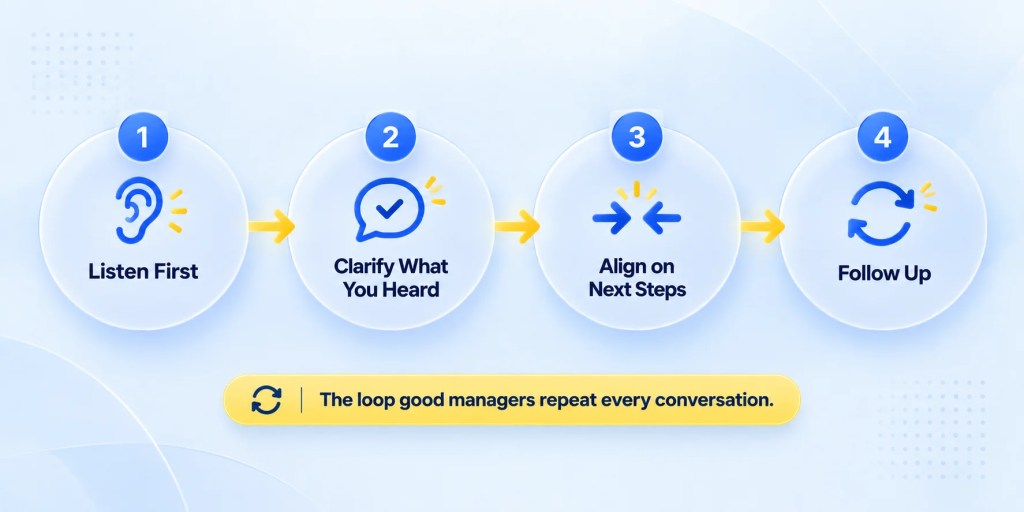
In practice, that looks like a repeatable loop: listen first without interrupting, clarify what you heard back to the person, align on what happens next, then follow up on whether it did. Skipping the “clarify” step is the single most common breakdown — managers assume they understood correctly and act on the wrong read. Teams with managers who close this loop consistently report fewer repeated misunderstandings and faster decision cycles, because nobody’s guessing what was actually agreed.
2. Strong Leadership: Where “Manager” Meets “Leader
Managing and leading aren’t the same skill, but the best managers do both. Managing is the operational half — assigning work, tracking progress, resolving blockers. Leading is the direction-setting half — giving people a reason the work matters beyond the task list in front of them. A manager who only manages keeps a team functional; one who also leads keeps it motivated.
This shows up in small, specific ways: explaining the “why” behind a request instead of just the “what,” modeling the standards you expect rather than just stating them, and being willing to make an unpopular call when the team’s long-term interest requires it. Managers who treat leadership as a separate skill to develop — not something that comes automatically with the title — consistently get better engagement scores from their direct reports.
BOOST YOUR TEAM’S ACCOUNTABILITY
See who’s following through — and who needs a nudge — without micromanaging.
Book a Free Demo3. Empathy and Emotional Intelligence: Why They’re Non-Negotiable
Empathy isn’t a soft add-on to management — it’s the mechanism that lets a manager notice a problem before it becomes a resignation. Emotional intelligence gives that empathy a practical use: recognizing when someone’s disengaged, frustrated, or overloaded, and responding before it compounds.
The practical version of this isn’t therapy-adjacent hand-holding. It’s noticing when a normally responsive team member goes quiet in meetings, asking a direct question about it privately, and actually adjusting based on the answer — whether that means redistributing a workload, changing a deadline, or just acknowledging that a project genuinely is harder than it looked. Managers who skip this step don’t find out something was wrong until it’s already cost them the person.
4. Decisiveness Under Pressure
Indecision is expensive. Every day a decision sits unmade, the team either stalls or makes the call themselves without the context the manager has — neither outcome is good. Good managers aren’t reckless, but they are willing to decide with 80% of the information rather than wait for 100%.
A simple urgency/importance filter does most of the work here: decisions that are both urgent and important get made same-day, ideally in the room. Important-but-not-urgent decisions get a deadline, not indefinite deliberation. The failure mode to watch for is treating every decision like it needs the same amount of analysis — that’s how a two-minute call turns into a two-week bottleneck.

5. Accountability: How Good Managers Build Trust
Accountability means owning the outcome of a decision — including the ones that didn’t work — without redirecting blame downward. This is one of the fastest trust-builders and trust-breakers on this list: a manager who says “that call was mine, here’s what I’d do differently” earns more credibility in one sentence than months of stated values ever will.
Practically, accountability is built through visible habits: setting expectations in writing so there’s no ambiguity later, giving feedback while it’s still actionable instead of saving it for a review cycle, and publicly crediting the team when something goes right instead of absorbing the praise. BRAVO’s manager enablement tools exist for exactly this — structured, lightweight check-ins that make accountability a habit instead of a once-a-year event.
6. Problem-Solving: Turning Challenges Into Opportunities
Reactive managers wait for a problem to become visible before addressing it. Good managers build in enough visibility — through regular 1:1s, honest status updates, and a team that isn’t afraid to flag bad news early — that most problems get caught while they’re still small and cheap to fix.
The habit that separates strong problem-solvers from the rest is resisting the urge to jump straight to the first workable solution. Breaking a messy situation into its actual components, pulling in someone with a different vantage point on the problem, and staying calm enough to think clearly under a deadline all compound over time — a team led this way develops more resilience simply from watching it modeled repeatedly.
7. Adaptability and Flexibility: Responding to Change Without Losing the Team
Priorities shift, tools change, and reorganizations happen — management qualities that hold up under stable conditions aren’t the ones that matter most. What matters is how a manager handles the moment plans stop working. Adaptable managers treat a changed plan as new information, not a personal failure, and they say so out loud instead of pretending everything is fine.
That transparency matters more than the adaptability itself. A team that watches its manager absorb a disruption calmly, explain what’s changing and why, and adjust the plan without panic learns that change is survivable. A team that watches its manager scramble silently learns the opposite — and starts bracing for bad news instead of trusting the process.
8. Conflict Resolution: Managing Team Tensions Before They Calcify
Unresolved conflict doesn’t disappear — it goes underground and shows up as passive-aggression, missed handoffs, or quiet disengagement. Good managers address tension early, before it hardens into a grudge that outlasts the original disagreement.
The mechanics are simple even if the conversations aren’t: address the specific behavior, not the person’s character; hear both sides before forming a position; and focus the conversation on what happens next rather than re-litigating who was right. Managers who avoid conflict entirely, hoping it resolves itself, consistently end up with worse outcomes than ones who have the uncomfortable conversation early.
9. Motivation and Recognition: How Good Managers Inspire Follow-Through
Recognition is one of the cheapest, most consistently underused management tools available — and one of the clearest manager strengths that separates engaged teams from disengaged ones. It’s not about grand gestures; it’s about specific, timely acknowledgment of work that mattered.
The pattern that works: recognize the specific action, not just the outcome (“the way you handled that client escalation” beats “great job this week”), do it close to when it happened rather than saving it for a review, and don’t reserve it exclusively for big wins — consistent small recognition compounds faster than occasional large recognition. BRAVO’s recognition tools are built around making this specific, timely pattern easy to sustain instead of something a manager has to remember to do manually.

10. Strategic Thinking: Connecting Daily Work to the Bigger Picture
The best manager qualities on a day-to-day list — communication, empathy, decisiveness — keep a team functioning. Strategic thinking is what keeps it pointed somewhere worth going. This is the quality that shows up least in a crisis and most in how a manager plans three months out: which goals actually matter, what’s a distraction, and where the team’s effort is best spent.
Practically, this means setting goals a team can actually track — through something like OKRs rather than vague annual objectives — and revisiting them often enough that “strategy” doesn’t mean a slide deck nobody looks at again until next year. Managers strong in this area treat planning as a recurring habit, not an annual event.
How to Tell If You Have These Manager Qualities
Reading a list of ten qualities is easy. Knowing where you actually stand is harder — most managers rate their own communication and empathy higher than their team would. A more reliable read comes from structured feedback rather than self-assessment: regular peer and upward feedback surfaces the gap between how a manager sees themselves and how their team experiences them.
A quick, honest self-check: Can you name the last specific thing you recognized a team member for, and when? Do you know which of your last five decisions your team would have made differently? Has a direct report disagreed with you in the last month, and how did you respond? If those are hard to answer, that’s not a character flaw — it’s a signal for where to focus first, and it’s exactly the kind of pattern structured feedback tools are built to surface consistently instead of leaving it to memory.
Conclusion: Building These Qualities Is a Practice, Not a Personality Test
None of these ten qualities are fixed traits some managers are born with and others aren’t. Communication, empathy, decisiveness, accountability, and the rest are practiced habits — which means they’re also learnable, one deliberate rep at a time. The manager who reviews their last week’s decisions honestly and adjusts is doing more for their team than the one who simply hopes their instincts are good.
If you’re looking for a way to build these habits into your actual workflow instead of just your intentions, BRAVO gives managers structured tools for recognition, feedback, and goal tracking that make the good qualities easier to practice consistently.
FAQs
The top qualities are communication, leadership, empathy, decisiveness, accountability, problem-solving, adaptability, conflict resolution, motivation/recognition, and strategic thinking. Each builds trust in a different way, but communication underpins the rest — without it, the other nine are harder for a team to see or trust.
Adaptability paired with curiosity shows up as treating a disrupted plan as new information rather than a failure — asking “what changed and what do we do now” instead of defending the original plan. Managers with this trait explain changes openly instead of scrambling silently.
A good manager keeps a team functional day-to-day. A great manager does that and also connects the work to a bigger purpose, develops people beyond their current role, and makes decisions that hold up over the long term — not just the immediate deadline.
Emotional intelligence lets a manager notice disengagement or frustration early, before it turns into attrition. Practically, it means responding to a team member’s actual state instead of just their output.
They’re learnable. Communication, decisiveness, and accountability are practiced habits, not fixed personality traits — a manager who deliberately reviews their own decisions and feedback consistently improves, regardless of where they started.
Self-rating is unreliable — most managers overestimate their own communication and empathy. Structured peer and upward feedback gives a more honest read than self-assessment alone, which is why regular feedback loops matter more than periodic self-reflection.

He is an SEO strategist and content writer focused on employee engagement and SaaS marketing. He creates data-driven content that ranks on Google and AI search while helping businesses improve motivation, productivity, and retention.


