

Global employee engagement fell to just 21% in 2025, the sharpest drop since the pandemic, according to Gallup’s 2025 State of the Global Workplace report.
An employee rewards program is one of the few levers HR teams can pull directly to counter that trend.
This guide defines what employee rewards actually are, breaks down every major reward type, and walks through building a program that holds up under real budget and headcount constraints — whether you call it an employee rewards program, a staff rewards program, or total rewards.
What Are Employee Rewards?
Employee rewards are the tangible and intangible incentives a company gives employees in exchange for specific performance, behavior, or achievement.
They range from cash bonuses and gift cards to public recognition, extra time off, and career development opportunities.
The distinction that matters most: rewards are earned through a specific action or result, while recognition is the act of acknowledging someone’s effort or character — often without a direct transaction attached. A reward is “here’s a bonus for hitting target.” Recognition is “thank you for how you handled that.” The strongest programs use both together, not one instead of the other.
Whether your team searches for “employee rewards,” “staff rewards,” or “employee reward system,” they’re describing the same underlying idea: a structured way to make good work visible and worth doing again.

Employee Rewards vs. Recognition: The Dimensions That Actually Matter
Most teams use “rewards” and “recognition” interchangeably. That’s a mistake — they solve different problems.
Rewards are transactional and tangible. Recognition is relational and often intangible.
| Dimension | Rewards | Recognition |
|---|---|---|
| Trigger | Tied to specific performance or milestone | Can happen anytime, for any positive behavior |
| Form | Usually tangible or monetary | Usually intangible (praise, visibility, status) |
| Timing | Planned — end of quarter, on-target | Spontaneous — in the moment |
| Purpose | Reinforces measurable outcomes | Reinforces belonging and effort |
Neither works well alone. Recognition without any tangible reward can feel hollow over time. Rewards without recognition feel transactional and cold. Programs that pair both consistently see stronger results than either alone — read more in BRAVO’s guide on advantages and disadvantages of a reward system for employees.
Intrinsic vs. Extrinsic Rewards: The Framework Behind Every Reward Type
Every reward, no matter the format, falls into one of two motivational categories.
Extrinsic rewards come from outside the person — bonuses, gift cards, public praise, promotions. They’re visible, easy to budget for, and effective for short-term performance pushes.
Intrinsic rewards come from within — a sense of purpose, autonomy, mastery, or meaningful work. They’re harder to design for directly but tend to drive longer-term engagement.
Extrinsic rewards move behavior fast. Intrinsic rewards make behavior stick. Programs that lean only on the extrinsic side tend to see performance dip the moment the incentive stops.
BRAVO’s breakdown of intrinsic vs. extrinsic rewards for employee engagement covers how to balance both inside one program — most effective rewards strategies deliberately mix them rather than picking one.
Types of Employee Rewards, With Examples
There’s no single best reward type. The strongest programs deliberately combine several.
Monetary rewards — bonuses, profit-sharing, gift cards, spot awards. Immediate and easy to measure, but their motivational effect fades fastest once the payout lands.
Non-monetary rewards — public praise, peer shout-outs, certificates. Low-cost, and often more durable in how employees remember them than a one-time payment.
Experiential rewards — team retreats, travel vouchers, event tickets. Create a memory tied to the company rather than a transaction that’s forgotten.
Professional development rewards — training stipends, certifications, mentorship, conference attendance. According to LinkedIn’s 2025 Workplace Learning Report, 88% of organizations now name retention as a top concern, and providing learning opportunities is their number-one retention lever — yet only 36% of companies act on it consistently enough to be “career development champions.”
Points-based rewards — employees earn redeemable points for defined actions, then choose their own reward from a catalog. This format scales well because it removes manager bottlenecks from day-to-day recognition. See BRAVO’s guide to employee recognition points systems for setup specifics.
Milestone and service rewards — work anniversaries, tenure awards, project-completion recognition. These mark time and consistency rather than a single peak performance.
Wellness and lifestyle rewards — extra PTO, flexible scheduling, wellness stipends. Increasingly expected as a baseline rather than a bonus.

Where Employee Rewards Fit Inside Total Rewards
“Employee reward system” is often searched by people trying to understand how rewards connect to the bigger compensation picture — that bigger picture is usually called total rewards.
Total rewards is the HR framework covering everything a company offers in exchange for someone’s work, organized into five pillars:
- Compensation — base salary, bonuses, commissions
- Benefits — health insurance, retirement contributions
- Work-life integration — flexibility, PTO, remote options
- Career development — training, mentorship, growth paths
- Recognition — the day-to-day acknowledgment layer
An employee rewards program is the operational engine behind pillar five, and it frequently borrows from pillars one, three, and four (monetary rewards, wellness rewards, development rewards). Thinking about rewards as part of total rewards — rather than a standalone perk — helps HR teams justify budget and avoid building a program that duplicates what benefits or comp already covers.
Benefits of a Structured Employee Rewards Program
Structured recognition isn’t a morale nice-to-have — it shows up directly in retention and performance numbers.
Retention. SHRM reports that employees with a positive workplace experience are 68% less likely to consider leaving, and employees in positive cultures are roughly four times more likely to stay.
Cost avoidance. Replacing an employee costs between 50% and 200% of their annual salary, according to SHRM — a cost structured rewards programs are built to reduce by keeping people from leaving in the first place.
Engagement. With global engagement sitting at just 21% in 2025 (Gallup), companies with consistent recognition practices are working against a genuinely low baseline — meaning the upside of doing this well is larger than it’s been in years.
Rewarded behavior gets repeated. When employees know that specific actions — hitting a target, submitting an idea, helping a teammate — get noticed, they direct more effort toward those actions specifically.
This is also a recruiting signal, not just a retention one. Culture is demonstrated through what gets rewarded, not described in a job posting.
Common Challenges With Employee Rewards Programs (and How to Fix Them)
Most rewards programs don’t fail from lack of budget — they fail from design mistakes that are easy to avoid once you know what to look for.
Perceived favoritism. If reward criteria aren’t published and consistent, employees assume managers pick favorites. Fix: publish criteria before launch, not after complaints start. BRAVO’s breakdown of the biggest problem with employee rewards covers this in more depth.
Budget mismatch. Programs often launch with a fixed budget and no plan for scaling as headcount grows, so recognition becomes rare exactly when it’s needed most.
Expectation gaps. What leadership thinks the program delivers and what employees actually experience often diverge. See employee rewards: expectations vs. reality for the specific gaps to check before launch.
Manager non-participation. A program only works if managers use it. If recognition still routes entirely through HR, it isn’t structural — it’s a bottleneck.
How to Build an Employee Rewards Program, Step by Step
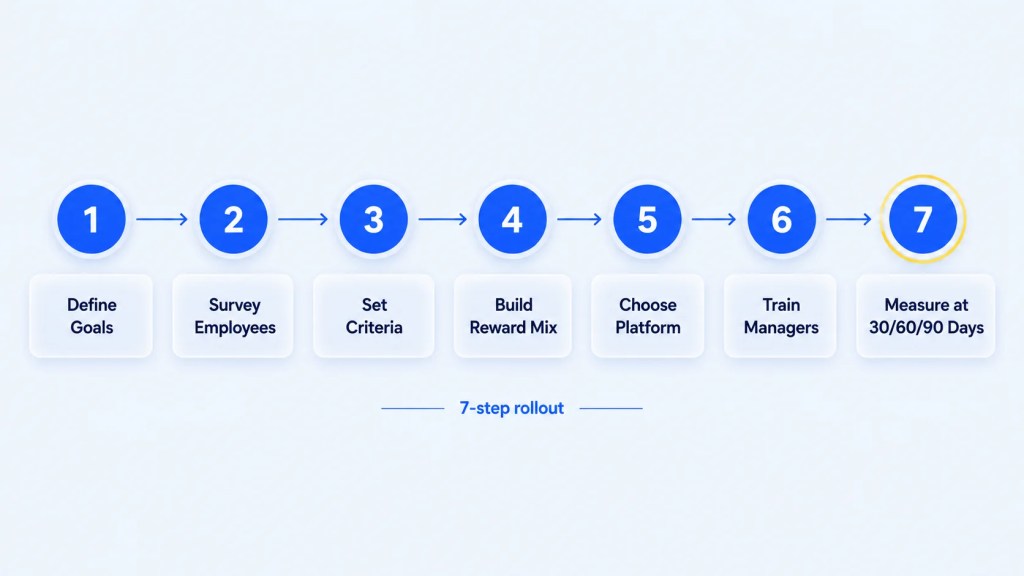
Building a program that lasts past its launch quarter takes seven steps.
- Define goals and success metrics — pick a specific target, like reducing voluntary turnover by a set percentage in 12 months, and set a baseline before launch.
- Ask employees what they actually want — a quick survey beats guessing. Frontline and knowledge workers often value different reward types entirely.
- Set transparent, published criteria — specific, tied to measurable behavior, and visible to everyone, not managed as discretionary.
- Build a balanced reward mix — combine monetary, social, experiential, development, and wellness rewards rather than leaning on one type.
- Choose a platform that scales — spreadsheets and ad hoc gift cards break down past roughly 50 employees.
- Train managers before launch — manager participation is the single biggest predictor of whether a program gets used at all.
- Measure at 30, 60, and 90 days — track participation, recognition frequency, and correlation with engagement scores, then adjust.
Employee Reward Ideas by Budget
Not every reward needs a large line item. Here’s a starting set across three budget tiers — see BRAVO’s full list of reward and recognition ideas for more.
Low-cost / no-cost:
- Handwritten thank-you note from a senior leader
- Public shout-out in a team meeting or company channel
- First pick of upcoming projects or assignments
- A work-from-home day of their choice
- Dedicated 1:1 time with a senior leader or mentor
- “Values Champion” or peer-nominated recognition spotlight
Mid-range ($25–$250):
- Gift cards to employee-preferred brands
- An online course or certification program
- Ergonomic desk accessories or a home-office upgrade item
- Event tickets (concert, sports, local experience)
- A wellness or fitness app subscription
- A team lunch or small group outing
Higher-value ($250+):
- Extra paid time off (1–3 days)
- Conference attendance tied to their role
- A larger home-office upgrade budget
- Profit-sharing or a performance bonus
- Professional coaching or a sponsored certification exam
- A travel voucher or team retreat for milestone achievements
The best programs don’t rely on any single tier — they combine frequent low-cost recognition with occasional higher-value rewards tied to real milestones.
Employee Rewards Best Practices
Be frequent, not just annual. Recognition acknowledged within days of the behavior lands harder than recognition saved for a quarterly review.
Personalize instead of standardizing. A gym membership means everything to one employee and nothing to another — choice-based reward catalogs consistently outperform fixed rewards.
Build in peer-to-peer recognition, not just manager-to-employee. Peers see day-to-day work managers don’t, which makes their recognition feel more credible. BRAVO’s guide to peer recognition in the workplace covers how to structure this without it becoming noise.
Tie rewards to stated company values, not just revenue targets — if innovation is a value, reward people who submit and implement ideas, not only top sellers.
Make recognition visible. Private recognition helps the individual; visible recognition tells the whole team what the company actually values.
Choosing an Employee Rewards Platform
Past roughly 50 employees, manually managing rewards — spreadsheets, ad hoc gift cards, memory-dependent recognition — breaks down.
Feature-driven decision. Look for a real-time recognition feed, peer nomination tools, a customizable reward catalog, and manager dashboards with budget controls by department.
HR tech stack fit. The platform should connect to what you already run — Slack, Microsoft Teams, and your HRIS — so recognition happens where work already happens, not in a separate app nobody opens. Automated triggers (work anniversaries, goal completions) also remove the manual step that causes recognition to lapse in the first place. BRAVO’s guide to managing employee recognition and rewards walks through what that integration should look like in practice.
Reporting. You can’t manage what you don’t measure — look for dashboards that tie recognition frequency to engagement and retention data, not just a running feed of activity.
Platforms like BRAVO, an AI-powered employee recognition platform, combine a real-time social recognition feed, peer nominations, a customizable reward catalog, and analytics that connect recognition activity to retention outcomes — purpose-built for mid-sized and enterprise teams running this at scale.
Conclusion
An employee rewards program only works when it’s specific, consistent, and tied to what the business actually values — not a once-a-year bonus cycle bolted onto payroll.
Start with the type mix that fits your team, publish clear criteria, and measure participation from day one rather than waiting for an annual survey to tell you it isn’t working.
If you’re ready to put recognition into practice, book a free BRAVO demo and see how your team can get started in minutes.
FAQs
Employee rewards are tangible or intangible incentives given for specific performance or achievements, like a bonus or a gift card. Recognition is the act of acknowledging someone’s effort or character, often informally and without a direct exchange attached. The strongest programs use both together.
There’s no single fixed industry benchmark for rewards-specific spend. A more reliable planning anchor is the cost of not doing it: replacing one employee costs 50%-200% of their annual salary, according to SHRM — budget against that cost, not a guessed percentage of payroll.
The main categories are monetary, non-monetary, experiential, professional development, points-based, milestone/service, and wellness rewards. Most effective programs deliberately combine several types rather than relying on one.
Extrinsic rewards come from outside the person — bonuses, gift cards, public praise. Intrinsic rewards come from within — a sense of purpose, autonomy, or mastery. Extrinsic rewards move behavior quickly; intrinsic rewards sustain it over time.
Total rewards is the broader framework covering compensation, benefits, work-life integration, career development, and recognition. An employee rewards program operationalizes the recognition pillar and often borrows elements from the others, like development stipends or extra PTO.
Recognition works best as an ongoing habit, not an annual event. Build it into weekly team meetings, one-on-ones, and everyday workflows rather than saving it for a formal review cycle.
Yes, and sometimes more so over time. Cash bonuses drive a short-term performance spike, but employees adjust to the new normal quickly. Non-monetary recognition — especially personalized and public acknowledgment — tends to create a longer-lasting emotional connection to the company.

He is an SEO strategist and content writer focused on employee engagement and SaaS marketing. He creates data-driven content that ranks on Google and AI search while helping businesses improve motivation, productivity, and retention.


