

Only 2% of companies say their employee referral programs meet hiring goals, according to HireClix research reported by WorldatWork (2025). Yet 71% of employers run one. The idea works. The execution usually doesn’t.
Employee referral programs succeed when referring is easy, progress is visible, and every referral gets recognized. The payoff is real: referred candidates reach interview at 40%, versus 3% for inbound applicants (Ashby, 2025).
This guide covers the benefits, benchmarks, a 6-step build plan, and the reward mix that keeps people referring. It also shows where BRAVO, an AI-powered employee recognition and engagement platform by WorkHub, fits in. BRAVO Points reward referrers and BRAVO Feats celebrate hires. BRAVO Voice surveys employees, and BRAVO Focus tracks referral goals.
What Is an Employee Referral Program?
An employee referral program is a structured hiring channel where employees recommend people from their networks for open roles. If the referred candidate is hired, the referrer earns a reward, such as cash, points, or public recognition.
Structure is what separates a program from a casual intro. Written rules define eligible roles, rewards, and payout timing, so every referral gets the same treatment. According to WorldatWork’s 2024 Bonus Programs and Practices data, 77% of organizations now run a formal program.
Most employee referral program processes follow five stages:
- Share open roles. HR posts each role with a short brief on the skills that matter most.
- Submit. The employee sends a name, contact details, and one line on why the person fits.
- Screen. The candidate goes through the same structured screen as every other applicant.
- Update. The referrer hears back at each stage, from interview to final decision.
- Reward. The referrer is paid and publicly thanked, often after the new hire passes 90 days.
A referral program turns employee networks into a tracked hiring channel. Employees submit candidates, recruiters screen them like any applicant, and referrers get updates. The result is a steady flow of pre-vetted candidates without agency fees.
Stage 4 is where most programs quietly break. Referrers who never hear back stop referring. The benchmarks below show how to spot that early.
Benefits of Employee Referral Programs
The biggest benefit of employee referral programs is conversion. Referred candidates move from application to interview at 40% and from interview to offer at 16%. Inbound applicants convert at 3% and 6% (Ashby, 2025).
Ashby’s data covers more than 38 million applications across 93,000 jobs from 2021 to 2024. Referrals were only 1% of applications. Yet in Q4 2024, referrals had a 7.3% offer rate against 0.2% for inbound.
| Benefit | Why it happens | How to see it in your data |
|---|---|---|
| Higher quality of hire | Employees pre-screen for skills and team fit | 90-day performance ratings by source |
| Faster hiring | Fewer weak applicants to screen out | Time-to-hire by source in your ATS |
| Lower cost per hire | No agency fees or job-ad spend | Cost-per-hire by source |
| Better retention | New hires arrive with a built-in ally | First-year retention by source |
| Access to passive candidates | Reaches people who aren’t job hunting | Share of referred hires with no prior application |
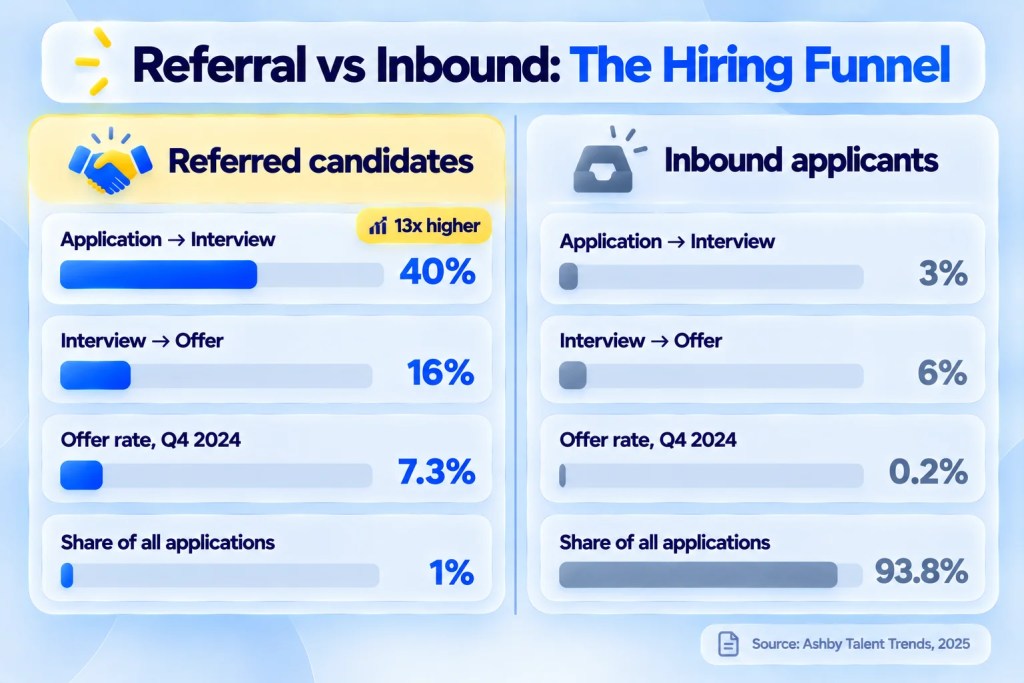
The importance of an employee referral program grows as referral volume shrinks. Ashby found referrals fell from 2% of applications in Q1 2021 to under 1% three years later. Fewer referrals with the same conversion edge means untapped hiring capacity.
Retention matters more in a disengaged workforce. Only 20% of employees worldwide were engaged in 2025, costing an estimated $10 trillion in lost productivity (Gallup, 2026). Our guide to employee turnover and retention covers the cost side in depth.
Referred candidates arrive pre-vetted by someone who knows the job. That endorsement lifts interview and offer rates at every funnel stage. The result is fewer wasted interviews and faster hires for the same roles.
Employee Referral Program Benchmarks: What Effective Looks Like
An effective employee referral program turns about 1 in 10 referrals into a hire. It also supplies roughly 10% of total hires. Those reference points come from ERIN’s analysis of 1.1 million referrals and SHRM’s own program (SHRM, 2025).
Use this table to measure your program against 2025 data:
| Metric | Formula | 2025 benchmark | Source |
|---|---|---|---|
| Referral-to-hire rate | Referral hires ÷ referrals submitted | ~10% (enterprise); ~50% (SHRM) | ERIN and SHRM, 2025 |
| Referral share of hires | Referral hires ÷ all hires | Just over 10% | SHRM, 2025 |
| Application-to-interview | Referred interviews ÷ referred applications | 40% (inbound: 3%) | Ashby, 2025 |
| Interview-to-offer | Offers ÷ interviews | 16% (inbound: 6%) | Ashby, 2025 |
| Referral funnel | Invites → responses → applications → interviews → hires | 10 → 8 → 6 → 4 → 1 | ERIN and SHRM, 2025 |
| Participation rate | Employees who referred ÷ eligible employees | No reliable public benchmark; set your own baseline | Internal |
Warm referral effectiveness comes down to three numbers read together: volume, conversion, and retention. High volume with low conversion means employees don’t know what a good fit looks like. Low volume with high conversion means the process is too hard or too quiet.
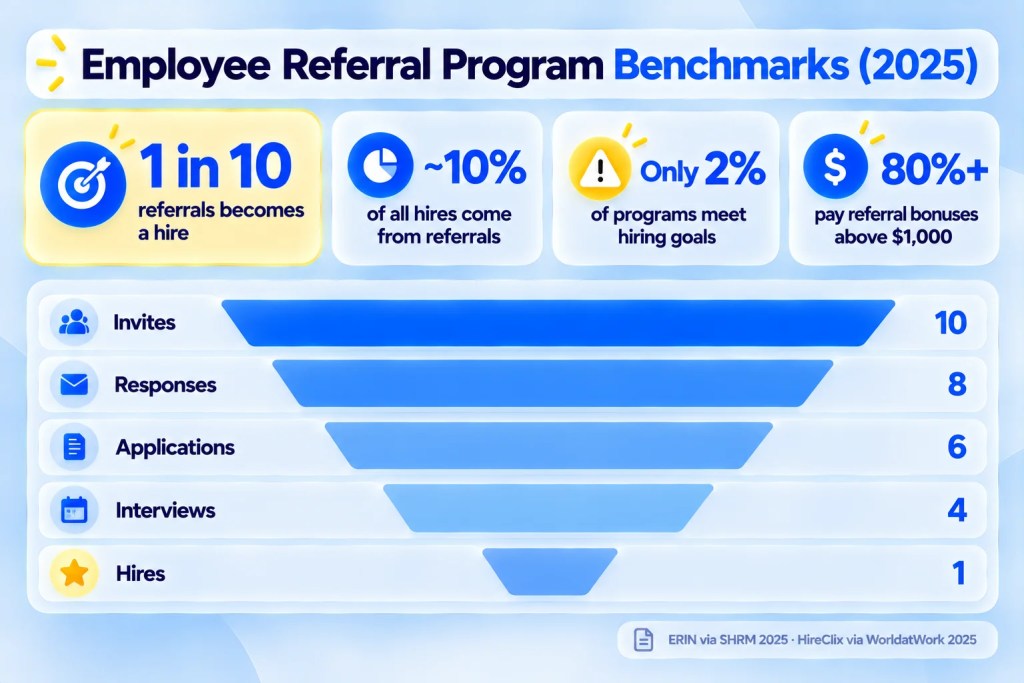
Channel matters too. Email carried 55% of referrals and social media 30%. But social media produced only 14% of hires, according to the same SHRM analysis.
Tip: Track every metric by source, not in total. A 10% referral share means little until you compare referred hires’ 12-month retention with job-board hires.
Referral effectiveness is measured by conversion at each funnel stage. Divide each stage’s output by its input and compare it with inbound candidates. The result shows exactly where referrals stall, from submission to hire.
Why Most Employee Referral Programs Underperform
Most employee referral programs underperform for four reasons. Employees can’t see open roles, the process is hard, referrers get no updates, and nobody recognizes successful referrals. HireClix identified these causes in research reported by WorldatWork (2025).
Money isn’t on that list. More than 80% of companies with programs already pay cash bonuses above $1,000. Cash isn’t the missing piece. Attention is.
| Failure reason | What it looks like | Fix |
|---|---|---|
| No visibility into open roles | Employees hear about roles after they close | Weekly roles digest in Slack or Microsoft Teams |
| Complicated submission | Long forms and a resume required upfront | Three fields: name, contact, one line on fit |
| No status updates | Referrers never learn what happened | Updates at submission, interview, and decision |
| No acknowledgment | Bonuses paid silently, or not at all | Public thanks at every stage, not only at hire |
That’s how to improve an employee referral program without raising the bonus. Fix the experience around the reward first.
Three of the four fixes are about communication and recognition, not recruiting. That’s why referral programs tie so closely to a structured employee recognition program. The same habits that make people feel valued also make them want to refer.
Referral programs stall when employees stop seeing roles and stop hearing results. Weekly visibility, simple forms, status updates, and public thanks remove each blocker. The result is steady referral volume without higher bonus spend.
How to Build a Successful Employee Referral Program in 6 Steps
A successful employee referral program starts with goals and rules, then makes referring easy, visible, and rewarded. These six steps cover the full build, from choosing target roles to quarterly reviews.
- Set goals and target roles. Pick one to three metrics from the benchmark table. For example: referrals fill 15% of engineering hires by Q2. Track the goal as an OKR in BRAVO Focus.
- Write clear rules. Define who can refer, which roles qualify, and when rewards pay out. Settle how duplicate referrals and rehires are handled.
- Design the reward mix. Pay larger cash bonuses for hard-to-fill roles. Add smaller rewards for every qualified referral, using a structured employee incentive program.
- Make submission take under two minutes. Cut the form to three fields. Let the recruiter collect the resume later.
- Promote roles every week. Share open roles where employees already work, with a one-line brief on who you need.
- Measure and adjust each quarter. Compare results with the benchmarks. Use a BRAVO Voice pulse survey to ask employees what stops them referring.
Payout timing shapes behavior. Many programs split the bonus into two parts: one at hire and one after 90 days. That split rewards quality over volume.

Keep the rules on one page. If a new employee can’t explain the program after reading it once, simplify it.
A referral program build moves from goals to rules, rewards, process, promotion, and review. Each step removes one reason an employee might hesitate to refer. The result is a program people use weekly, not once a year.
How to Encourage Employee Referrals and Reward Them Well
To encourage employee referrals, reward the behavior, not only the hire. Recognize every qualified referral, pay meaningful bonuses for hires, and keep the program visible where people work.
These seven tactics consistently lift referral volume:
- Share a weekly digest of open roles.
- Describe who you need, not just the job title.
- Cut the referral form to three fields.
- Update referrers at every hiring stage.
- Thank referrers publicly, in team channels.
- Reward quality referrals, not only hires.
- Run short referral sprints for hard-to-fill roles.

Ask a sharper question. “Who’s the best analyst you’ve worked with?” beats “Do you know anyone?” It pulls names from memory instead of from job boards.
Employee referral program rewards work best as a mix. Cash drives hires for senior or scarce roles. Smaller, frequent rewards keep people engaged between hires. SHRM’s 2025 coverage notes that even modest incentives, like $25 gift cards, help.
| Reward type | Best for | Example |
|---|---|---|
| Tiered cash bonus | Senior or hard-to-fill roles | Higher tier for engineering than for general roles |
| Points per qualified referral | Keeping volume up between hires | Points redeemable for gift cards or experiences |
| Public recognition | Every hiring stage | Team-channel shout-out when a referral reaches interview |
| Leaderboards and badges | Short hiring sprints | Monthly top-referrer badge |
For more reward ideas, see our guides to employee incentives for engagement and gamification for employee engagement.
Referral rewards work best when they recognize effort as well as outcomes. Frequent small rewards and public thanks sit alongside cash bonuses for hires. The result is steady participation, not a burst after each bonus announcement.
How to Keep Referrals Fair and Diverse
Employee referral programs can narrow diversity, because people tend to refer people like themselves. The fix is structure: the same screen for every candidate, prompts that widen networks, and tracking outcomes by source.
This risk is real, but manageable. Treat referrals as one channel in a broader sourcing mix, not a replacement for it. These practices keep the channel fair:
- Use the same structured interview and scorecard for referred and non-referred candidates.
- Share the referral source with recruiters only, not with every interviewer.
- Prompt beyond close friends: former classmates, bootcamp peers, and community groups.
- Partner with employee resource groups on outreach for key roles.
- Review hires by source and demographic every quarter.
Fairness also applies to referrers. Publish the reward rules and pay every bonus on time. A late or disputed payout damages trust faster than no program at all.
Inclusive referral habits grow from an inclusive culture. Our guide to strategies for an inclusive workplace covers the wider groundwork.
Referral bias happens when employees refer mainly from similar networks. Structured screening, wider prompts, and source-level tracking reduce that effect. The result is a referral channel that adds diversity instead of narrowing it.
Conclusion
Employee referral programs rarely fail for lack of money. They fail when employees can’t see roles, can’t track progress, and never hear thanks. Fix those three and measure against 2025 benchmarks. A channel that converts at 40% can then carry far more of your hiring.
Start this week. Pull last year’s hires by source and calculate your referral share and referral-to-hire rate. That baseline tells you which of the six steps to fix first.
Recognition is what keeps referring alive between bonus payouts. Want thank-yous, points, and pulse surveys in one place? Book a free BRAVO demo and see how your team could run it.
Frequently Asked Questions
A successful employee referral program makes referring easy and keeps open roles visible. It also updates referrers at every stage and recognizes each qualified referral. HireClix research reported by WorldatWork in 2025 found only 2% of programs meet hiring goals. Most miss because of poor visibility, complicated forms, silence, or no acknowledgment, not low bonuses.
A good referral-to-hire rate is about 10%, meaning 1 in 10 referrals becomes a hire. That figure comes from ERIN’s 2024 analysis of 1.1 million referrals, reported by SHRM in 2025. Smaller, tightly run programs can go higher. SHRM reported about half its own referrals became hires.
Most companies with formal programs pay cash referral bonuses above $1,000, according to HireClix data reported by WorldatWork in 2025. Many pay larger tiers for senior or hard-to-fill roles. Many also split the payout, paying part at hire and part after 90 days, to reward referrals that stay.
Low participation usually signals friction, not apathy. Share open roles weekly with a clear brief, cut the form to three fields, and update referrers at every stage. Then recognize referrals publicly and reward qualified referrals, not only hires. Ask specific questions, such as “Who’s the best engineer you’ve worked with?”
Referred employees often stay longer, because they join with a trusted colleague already on the team. Results vary by company, so measure it directly. Compare first-year retention for referred hires with job-board and agency hires in your own ATS. That internal comparison is more reliable than any industry average.
Yes, referral programs can reduce diversity, because employees often refer people with similar backgrounds. Prevent it by using the same structured interviews for every candidate. Prompt employees to think beyond close friends and partner with employee resource groups. Review hires by source and demographic each quarter.
Employee referral software should make submission quick, show open roles where employees work, and send status updates automatically. It should also track conversion by stage and pay rewards reliably. Pair it with recognition, because public thanks keeps referrers active. Ashby’s 2025 data shows referred candidates reach interview at 40%, versus 3% for inbound.

He is an SEO strategist and content writer focused on employee engagement and SaaS marketing. He creates data-driven content that ranks on Google and AI search while helping businesses improve motivation, productivity, and retention.


