

The most useful thing about studying how other companies run rewards and recognition programs isn’t the program name or the platform they use — it’s the design decision behind it: what behaviors they chose to reward, how frequently, through what mechanism, and what measurable outcome they were trying to produce.
This guide covers 15 real employee rewards and recognition programs from organizations across different industries and sizes. For each one, you’ll find what the program actually does, what makes it structurally notable, and what HR teams can take from it — regardless of budget or company size.
It also covers the five main program types, how to build one from scratch, and what the current research says about what actually works.
What Makes an Employee Rewards and Recognition Program Actually Work?
Employee rewards and recognition programs produce measurable outcomes when they’re frequent, specific, tied to observable behaviors, and combined with non-financial recognition — not when they’re expensive, elaborate, or one-time.
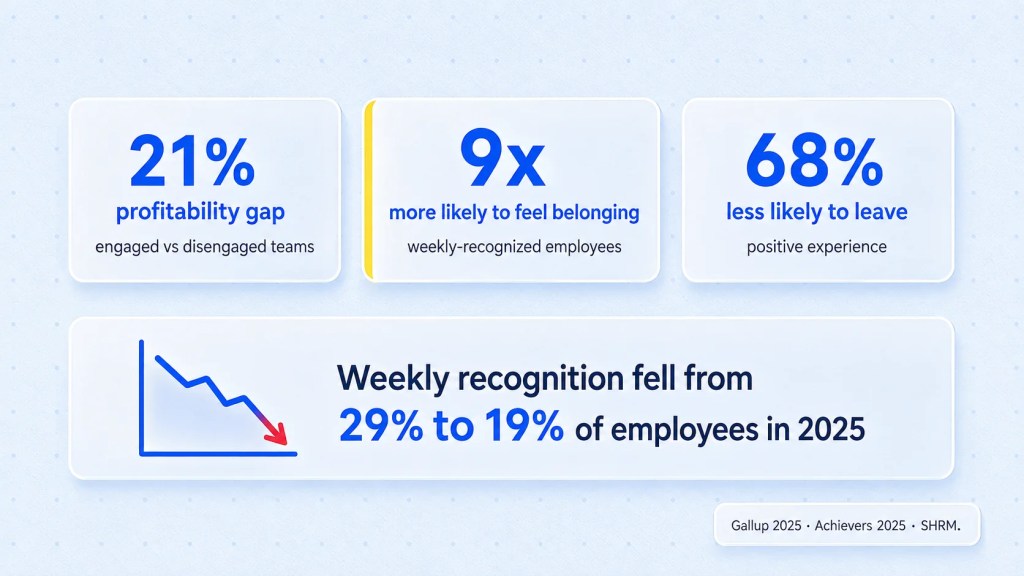
The 2025 data is consistent on this point. Gallup’s State of the Global Workplace 2025 report found engaged teams show a 21% profitability gap over disengaged ones, and global engagement fell to its lowest point since the pandemic — costing an estimated $438 billion in lost productivity worldwide.
The Achievers Workforce Institute’s 2025 State of Recognition Report adds the frequency dimension: employees recognized weekly are 9 times more likely to feel belonging and 6 times more likely to see a long-term future at their company, yet weekly recognition itself is becoming rarer — down from 29% of employees in 2024 to 19% in 2025.
BRAVO’s employee recognition platform is built around exactly this frequency gap — most manual programs lose consistency within a year; automating it is the fix.
What the data does not predict success is reward size, platform sophistication, or the frequency of company-wide award ceremonies. The programs that consistently outperform are the ones where recognition is part of daily workflow — easy to give, visible to the team, tied to specific behaviors.
Recognition also reaches outcomes engagement scores alone miss. SHRM reports that employees with a positive overall experience are 68% less likely to consider leaving — and recognition is one of the most controllable levers inside that experience.
The 15 companies below span industries, sizes, and program designs. What they share is intentionality: each program was built around a specific goal, with a specific mechanism, and in most cases a measurable outcome.
The 5 Types of Rewards and Recognition Programs Top Companies Use
The most effective programs combine multiple reward types rather than relying on one mechanism, because different employees are motivated by different things, and no single type sustains engagement across an entire workforce.

1. Points-based rewards systems. Employees earn points for performance, peer recognition, milestones, or values demonstrations, and redeem them from a catalog. The flexibility is the core strength — one employee redeems for a gift card, another for a donation, another for travel. Points systems also generate the most usable program data: which behaviors get recognized most, which teams are most active, and where recognition gaps exist.
Best for: diverse, global, or distributed workforces that need a scalable, measurable system.
2. Peer recognition programs. Employees acknowledge colleagues directly, without manager approval, through a feed, nomination, or points transfer. Colleagues have the most direct visibility into day-to-day contributions managers may not see — and peer-driven acknowledgment tends to feel more credible to the recipient than a quarterly manager review.
Best for: teams building a collaborative culture where recognition flows horizontally, not just top-down.
3. Employee bonus programs. Financial rewards tied to specific outcomes — quarterly targets, project completions, customer satisfaction scores. The design risk is vague criteria: “exceptional performance” breeds resentment, while “close $X in new revenue this quarter” creates clear motivation.
Best for: roles with clearly measurable outputs — sales, delivery, operations, customer success.
4. Experience-based rewards. Travel, event tickets, retreats, and unique activities create lasting emotional memories that behavioral research consistently finds outperform equivalent cash in long-run satisfaction — people mentally revisit experiences far more often than possessions, and adapt to material goods faster (Van Boven & Gilovich, Consumer Psychology Review).
Best for: high-performer recognition, team milestones, and moments meant to create lasting emotional connection.
5. Wellness and lifestyle rewards. Gym memberships, mental health support, flexible scheduling, and wellbeing stipends recognize employees through investment in their health and quality of life — a growing priority as Deloitte’s 2025 Global Human Capital Trends report finds leaders increasingly balancing business priorities against employee wellbeing tension.
Best for: high-demand, burnout-prone roles, and organizations competing for talent where base compensation is comparable across employers.
15 Employee Rewards and Recognition Program Examples with Proven Results
Each program below represents a distinct structural approach — the goal is to identify what’s replicable, not just whose name is on it.

1. Cisco — Payroll-Funded Global Peer Recognition
Program type: Points-based peer recognition at enterprise scale · Scale: 80,000+ employees globally
Cisco’s Connected Recognition program, run with Workhuman, is funded as a percentage of payroll rather than a fixed discretionary budget — a compensation line item, not a perk that can be cut. Any employee can give a peer a $25 award tied to company values.
The results are documented: 85% of employees gave or received an award in the program’s first year, nearly half of all awards came from individual contributors rather than managers, and the program has issued more than 1.2 million awards over five years, per Workhuman’s Cisco case study.
Cisco extends the same recognition logic to community involvement, rewarding employees who complete volunteer hours through approved organizations with a tangible gift-card acknowledgment.
Lesson for your program: funding recognition as a payroll percentage removes the annual budget fight and signals it’s a compensation commitment, not a perk — and tracking individual-contributor participation specifically is the clearest sign the program isn’t just manager-driven.
2. Airbnb — Culture-First Experience Rewards
Program type: Experience-based and culture-driven recognition · Scale: ~6,000 employees
Airbnb’s rewards philosophy mirrors its product: experiences over cash. The program prioritizes travel credits, team experiences, paid volunteer time, and flexible benefits, with recognition explicitly tied to demonstrated values rather than performance metrics alone.
Lesson for your program: if your company has a distinctive culture, aligning the reward catalog to that identity — instead of a generic gift card — creates a stronger emotional connection between recognition and the company.
3. Southwest Airlines — Flexible Points with Travel Redemption
Program type: Points-based rewards with an industry-specific catalog · Scale: ~70,000 employees
Southwest’s SWAG points platform lets employees send peer appreciation with redeemable points, alongside its Winning Spirit Program for extraordinary service and President’s Awards for consistent excellence. The catalog leans toward travel, merchandise, and experiences — reward types that feel genuinely desirable to this specific, frontline-heavy workforce, not a generic default.
Lesson for your program: survey employees before building your reward catalog. One that reflects what your workforce actually wants drives meaningfully higher redemption than a generic offering.
4. Norton Healthcare — High-Frequency, Low-Cost Recognition
Program type: Structured peer recognition focused on daily appreciation · Scale: ~20,000 employees
Norton Healthcare’s program demonstrates that frequency matters more than financial value. It generates thousands of peer recognitions monthly, most with no monetary component, by making it easy to send specific, visible acknowledgment of contributions that would otherwise go unnoticed — a model frequently cited in healthcare HR literature for sustaining engagement in a high-burnout industry without a large per-employee budget.
Lesson for your program: in resource-constrained environments, recognition frequency — even unpaid — consistently outperforms occasional high-value awards. Design for daily use, not monthly occasions.
5. Zappos — Peer-to-Peer “Zollars” with Value Alignment
Program type: Peer bonus program tied explicitly to company values · Scale: ~1,500 employees
Zappos’s peer system, “Zollars,” lets employees award points to colleagues who demonstrate one of its 10 core values — and requires naming which value was demonstrated. That creates a recurring, visible articulation of what the company actually stands for, and generates a data trail: which values show up most, which teams exemplify them, and where cultural gaps exist.
Lesson for your program: requiring recognition to name a specific value creates cultural data and cultural reinforcement from a single design decision.
6. Mondelēz International — Global Wellbeing as Recognition
Program type: Global health and wellbeing recognition · Scale: ~90,000 employees across roughly 80 countries
Mondelēz runs “The Right You,” a global health and wellbeing initiative that started in Australia and New Zealand before expanding worldwide, alongside its Thrive mental-wellbeing program supporting employees through high-change periods. Recognition and performance bonuses are built into the benefits structure across career stages, and the approach has earned the company back-to-back regional HR excellence recognitions in 2025, per Mondelēz’s own wellness reporting.
Lesson for your program: piloting a wellbeing-linked recognition initiative regionally before scaling it globally reduces rollout risk in large, multi-country organizations.
7. HP Inc. — Hybrid Rewards for Remote and In-Person Teams
Program type: Digital rewards blending lifestyle and performance · Scale: ~50,000 employees
HP redesigned its rewards infrastructure after the shift to distributed work made its in-person-centric program inadequate. The revised version includes virtual events, cash rewards, lifestyle benefits, employee discounts, and paid volunteer time, all accessible digitally regardless of location.
Lesson for your program: audit your current program for remote accessibility. If participation is lower among remote and hybrid employees than in-person ones, the program design itself is creating an equity gap.
8. Unilever — Personalized Rewards at Scale
Program type: Personalized digital rewards platform · Scale: ~127,000 employees across roughly 190 countries
A reward that’s meaningful in the UK may be irrelevant in Vietnam. Unilever’s digital platform lets employees select from a catalog filtered by region, preference, and individual profile, supporting custom recognition events and performance rewards that vary by business unit and geography.
Lesson for your program: for any organization spanning multiple countries or a demographically diverse workforce, catalog personalization isn’t a feature — it’s a prerequisite.
9. Asana — Wellbeing as a Recognition Philosophy
Program type: Wellness-first experience rewards · Scale: ~2,000 employees
Asana treats employee wellbeing as a strategic investment, not a benefit line item — on-site yoga, high-quality meals, flexible workspace access, and remote workspace budget support are part of the core offering, reflecting the company as a whole-person employer rather than only a productivity engine.
Lesson for your program: in competitive talent markets where salary is comparable across employers, a distinctive wellbeing program can differentiate more effectively than incremental compensation increases.
10. Typeform — Spontaneous Peer Recognition Culture
Program type: Spontaneous, informal peer recognition · Scale: ~500 employees
Typeform’s recognition culture is deliberately informal — appreciation is encouraged to be immediate and lightweight, a quick public message in a team channel rather than reserved for formal occasions. The infrastructure also includes performance rewards and remote-work reimbursements, but it’s the cultural norm around spontaneity that drives the highest frequency of acknowledgment.
Lesson for your program: the most durable recognition cultures make the lowest-friction option — a quick peer message — also the most visible and valued one.
11. Siemens — Digital Recognition at Enterprise Scale
Program type: Digital performance and recognition program · Scale: ~300,000 employees across roughly 90 countries
At Siemens’s scale, manual recognition isn’t operationally possible. The program runs through a global digital platform — e-cards, points rewards, performance bonuses — that standardizes recognition while allowing local adaptation.
Lesson for your program: past roughly 200 employees and growing, the question isn’t whether to use a recognition platform — it’s which one, and when.
12. ALKU — Culture-Based Recognition with Branded Awards
Program type: Values-based recognition with physical branded awards · Scale: ~500 employees
ALKU recognizes employees specifically for demonstrating stated company values, and the awards themselves — branded, physical, tangible — serve as ongoing environmental reminders of those values, reinforced through team competitions and celebration events.
Lesson for your program: genuinely premium physical recognition items create persistent environmental reinforcement that digital-only recognition can’t replicate.
13. Bain & Company — Flexible Benefits as Recognition
Program type: Flexibility-focused recognition and benefits · Scale: ~12,000 employees
Bain treats flexible work arrangements and time-based rewards as integrated with recognition, not a separate benefit category — a framing that matters in consulting, where demanding hours make flexibility a more acute need than incremental cash.
Lesson for your program: in industries with demanding work norms, recognizing employees through schedule flexibility often outperforms cash bonuses of equivalent value, because it addresses the actual pain point.
14. Burton — Lifestyle Rewards and Seasonal Benefits
Program type: Lifestyle-aligned rewards tied to brand identity · Scale: ~600 employees
Burton’s program reflects its identity as an outdoor lifestyle brand — product discounts, paid recreation time, and seasonal benefits reinforce alignment between employees who chose the company for its values and the rewards they receive.
Lesson for your program: for purpose-driven or lifestyle brands, matching the rewards catalog to brand identity feels authentic rather than transactional.
15. Clif Bar — Activity and Fitness Recognition
Program type: Wellness and activity-focused rewards · Scale: ~1,000 employees
Clif Bar centers recognition on health and physical activity — fitness stipends, wellness facilities, and paid workout time acknowledge the connection between physical wellbeing and sustained performance, rather than treating fitness as a generic add-on perk.
Lesson for your program: recognition addressing the physical dimension of work creates a differentiated value proposition generic cash programs can’t match.
Company Comparison: Rewards and Recognition Program Structures
| Company | Program Type | Scale | Key Structural Feature | Replicable for SMBs? |
|---|---|---|---|---|
| Cisco | Points + peer recognition | 80K+ | Payroll-percentage funding model | Yes — as a budget principle |
| Airbnb | Experience + culture rewards | ~6,000 | Value-aligned reward catalog | Yes — catalog design principle |
| Southwest | Points + travel catalog | ~70,000 | Workforce-specific catalog relevance | Yes — survey before designing catalog |
| Norton Healthcare | High-frequency peer recognition | ~20,000 | Volume over value — daily focus | Yes — lowest cost, highest frequency |
| Zappos | Value-linked peer points | ~1,500 | Recognition requires naming a value | Yes — single design rule to add |
| Mondelēz | Global wellbeing recognition | ~90,000 | Regional pilot before global rollout | Partial — needs multi-country infrastructure |
| HP Inc. | Digital hybrid rewards | ~50,000 | Remote-equity design | Yes — audit for remote participation gaps |
| Unilever | Personalized global platform | 127K+ | Region- and preference-filtered catalog | Partial — personalization at smaller scale |
| Asana | Wellness-first experience | ~2,000 | Total wellbeing as recognition philosophy | Yes — wellbeing as strategic framing |
| Typeform | Spontaneous peer recognition | ~500 | Cultural norm of informal appreciation | Yes — lowest friction, high frequency |
| Siemens | Digital enterprise recognition | 300K+ | Platform as equity infrastructure | Yes — scale trigger for platform adoption |
| ALKU | Values-based branded awards | ~500 | Physical branded awards as cultural anchors | Yes — for values-alignment programs |
| Bain & Company | Flexible benefit recognition | ~12,000 | Flexibility as recognition currency | Yes — especially in demanding industries |
| Burton | Lifestyle + brand-aligned rewards | ~600 | Brand identity in reward catalog | Yes — for purpose-driven organizations |
| Clif Bar | Activity and fitness recognition | ~1,000 | Physical wellbeing as recognition | Yes — for active or health-focused cultures |

Best Employee Rewards and Recognition Software in 2026
The right software depends on your organization’s size, program complexity, and how much you need platform analytics to drive strategy — there’s no single best option across every context.
Disclosure: BRAVO is our platform. Independent alternatives are included for comparison.
| Platform | Best For | Key Strengths | Limitations |
|---|---|---|---|
| BRAVO | Mid-to-large orgs needing an all-in-one system | Points, peer recognition, bonuses, milestones, analytics, HRIS integrations | More configuration time than lightweight tools; may exceed what small teams need |
| Bonusly | Small teams (under 200) wanting fast peer recognition | Quick adoption, micro-bonuses, Slack/Teams integration | Limited analytics depth; less suited to complex milestone programs |
| Motivosity | SMBs focused on culture building | Social recognition, financial wellness tools, community feed | Less suited for enterprise-scale programs |
| Awardco | Large enterprises needing global catalog depth | Amazon-backed rewards catalog, complex admin controls | Higher cost; less intuitive for day-to-day peer recognition |
| Kudos | Teams prioritizing engagement metrics | Recognition tools, engagement tracking, culture analytics | Less comprehensive rewards catalog than points-based platforms |
Organizations using recognition software consistently report higher participation than those using manual systems, because the friction of giving recognition drops when it’s built into tools employees already use daily, like Slack or Teams. For a deeper look at program types and platform selection criteria, see BRAVO’s employee recognition program guide.
How to Build an Employee Rewards and Recognition Program in 5 Steps
Building an effective program means defining measurable goals before choosing mechanics, selecting a reward mix based on employee preference rather than assumption, and measuring outcomes against a pre-launch baseline.

Step 1: Define what you want the program to change. Start with the specific outcome — voluntary turnover in a team, engagement scores in a department, recognition frequency organization-wide. Common goals: reduce turnover among employees in their first two years, raise peer recognition frequency from once to three times a month per employee, lift engagement scores in under-recognized teams by 10 points within 12 months.
Step 2: Survey employees before designing the reward mix. The most common design mistake is building a catalog around what HR leadership assumes employees want. Ask directly: a $100 gift card, an extra day off, public acknowledgment, or a development credit? The answers routinely surprise teams, and programs built around actual preference consistently outperform ones built on assumption.
Step 3: Choose the right mix of program types. For most organizations, peer-to-peer recognition (for frequency), spot bonuses (for exceptional moments), and milestone recognition (for tenure and achievement) cover most engagement needs. Add wellness or experience rewards based on survey data and budget. If you’re starting from zero, peer-to-peer is the lowest-cost, highest-frequency mechanism to implement first — see BRAVO’s reward and recognition ideas guide and 30 employee appreciation messages for ready-to-use language.
Step 4: Launch with manager training, not just platform access. Manager participation is the single biggest adoption factor — if managers don’t visibly use the program, employees read that as a signal about how much it actually matters. Training should cover writing specific messages (not “great job”), recognition frequency (weekly is the evidence-based benchmark), and balancing public versus private recognition by individual preference.
Step 5: Measure against baselines at 30, 60, 90, and 365 days. Track recognition frequency per employee, voluntary turnover, engagement scores, and participation by department against pre-launch numbers. Programs showing no improvement at 60 days usually have an adoption problem — managers not participating — rather than a design problem, and the fix for each is different.
Common Mistakes Companies Make in Rewards and Recognition Programs
The most common mistakes are infrequent recognition, vague criteria, individual incentives applied to collaborative roles, and treating money as a substitute for genuine appreciation.

Recognition happens only annually. An annual awards cycle produces one engagement spike and 51 weeks of silence. Weekly or biweekly recognition — even lightweight — consistently outperforms elaborate annual programs.
Criteria are vague or invisible. Employees can’t be motivated by a reward they can’t predict earning. “Exceptional performance” isn’t a criterion; “closing three new accounts this quarter” is.
Individual rewards in collaborative environments. Commission structures and individual bonuses applied to team-dependent roles incentivize information-hoarding over sharing. Match incentive type to role structure.
Monetary rewards without recognition. Money that arrives without acknowledgment of the specific contribution feels transactional. Pair every monetary reward with a written or verbal note naming what the person did and why it mattered.
No measurement. Programs that aren’t measured aren’t managed — without baseline data, participation drifts, managers stop using the program, and recognition activity concentrates in the same few teams instead of reaching who needs it.
What We’ve Learned Running Recognition Programs
Based on BRAVO’s experience working with recognition programs across organizations of different sizes and industries, three patterns consistently separate programs that sustain engagement from ones that fade after launch.
Participation drops fastest where manager involvement is lowest. Across departments, the strongest predictor of low employee participation is low manager participation in that same department — not demographics, not catalog size, not budget. When managers don’t recognize, employees don’t either, and the reverse holds too.
Frequency beats value at every budget level. Clients who move from monthly to weekly acknowledgment consistently see stronger engagement gains than those who increase reward amounts while keeping the same low frequency. A $20 recognition given weekly outperforms a $500 award given annually in cumulative effect.
Peer recognition scales where manager recognition can’t. In organizations with high manager-to-employee ratios (10:1 or higher), peer programs are the only mechanism that can realistically sustain weekly-frequency recognition — a manager can’t personally recognize ten-plus people every week while doing the rest of the job.
Organizations using BRAVO’s peer recognition features report meaningfully higher monthly recognition frequency than those relying on manager-only recognition, translating into measurable engagement gains within the first 90 days.
Conclusion
These 15 programs aren’t templates to copy — they’re design principles to adapt. Cisco’s payroll-funding model is replicable at any scale. Norton Healthcare’s frequency-over-value philosophy costs almost nothing to implement. Zappos’s value-alignment requirement takes minutes to add to an existing peer program.
The principle that holds across all 15: recognition that’s frequent, specific, and visible consistently outperforms recognition that’s expensive, elaborate, and rare. Start with what you can do at the highest frequency — usually peer recognition — and build from there.
If you’re ready to build or rebuild your program on a platform that scales with you, book a free BRAVO demo to see points-based recognition, peer appreciation, milestone automation, and engagement analytics running in one place.
FAQs
The primary benefits are lower voluntary turnover, higher engagement scores, stronger collaboration, and better performance in roles with measurable output. Gallup’s 2025 research shows engaged teams see a 21% profitability gap over disengaged ones, and SHRM finds employees with a positive overall experience are 68% less likely to consider leaving. Benefits are largest when recognition is frequent, specific, and visible.
Most platforms price between roughly $3–$15 per employee per month for platform access, separate from the rewards budget itself. As a working example: a 200-person company allocating around 1–2% of payroll to the combined program (platform plus rewards budget) lands in the range of $140,000–$280,000 annually — a fraction of what unmanaged voluntary turnover typically costs at scale.
Yes — most modern platforms integrate with major HRIS systems including Workday, BambooHR, ADP, and Rippling, plus communication tools like Slack and Microsoft Teams. Depth of integration matters: platforms that surface recognition inside tools employees already use daily generate meaningfully higher participation than those requiring a separate login.
The most effective catalogs offer genuine choice: gift cards across a wide range of merchants, experiential rewards like travel or events, charitable donation options, merchandise, and sometimes cash equivalents. Catalogs that are region-specific rather than US-centric by default perform better in global organizations, and redemption rates are highest where employees report the catalog includes things they actually want.
A basic peer recognition program on an existing platform typically takes 2–4 weeks, covering configuration, manager training, and rollout communication. A full-featured program with points systems, milestone automation, and HRIS integration usually takes 6–12 weeks depending on complexity. The most common implementation mistake is skipping manager training — programs launched without it consistently show low participation in the first 60 days, a perception gap that’s difficult to reverse later.
Recognition is the acknowledgment itself — a shout-out, a nomination, a value callout. Rewards are the tangible outcome attached to it — a bonus, a gift card, a redeemed point. Most of the strongest programs in this guide, including Zappos and Cisco, combine both deliberately: recognition provides the emotional acknowledgment, rewards provide the tangible signal that it carries real organizational weight.
There’s no single “best” — the strongest programs match their mechanism to their workforce. Cisco and Siemens show what works at enterprise scale; Zappos and ALKU show what works for values-driven mid-size companies; Norton Healthcare and Typeform show that frequency and culture, not budget, drive the results smaller organizations can realistically replicate.

He is an SEO strategist and content writer focused on employee engagement and SaaS marketing. He creates data-driven content that ranks on Google and AI search while helping businesses improve motivation, productivity, and retention.


