

A sales rep who hits quota this quarter and hears nothing back rarely hits it the same way twice. Sales team incentives exist to close that gap. Yet most programs still reward the deal itself, not the effort and consistency that produced it.
According to Gallup’s State of the Global Workplace (2025), global employee engagement fell from 23% to 21% in a single year, costing the world economy $438 billion in lost productivity. Sales teams feel this first — missed pipeline, slower ramp times, quietly abandoned stretch goals.
This guide breaks down how to build sales team incentives reps actually trust: what to pay in cash, what to recognize publicly, and how to combine both without the program feeling arbitrary.
BRAVO, an AI-powered employee recognition and engagement platform by WorkHub, helps sales leaders run programs like this — BRAVO Points for redeemable rewards, BRAVO Voice for peer recognition, BRAVO Feats for milestone tracking, and BRAVO Focus for goal alignment.
What Are Sales Team Incentives (and Why Most Programs Underperform)
Sales team incentives are structured programs that reward performance and reinforce the behaviors a sales org actually wants repeated. They combine monetary rewards — commissions, bonuses — with non-monetary motivators like recognition, career growth, and flexible time off. The mix matters more than the size of any single reward.
Sales team incentives align individual effort with company revenue goals.
They work by pairing a measurable trigger — a closed deal, a renewal, a quota milestone — with a reward delivered close to that moment.
The result, when done well: reps chase the harder deal because the system visibly rewards it, not just the easy one.
Effective programs share three qualities:
- Relevance: matched to what actually motivates that specific rep
- Transparency: clear rules, fair measurement, visible results
- Impact: rewards specific enough that reps remember them months later
Most sales incentive programs fail quietly. They hit budget, publish a leaderboard, and still lose top performers — usually because the reward system feels disconnected from how reps judge fairness day to day. Understanding the relationship between incentives and daily sales behavior is what separates a program that compounds over a full sales cycle from one that fades by month two.
The Four Types of Sales Incentives That Actually Move the Needle
Designing sales team incentives means choosing a deliberate mix across four categories, not defaulting to commission alone. Each type reaches a different motivator, and the strongest programs draw from all four.

Monetary rewards remain the backbone. A 5–10% commission per closed deal, milestone bonuses for hitting quarterly targets, and one-time cash prizes for standout wins all give reps a direct, measurable link between effort and pay.
Non-monetary rewards — extra PTO, travel experiences, wellness stipends, tech gadgets — often outperform cash on emotional impact. They signal that the company sees a rep as a person, not just a quota number.
Recognition-based incentives tap a different lever entirely.
They give reps public acknowledgment for contributions commission alone doesn’t capture, like mentoring a new hire or saving an at-risk account.
The result: stronger team cohesion, since recognition is visible to peers, not just tracked on a private commission sheet.
Gamified incentives apply game mechanics — leaderboards, badges, short-cycle challenges — to routine sales activity, keeping momentum high between big deal closes.
| Incentive type | Best for | Example |
|---|---|---|
| Monetary | Revenue-driven goals | 5–10% commission per closed deal |
| Non-monetary | Engagement and retention | Extra PTO or a travel voucher |
| Recognition | Culture and morale | Public peer shoutout via BRAVO’s recognition and rewards platform |
| Gamification | Sustained motivation | Weekly deal-velocity leaderboard |
Teams that also lean on general incentive frameworks that hold up across departments tend to adapt these four categories faster, since the underlying design principles don’t change much between sales and other revenue-adjacent roles.
How to Design a Sales Incentive Program Reps Trust
A sales incentive program only works if reps believe it’s fair — and “how do I build that trust” is one of the most common questions sales leaders ask before launch. Trust isn’t a soft add-on. It’s the mechanism that makes every other design choice actually land.
Start with goals reps can verify themselves.
Vague targets erode trust fast.
Every incentive should tie to a measurable KPI — quota growth, retention rate, deal size, pipeline conversion — that a rep can check without asking a manager to confirm it.
The result: fewer disputes, because the math is visible, not asserted.
Three mechanics build trust specifically:
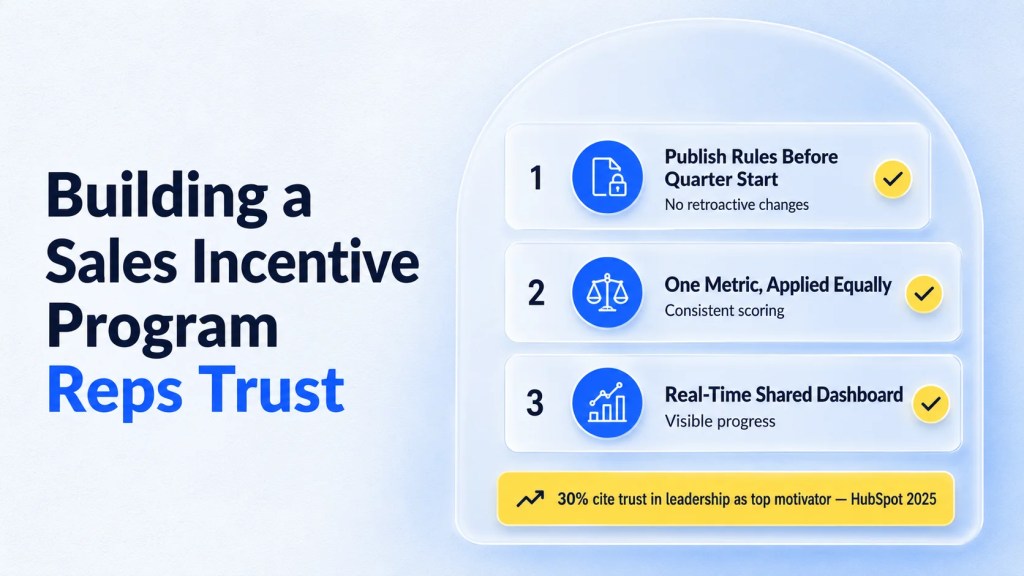
- Publish the rules before the quarter starts. No retroactive changes to how a reward is earned.
- Use one evaluation metric per goal, applied to every rep equally. Inconsistent scoring is the fastest way to lose a team’s confidence.
- Show real-time progress on a shared dashboard, using manager tools that make tracking and payout visible rather than a spreadsheet only management can see.
HubSpot’s 2025 State of Sales Report found that trust in leadership and healthy competition each motivate 30% of sales professionals — statistically tied with career development at 28%. Trust isn’t a nice-to-have next to pay. It performs at the same level.
Reps who can see exactly how a reward was earned stay longer and push harder for the next one. That’s the entire case for treating transparency as a design requirement, not a courtesy.
Ready to Build Trust Reps Actually Feel?
See how BRAVO turns transparent goals into recognition your sales team can verify in real time.
Book a Free DemoSales Recognition Programs That Complement (Not Replace) Commission
Sales recognition programs solve a problem commission structures can’t: they reward behavior that doesn’t show up on a payout sheet. A rep who mentors a struggling teammate, saves a churning account, or keeps a difficult client calm during a rocky renewal deserves acknowledgment — even when it doesn’t close new revenue.
Recognition drives sales productivity in a way pure compensation doesn’t reach.
Sales recognition programs work by making effort visible to the whole team, not just to a manager reviewing a spreadsheet.
A public shoutout, delivered close to the moment it’s earned, reinforces the behavior far more than the same praise delivered privately weeks later.
The result: reps repeat the behavior that got recognized, because they watched it get noticed.
Three formats consistently work for sales teams:
- Employee-of-the-month style awards for sustained performance, not just the biggest single deal
- Team achievement celebrations for collective wins — a shared quota, a strong quarter close
- Peer-to-peer recognition, where reps recognize each other directly through a tool like BRAVO’s peer feedback and recognition feature instead of waiting for a manager to notice
Recognition-based incentives compound differently than cash. A bonus is spent and forgotten within weeks; a specific, public acknowledgment tends to get referenced again — in a review, in a resignation conversation that doesn’t happen, in how a rep describes the job to a friend. That compounding effect is why this category deserves its own budget line, not just a leftover slice of the incentive spend.
Creative and Gamified Sales Incentive Ideas
Sales incentive ideas that stay fresh year over year tend to combine short-cycle challenges with recognition, rather than relying on one annual contest to carry motivation for twelve months.

Gamification transforms routine pipeline work into something reps opt into rather than tolerate.
A weekly or monthly challenge — “most new conversations started,” “fastest deal cycle,” “highest average deal size” — keeps momentum high between larger wins.
Leaderboards with visible points and badges, tracked through gamified recognition tools, turn routine activity into friendly competition instead of quiet grinding.
The result: reps who stay engaged in slow weeks, not just during the final push before quarter-close.
A few formats worth building into a 2026 rotation:
- 7-day activity sprints — reward volume of qualified activity, not just closed deals, so reps in a slow pipeline week stay engaged
- Team-vs-team pipeline races — build collaboration into what’s usually a purely individual metric
- Sales incentive award programs for non-obvious wins — best objection handling, best cross-sell, most improved close rate
- Milestone-based rewards tied to career growth, not just revenue — a training budget or a mentorship slot for hitting a development goal, not a sales number
Hybrid rewards — pairing a cash SPIFF with a smaller, immediate recognition moment — consistently outperform either approach alone, because the cash motivates the push and the recognition makes the win memorable past payday.
Common Sales Incentive Mistakes That Kill Trust and Momentum
Even well-funded sales incentive programs fail when they repeat a handful of avoidable mistakes. Most of these trace back to the same root cause: reps stop believing the program is fair.
Over-relying on money. Cash moves behavior short-term but rarely builds the loyalty a blended program does.
Vague or shifting rules. Any perceived rule change mid-quarter — even a well-intentioned one — reads as the game being rigged, regardless of intent.
One-size-fits-all rewards. A single reward type ignores that different reps are motivated by different things; a flat leaderboard alone under-serves reps who respond more to recognition than rank.
Ignoring rep feedback. Programs that never change based on what reps actually say lose relevance fast, especially as team composition shifts quarter to quarter.
Avoiding these four mistakes is less about adding new tactics and more about protecting the trust that makes every existing tactic work.
Conclusion: Future-Proofing Sales Team Incentives
The strongest sales team incentives aren’t the most expensive ones — they’re the ones reps can verify, understand, and trust to repeat next quarter. Blending commission with recognition, gamification, and transparent design turns a compensation line item into a system reps actually buy into.
If you’re ready to put a transparent, trust-first incentive program into practice, book a free BRAVO demo and see how goal tracking, recognition, and rewards work together for your sales team.
Frequently Asked Questions
A sales commission is a percentage-based payout tied to closed revenue. A sales incentive program is broader: it layers commissions with bonuses, recognition, and non-monetary rewards to reinforce behaviors commission alone doesn’t reach, like pipeline consistency, teamwork, and account retention.
Public recognition in team meetings, personalized achievement certificates, flexible scheduling, and peer-to-peer shoutouts through a platform like BRAVO all cost little but measurably lift morale. Small teams get the most return from consistency — a small reward given weekly beats a large one given rarely.
Quarterly. Sales incentive programs lose relevance as quotas, market conditions, and team composition shift, so reviewing revenue impact, retention, and quota-attainment rates every quarter keeps the program aligned with what’s actually motivating reps right now.
Commission drives short-term output, but HubSpot’s 2025 State of Sales Report found trust in leadership and healthy competition each motivate 30% of sales professionals — on par with pay. Non-monetary rewards like recognition and career growth sustain motivation commission alone can’t reach.
Publish the rules before the quarter starts, use the same evaluation metric for every rep, and show real-time progress on a shared dashboard. Trust breaks when reps can’t verify how a reward was earned — transparency, not reward size, is what fixes that.
Not every team needs a points-redemption system. BRAVO Voice lets managers and peers send specific, public recognition without a points economy attached, which suits teams that want recognition to feel personal rather than transactional. Fit depends on team culture, not the tool’s feature list.
Short, time-bound contests work better than year-long leaderboards for sustained energy. Try a 7-day “most new conversations started” challenge, a weekly deal-velocity race, or a team-vs-team pipeline sprint — each rewards activity, not just closed revenue, so reps stay engaged between wins.

He is an SEO strategist and content writer focused on employee engagement and SaaS marketing. He creates data-driven content that ranks on Google and AI search while helping businesses improve motivation, productivity, and retention.


