

An employee satisfaction survey is one of the most powerful tools organizations can use to measure morale, engagement, and workplace sentiment — and to unlock the full potential of their workforce. When done right, this simple but strategic tool becomes the foundation of a culture where employees feel heard, valued, and motivated to give their best.
What is an Employee Satisfaction Survey?
An employee satisfaction survey (also called a workplace satisfaction survey or employee feedback survey) is a structured questionnaire designed to gather honest feedback from staff about various aspects of their workplace experience. It covers issues like workload, recognition, culture, work-life balance, growth opportunities, and overall well-being.
The purpose is simple but vital: to get real data on how employees feel and what drives their engagement, then use those insights to make informed improvements — not guesswork.
Why Employee Surveys Matter
- Teams with high engagement consistently outperform others: they are more productive, less likely to be absent, and stay longer.
- Organizations that actively gather and act on feedback see major gains: reduced turnover, better customer service, and increased profitability.
- According to recent research, many companies overlook a critical fact: nearly 42% of employee turnover is preventable — often by responding to known dissatisfaction signals.
In short: an employee engagement survey is not just a “nice to have” — it’s a strategic investment that connects employee sentiment, retention, performance, and business outcomes.
Ready to Launch Surveys That Drive Real Change?
Use BRAVO Employee Feedback AI to run surveys in minutes — not weeks.
Book a Free DemoHow to Design an Effective Employee Satisfaction Survey
| Step | What to Do |
|---|---|
| 1. Define What to Measure | Culture, recognition, workload, career growth, work-life balance, wellbeing, feedback mechanisms. |
| 2. Craft the Right Questions | Use mix of Likert-scale (e.g. 1–5), multiple choice, and open-ended questions. Examples: “Do you feel recognized for your work?”, “How satisfied are you with career growth opportunities?”, “What’s one thing you would improve in our workplace?” |
| 3. Ensure Anonymity & Confidentiality | Communicate clearly that responses are confidential to encourage honesty and protect trust. |
| 4. Build a Simple, Intuitive Survey Interface | Use an easy-to-use tool or an AI-enabled survey platform — make it mobile-friendly and quick to complete. |
| 5. Plan for Distribution & Reminders | Send via email/intranet, allow a flexible response window, and send gentle reminders to maximize participation. |
A well-designed survey becomes more than a questionnaire — it becomes a mirror showing where your organization stands in terms of employee satisfaction and engagement.
How to Analyze Feedback — and Translate into Action

Aggregate Results & Spot Trends
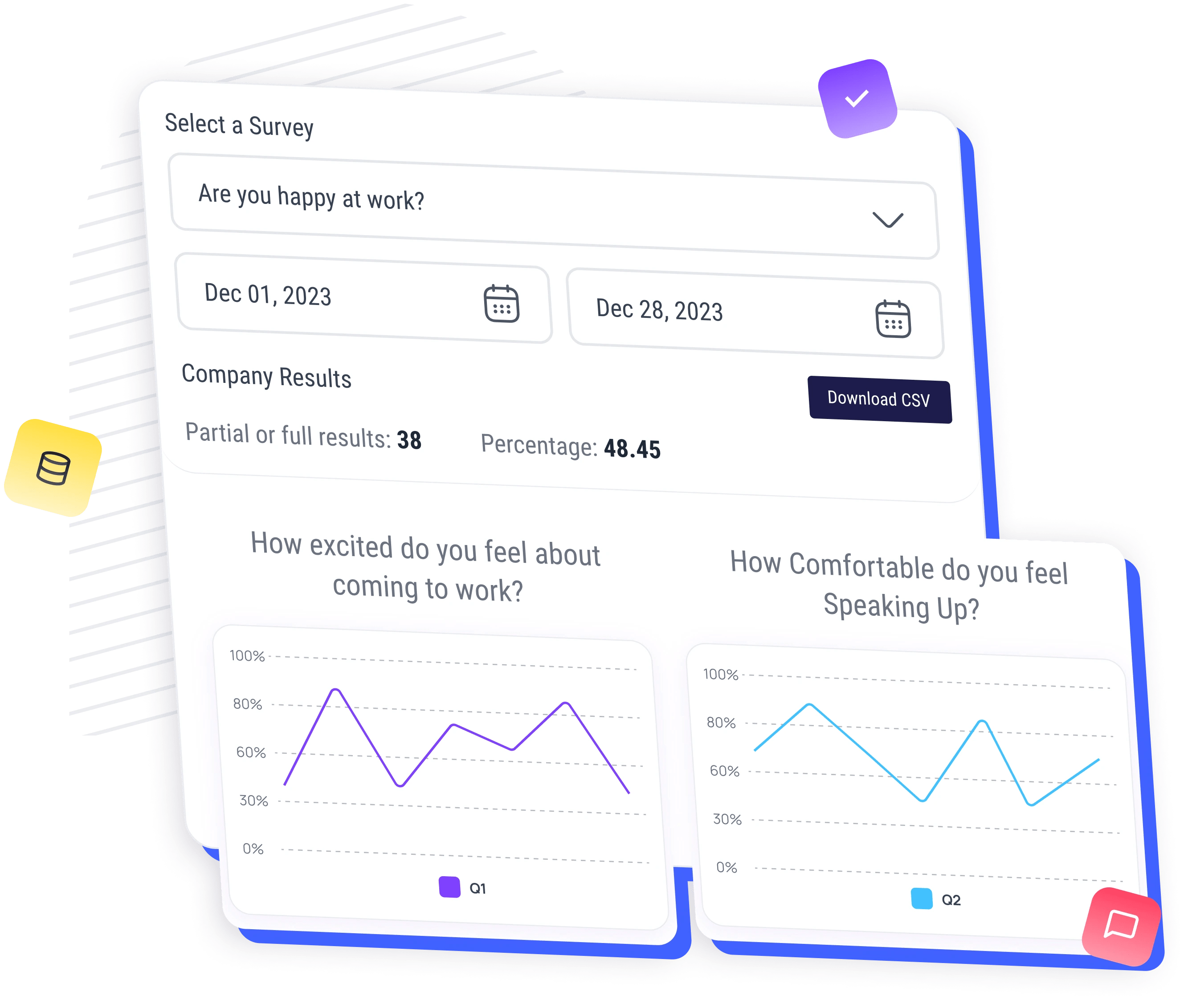
After collecting responses from your employee satisfaction survey, begin by aggregating results using dashboards or spreadsheets. This lets you quickly identify low-scoring areas — for example, issues related to recognition, workload, or growth opportunities. By visualizing scores across different categories (e.g. culture, workload, recognition), you reveal patterns and recurring pain points that may not be obvious when viewing individual responses. This foundational step ensures that your analysis is data-driven, objective, and actionable.
Segment by Team, Tenure, Department
Next, segment the survey data by team, tenure, or department. Breaking down results by demographic or organizational group helps pinpoint where concerns are concentrated. For example, newer hires might feel differently about growth opportunities than long-standing staff, or one department may consistently report high workload stress while another reports low recognition. This segmentation provides clarity, enabling tailored interventions rather than one-size-fits-all solutions — a key benefit of using an employee feedback survey.
Prioritize Issues by Impact & Feasibility
Once you identify patterns, it’s crucial to prioritize which issues to address first. Use a simple impact vs. effort matrix to map each concern: high-impact/high-effort, high-impact/low-effort, and so on. Focus first on issues that offer high impact with feasible effort — e.g., improving recognition programs or adjusting workloads. This approach helps your organization allocate resources wisely and achieve quick wins that reinforce trust in the survey process.
Develop Specific Action Plans
For each prioritized issue, draft a clear, specific action plan. For instance:
- If recognition is low → launch a structured recognition & rewards program
- If workload is high → re-balance tasks, add support or redistribute responsibilities
- If communication is weak → set up regular feedback loops, team check-ins, or anonymous suggestion channels
Each plan should include concrete steps, responsible owners, and a timeline. This makes your response to the employee engagement survey results tangible, transparent, and goal-oriented.
Communicate Findings & Next Steps Transparently
Finally, share high-level results and planned next steps with your employees. Celebrate strengths and improvements, acknowledge areas needing work, and outline proposed changes. Transparent communication builds trust and demonstrates that employee feedback truly matters. It turns the survey from a data-gathering exercise into a collaborative process — strengthening engagement and reinforcing a culture of openness.
Why Implementing Feedback Matters — Real Benefits of Acting
Acting on feedback from an employee satisfaction survey delivers tangible benefits across multiple dimensions:
- Better Employee Retention: Companies that respond to feedback and implement recognition strategies reduce turnover risk. Employees who feel heard and valued are much less likely to leave. Data shows that well-recognized employees are significantly less likely to seek new jobs over time.
- Improved Productivity & Engagement: Engaged employees — especially those receiving regular meaningful feedback — tend to be more motivated, take the initiative, collaborate better, and deliver higher quality work.
- Enhanced Workplace Culture & Morale: When feedback leads to real change, trust and loyalty grow. Employees feel valued, communication improves, and the overall atmosphere becomes inclusive and supportive.
- Better Customer Outcomes and Business Results: Satisfied, engaged employees often provide better service, innovate more, and contribute positively to customer satisfaction and business performance — which ultimately impacts profitability.
Implementing changes based on survey feedback is more than just good HR practice — it’s a strategic lever for organizational growth, stability, and long-term success.
Tools & AI Solutions for Surveys — (Yes, Here’s Where BRAVO Fits In)
Using modern employee survey tools — especially ones with AI-enabled analytics — dramatically simplifies the process:
- Automate survey creation, distribution, reminders
- Generate real-time dashboards and sentiment analysis
- Identify patterns (e.g. recurring complaints or high-impact concerns)
- Provide benchmarking against industry norms
With a tool like BRAVO, survey creation becomes fast and efficient — and insights come quickly. That lets you act swiftly, boosting engagement before issues fester.

How Surveys + Recognition + Engagement Work Together
Measuring satisfaction is just the first step. For maximum impact:
- Pair surveys with employee recognition and reward programs
- Encourage transparent communication and open feedback loops
- Provide opportunities for growth, development, and career progression
- Maintain regular pulse surveys to track changes over time
This holistic approach — combining data, action, recognition, and ongoing feedback — builds a workplace where employees feel valued, motivated, and committed.
Conclusion — Start Measuring, Start Improving
An employee satisfaction survey is not a one-time exercise. It’s a strategic commitment to listen, understand, and improve. When designed properly, analyzed thoughtfully, and followed by real action, it transforms workplaces — reducing turnover, improving performance, and building a stronger culture.
Ready to harness the full power of employee feedback with modern tools?
See how BRAVO’s AI-powered survey platform can help you run surveys efficiently and turn feedback into action.
Book Free Demo →
Frequently Asked Questions (FAQs)
An employee satisfaction survey typically measures how content employees are with aspects like work conditions, pay, recognition, and workplace culture. An employee engagement survey goes deeper — measuring emotional commitment, motivation, willingness to go the extra mile, and sense of belonging. Many organizations combine both in one survey.
It’s best to run a full survey annually or bi-annually, with shorter “pulse surveys” quarterly or semi-annually to monitor trends and catch emerging issues early.
Guarantee anonymity and confidentiality, communicate the purpose clearly, and follow up by acting on feedback. Transparency builds trust and encourages honest feedback.
Use the results to develop targeted action plans: improve communication, offer recognition, adjust workload balance, provide training or development opportunities, and review management practices.
Yes — even small teams benefit greatly. Surveys help surface issues early, improve communication, and create a positive culture, which in turn helps with retention and productivity, regardless of company size.
Track metrics like retention rate, employee engagement score, absenteeism, participation rate in surveys, employee performance, and overall morale or feedback trends.
Yes — AI tools simplify distribution, analysis, and trend spotting. They save time, ensure confidentiality, and often provide deeper insights (sentiment analysis, heat maps, trend tracking) than manual surveys.


