

A paycheck alone doesn’t keep people engaged anymore.
Gallup and Workhuman tracked nearly 3,500 employees from 2022 to 2024 and found that well-recognized employees were 45% less likely to have left their job two years later (Gallup 2025).
An employee recognition points system turns that insight into a repeatable process. Instead of occasional bonuses or one-off praise, employees earn points for achievements and behaviors, then redeem them for rewards they actually want.
This guide covers how points systems work, how to price and budget one, how to build and launch it, and the mistakes that sink most programs before year one.
What Is an Employee Recognition Points System?
An employee recognition points system is a structured program that rewards employees with points for specific actions, achievements, or behaviors.
Those points function as a running record of contribution. Completing a project ahead of schedule might earn 75 points. Mentoring a new hire might earn 40. Over time, the balance becomes something employees can track and redeem — for gift cards, experiences, merchandise, or extra time off.
The difference from traditional recognition isn’t the reward. It’s the structure.
A points-based reward system replaces one annual “employee of the year” moment with recognition that happens weekly, tied to clear, visible criteria everyone understands.
Compared with ad-hoc praise, a recognition points program gives you four things at once:
- Transparency — employees know exactly how points are earned
- Consistency — recognition happens continuously, not once a year
- Choice — employees redeem points for rewards that fit them, not a generic gift
- Data — every point awarded is a data point on what’s actually driving performance
Most companies now manage this through dedicated software rather than spreadsheets. Platforms like BRAVO sync recognition into Slack or Microsoft Teams so points get awarded inside the tools employees already use — not in a separate portal nobody opens.
How Employee Recognition Points Systems Work
A points-based reward system for employees runs on three steps: earning, tracking, and redeeming.
Employees earn points for actions tied to company values — hitting a target, helping a teammate, proposing an idea that gets used. Managers and, in peer-to-peer programs, coworkers award points directly.
Balances stay visible in real time, usually through a dashboard. That visibility matters more than it sounds: employees who can see their progress toward a reward stay more engaged with the program itself.
Instant point awards let managers or peers recognize a moment the second it happens. The award posts to a shared feed inside Slack or Teams, so the whole team sees it. Recognition delivered immediately after the action reinforces it more strongly than recognition delayed by weeks, which is the core reason instant systems outperform annual review-cycle praise.
| Recognition type | Frequency | Employee choice | Admin burden |
|---|---|---|---|
| Annual awards / bonuses | 1x/year | None | High (single event) |
| Manager-only praise | Sporadic | None | Low |
| Points-based system | Daily/weekly | High | Low, once automated |

A company milestone point system — work anniversaries, tenure, project completions — is usually layered on top of day-to-day points, since milestones deserve a bigger, one-time award rather than the standard daily range.
How Many Points Should Employees Earn? Point Values and Conversion Ratios
The most common question teams ask before launch isn’t “what rewards should we offer” — it’s “what is a point actually worth.”
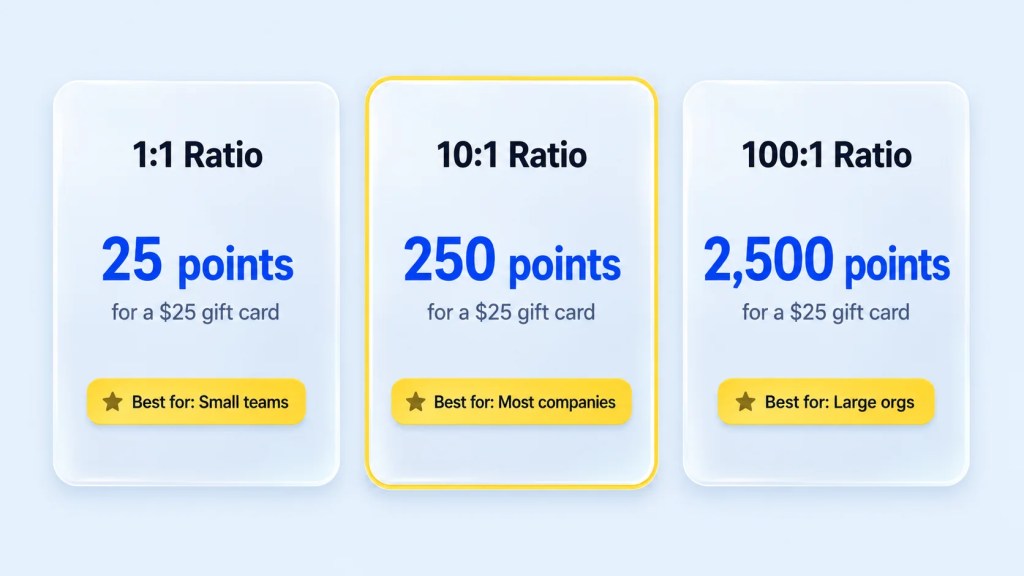
Three conversion ratios cover almost every program:
| Ratio | Example | Best for |
|---|---|---|
| 1:1 (1 point = $1) | 25-point gift card = $25 | Small teams, simple math, higher cost |
| 10:1 (10 points = $1) | 250-point gift card = $25 | Most companies — balances psychology and budget |
| 100:1 (100 points = $1) | 2,500-point gift card = $25 | Large orgs needing granular point tiers |
A 10:1 ratio is the most common starting point because larger point numbers feel more rewarding to earn, without the budget exposure of a 1:1 system.
Typical point ranges once a ratio is set:
- Daily recognition (helping a teammate, good customer interaction): 10–25 points
- Project milestones: 50–100 points
- Innovation or process-improvement ideas adopted: 200–500 points
- Annual or tenure milestones: 1,000+ points
Rather than build a conversion calculator into every internal process, most teams point employees to a live tool. BRAVO’s own reward points calculator shows the redemption value of any point balance instantly, which removes the “what is this actually worth” confusion that derails adoption in the first month.
How to Budget an Employee Recognition Points Program
Budget uncertainty is the single most common reason a points program gets killed before it launches.
A working annual budget formula:
Annual budget = (employees × monthly allowance × 12) + (employees × milestone bonus) + (special recognition fund)
Worked example for 100 employees:
- Monthly allowance: $20/employee → $24,000/year
- Milestone bonus (birthdays, anniversaries): $75/employee → $7,500/year
- Special recognition fund (buffer for standout achievements, ~20%): $6,300/year
Total: roughly $37,800/year, or about $31.50 per employee per month.
Smaller companies (10–50 employees) typically run higher per-person allowances ($20–30/month); larger organizations (200+) usually run leaner ($10–20/month) since volume drives more total recognition moments even at a lower per-person rate.
Build in a buffer. Programs without one tend to freeze mid-year when a department has an unusually strong quarter and managers can’t award what the moment deserves.
Benefits of an Employee Rewards Points Program
The business case for a recognition system for employees goes well past morale.
Gallup’s research found that employees receiving recognition across at least four of five “strategic recognition” pillars are nine times more likely to be engaged than employees receiving none (Gallup 2025). Personalization matters too: SHRM reported in March 2025 that 70% of employees say recognition feels most meaningful when it’s personalized, based on a large-scale global culture study (SHRM, 2025).
A well-run points program delivers:
- Fairness at scale — every employee is measured against the same visible criteria, not manager discretion alone
- Retention support — tied directly to Gallup’s 45%-less-likely-to-leave finding above
- Peer-to-peer reach — recognition isn’t gated behind a manager’s calendar; teammates can recognize each other in the moment via BRAVO’s peer feedback feature
- Global consistency — a common points framework keeps recognition fair across regions, which matters once you have distributed or international teams redeeming in different currencies
A shared points framework standardizes what “good work” looks like across every team. Every manager and peer applies the same point ranges to the same categories of behavior. That consistency is what closes the fairness gap Gallup identifies as the biggest blocker to program trust.
What Recognition Points Look Like in Practice
Points systems work best when they’re visible in the flow of daily work, not buried in a quarterly report.
A few patterns show up consistently across companies that run mature programs:
- Performance milestones — a rep closes a deal, a support agent resolves an escalated ticket, an engineer ships ahead of schedule. Points post immediately, visible to the team.
- Peer recognition — a teammate publicly credits a colleague for help on a deadline. This is where programs like Zappos’ long-running peer-nominated points currency have drawn attention in HR circles, precisely because recognition comes from coworkers, not just managers.
- Learning and development — completing a certification or leading a training session earns points, reinforcing growth alongside output.
- Wellbeing participation — joining a step challenge or wellness program earns smaller, recurring points that keep engagement steady between bigger wins.
None of these require a new process. They require a platform that makes the moment easy to capture — which is the actual adoption bottleneck in most rollouts, not the reward catalog.
How to Build Your Employee Points Program: A Step-by-Step Plan
Skip the improvisation. Programs that launch with a defined sequence adopt faster and survive past the first six months.

- Define goals and criteria. Pick 2–3 measurable outcomes (engagement score, recognition frequency, retention) and write down exactly which behaviors earn points.
- Set your budget and conversion ratio. Use the formula above; pick 10:1 unless you have a specific reason not to.
- Choose a platform. Look for Slack/Teams-native tools over a standalone portal — adoption drops sharply when recognition lives somewhere employees have to remember to open. If you’re comparing employee reward point system alternatives, weigh integration depth over catalog size.
- Build the rewards catalog. Aim for 15–25 options across gift cards, experiences, and merchandise so most employees find something they actually want.
- Pilot with one team. Run it for 2–4 weeks with a single department before rolling out company-wide, and fix friction points before they scale.
- Launch, then measure monthly. Track recognition frequency, redemption rates, and engagement scores — and adjust point values if certain categories go unused.
A pilot phase surfaces friction — confusing point values, an unclear catalog — before company-wide rollout. Fixing those issues with 20–30 employees costs a afternoon; fixing them after a full launch costs months of stalled adoption. Companies that pilot first see materially smoother company-wide adoption than those that skip straight to a full rollout.
Common Mistakes to Avoid With a Points-Based Reward System
Most failed programs fail for the same handful of reasons, not for lack of budget.
- No clear criteria. If employees can’t predict what earns points, the system reads as arbitrary — and arbitrary recognition erodes trust faster than no recognition at all.
- Points that never expire. Balances that sit untouched for years become a liability on the books and lose motivational value. Most mature programs expire points after 12–18 months, with reminders before expiration.
- Manager-only awarding. Programs that don’t allow peer-to-peer points miss most of the day-to-day moments worth recognizing — managers simply aren’t present for all of them.
- Ignoring remote and distributed employees. Criteria built around visibility in the office quietly excludes remote staff. Build in recognition categories that don’t require physical presence.
- No review cadence. Programs set up once and never revisited drift out of step with what the business actually values a year later.
We’ve gone deeper on this in 5 horrible mistakes you’re making with employee rewards if you want the full breakdown before you launch.
Points vs. Badges vs. Coins: Where Gamification Fits In
Points, badges, and virtual “coins” often get used interchangeably, but they solve different problems.
Points are a currency — they accumulate and get redeemed for real rewards. Badges are a status signal — they mark an achievement but usually can’t be spent. Coins are typically a game-economy layer on top of points, used to drive engagement inside a specific platform experience rather than function as a redeemable reward currency.
For most HR teams, points-with-redemption is the simpler, more directly motivating system, since the connection between effort and tangible reward is immediate and obvious. Gamified layers — leaderboards, streaks, badges — work well as an addition, not a replacement. If you’re exploring this further, our guide to gamification for employee engagement covers where the two overlap.
How BRAVO Makes Employee Recognition Points Effortless
BRAVO is an AI-powered employee recognition and engagement platform built around exactly this model.
BRAVO Points let managers and peers award recognition directly inside Slack or Microsoft Teams, so recognition happens where work already happens instead of in a separate app nobody logs into.

BRAVO syncs point balances and redemption in real time across every connected workspace. Employees see their balance the moment a point is awarded, without checking a separate dashboard. That immediacy is what keeps programs active past the initial launch excitement — engagement doesn’t fall off once the novelty wears out.
What that looks like in practice:
- Instant, peer- and manager-awarded points inside Slack or Teams
- A built-in reward points calculator so employees always know redemption value
- A customizable rewards catalog spanning gift cards, experiences, and merchandise
- Full visibility into program data for HR teams tracking adoption and ROI
See the full breakdown on BRAVO’s features page, or explore how employees earn BRAVO points for a walkthrough of the mechanics.
Conclusion
A points-based recognition system only works if it’s structured, budgeted, and built around real employee behavior — not bolted on as an afterthought.
Get the conversion ratio and budget right, launch with a pilot, and avoid the handful of mistakes that kill most programs in year one, and the payoff is measurable: stronger retention, broader participation, and recognition that actually reaches every team, not just the loudest performers.
If you’re ready to put this into practice, book a free BRAVO demo and see how points-based recognition runs inside Slack or Teams in minutes.
FAQs
An employee recognition points system is a structured program where employees earn points for achievements, milestones, or behaviors, then redeem those points for rewards like gift cards, experiences, or merchandise.
Most programs allocate enough monthly points for 2–3 meaningful recognitions per employee. Using a 10:1 ratio, that typically works out to $20–30 in monthly redemption value, adjusted for company size.
Most mature programs expire points after 12–18 months, with reminders 30–60 days before expiration. This encourages redemption without pressuring employees into rushed choices.
Build recognition categories that don’t depend on physical office presence, and standardize point values and conversion rates across regions rather than adjusting them informally team by team.
A points system is a redeemable currency tied to real rewards. Gamification layers — badges, leaderboards, streaks — add engagement on top of points but usually aren’t redeemable on their own.
A 1:1 ratio is simplest but gets expensive to sustain at scale. A 10:1 ratio is the more common choice because larger point numbers feel more rewarding without increasing actual cost.
BRAVO awards and tracks points directly inside Slack or Microsoft Teams, pairs them with a built-in redemption calculator, and gives HR teams real-time visibility into program adoption and ROI.

He is an SEO strategist and content writer focused on employee engagement and SaaS marketing. He creates data-driven content that ranks on Google and AI search while helping businesses improve motivation, productivity, and retention.

