

Most organizations have some form of rewards. Few have a system that actually changes behavior, builds culture, and reduces turnover at the same time.
A reward system in an organization is the structured combination of incentives and recognition designed to acknowledge employee contributions, reinforce specific behaviors, and align individual effort with business goals.
Global employee engagement fell to 20% in 2025, the second consecutive annual decline, and Gallup estimates disengagement now costs the world economy roughly $10 trillion a year — about 9% of global GDP (Gallup, 2026). The gap between organizations that recognize well and those that don’t is only widening.
BRAVO is an AI-powered employee recognition and rewards platform that helps HR teams build structured, data-informed reward programs — from peer-to-peer recognition to points-based incentives — in a single interface. This guide covers what a reward system includes, why it matters, the types that work, and how to build one from scratch.
Why Does a Reward System Matter for Organizational Success?
A well-designed employee reward system affects the business at multiple levels — not just morale.
Retention. SHRM’s 2025 State of the Workplace research found that employee experience and engagement account for 42% of turnover intent — nearly half of why people leave (SHRM, 2025). A structured reward system is a direct lever on that number.
Engagement. Recognition triggers a psychological response that drives sustained effort. Workhuman’s 2025 global study of 2,500+ employees found that people with a very positive rewards experience are 19x more likely to recommend their employer as a great place to work (Workhuman, 2025).
Culture. Rewards reinforce values. A company that recognizes collaboration gets more of it. A company that only rewards individual output sees the same.
None of these outcomes happen by accident. They follow from intentional design — which starts with knowing what the system is actually for.
5 Core Objectives of an Effective Reward System
A reward system in an organization typically exists to achieve five things at once:
- Motivation — encouraging discretionary effort, not just baseline compliance
- Engagement — building emotional and psychological investment in the work
- Accountability — making performance expectations visible and consistently applied
- Talent management — helping attract, develop, and retain the right people
- Strategic alignment — tying individual behavior to what the business is actually trying to achieve
A program that hits only one or two of these — say, motivation through cash bonuses, with nothing tied to strategy — tends to plateau. The programs that keep working are the ones built against all five from the start.
Employee Rewards vs. Recognition: What’s the Difference?
Rewards and recognition get used interchangeably. They’re not the same, and confusing them leads to programs that underperform.
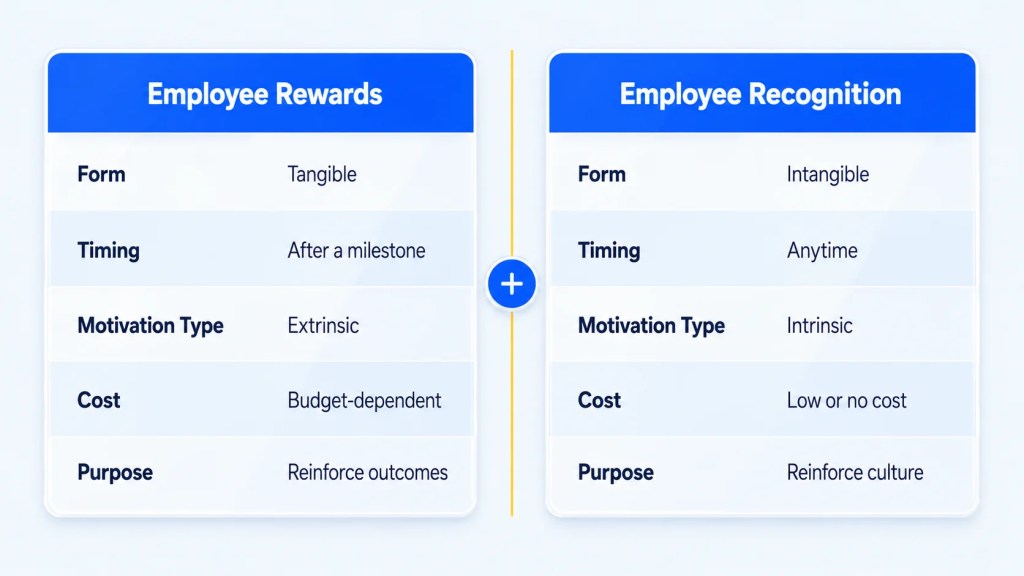
Employee rewards are tangible and outcome-tied — bonuses, commissions, gift cards, extra PTO.
Employee recognition is intangible and effort-tied — a public shout-out, a peer nomination, a manager’s thank-you note.
Rewards without recognition feel transactional.
Recognition without rewards can feel hollow over time, especially for high performers.
| Aspect | Employee Rewards | Employee Recognition |
|---|---|---|
| Form | Tangible — pay, perks, gifts | Intangible — praise, acknowledgment |
| Timing | After a milestone or target | Anytime, based on observed effort |
| Motivation type | Extrinsic | Intrinsic |
| Cost | Budget-dependent | Often low or no cost |
| Purpose | Reinforce specific outcomes | Reinforce culture and values |
A complete reward system in an organization uses both. Rewards drive outcomes; recognition sustains culture between milestones. For a deeper breakdown of how the two combine, see 5 intrinsic vs. extrinsic rewards to improve employee engagement.
How to Build a Reward System for Employees: A 5-Step Framework
Building an effective employee reward system is an ongoing practice, not a one-time project. Here’s how HR teams approach it.

- Anchor rewards to business objectives. Reward behaviors that map to what the organization is actually trying to achieve — not generic “Employee of the Month” territory.
- Combine intrinsic and extrinsic incentives. Non-monetary rewards — development, flexibility, public recognition — drive engagement just as effectively as cash, sometimes more so for longer-tenured employees.
- Build in peer-to-peer recognition. Top-down recognition alone misses most day-to-day contributions. BRAVO’s peer-to-peer recognition lets employees send real-time recognition across teams, visible to the wider organization.
- Set clear, transparent criteria. Ambiguity kills trust. Employees need to know exactly what earns recognition, how often, and by what process.
- Measure and adjust. Track participation rates, recognition frequency by team, and correlation with engagement scores. BRAVO’s reporting dashboard surfaces these metrics without manual data pulls.
A program anchored to strategy, measured consistently, and open to adjustment outperforms a static one every time.
What Types of Rewards Work Best in the Workplace?
An effective reward system for employees draws from multiple categories, because different people are motivated by different things. At the broadest level, every reward falls into one of two buckets.
| Category | Examples | Best for |
|---|---|---|
| Monetary rewards | Bonuses, commissions, profit-sharing, stock options | Sales roles, milestone-driven teams |
| Non-monetary rewards | Public recognition, development funding, flexible time, experiences | Long-term engagement, culture-building |
Within those two buckets, five specific categories cover most of what shows up in practice:
- Monetary and financial incentives — bonuses, commissions, profit-sharing
- Public recognition — team shout-outs, peer nominations, newsletter spotlights
- Career development rewards — certifications, mentorship, structured career pathing
- Work-life and flexibility rewards — extra PTO, flexible scheduling, wellness stipends
- Experiential and tangible rewards — team retreats, gift cards, milestone experiences
Financial incentives are direct and legible, but they don’t build the emotional connection that keeps people long-term.
Development and flexibility rewards often outweigh cash bonuses for knowledge workers specifically. BRAVO’s extensive rewards catalog lets HR teams offer across all five categories without managing separate vendors.
Points-Based and Incentive Reward Systems: Why They’re Gaining Ground
Two reward formats deserve their own section because they work differently from a one-time bonus or a single shout-out: points-based systems and structured incentive programs.

Points-based reward systems let employees earn redeemable points for recognized behavior, then choose their own reward.
Employees who redeem points frequently report 34% higher belonging than those who don’t (Workhuman, 2025).
The mechanism works because it separates the moment of recognition from the moment of redemption — employees get a dopamine-adjacent lift twice: once when they’re recognized, again when they redeem.
Incentive programs work differently. They’re tied to a specific, defined target — a sales quota, a safety record, a project milestone — with the reward known in advance.
Points-based and incentive programs aren’t competing approaches. Most mature reward systems run both: incentives for defined, high-stakes goals, and a continuous points program for the day-to-day behaviors that don’t fit a quarterly target.
BRAVO’s employee incentive program feature and points-based recognition system run side by side inside a single platform, so HR teams don’t have to stitch together two separate tools.
Types of Reward Systems in HRM: How They’re Structured
From an HRM perspective, reward systems fall into a few structural categories.
- Individual performance-based systems — reward personal output, common in sales
- Team-based reward systems — recognize collective achievement over individual competition
- Tenure and milestone programs — anniversary awards, service recognition
- Continuous recognition platforms — real-time recognition, not tied to a review cycle
The most effective organizations don’t pick one structure. They layer them.
When HR teams implement a layered model — individual incentives for performance, team rewards for cohesion, continuous recognition for everyday moments — they typically see participation rates climb across the whole organization, not just among top performers. BRAVO’s Coface implementation is one example of this layered approach in practice, combining structured milestones with everyday peer recognition.
BRAVO’s employee milestones feature automates the tenure and service-anniversary layer specifically, so it doesn’t fall through the cracks between quarterly reviews.
Benefits of a Reward System: For Employees and for the Organization
The benefits of a structured reward system split cleanly into two tracks — what employees get, and what the business gets. Most write-ups only cover one side.

For employees, a well-run reward system for employees delivers a greater sense of accomplishment, more development opportunities, and a stronger sense of belonging — the same belonging effect Workhuman measured directly among frequent points redeemers.
For organizations, the return shows up as reduced voluntary turnover, higher engagement, and a stronger employer brand in a market where 42% of turnover intent traces back to experience and engagement gaps (SHRM, 2025).
Recognition patterns also generate people data most engagement surveys miss.
Participation rates by manager surface accountability gaps early — before they show up in an exit interview. For a closer look at where reward programs commonly fall short on the employee side, see advantages and disadvantages of a reward system for employees.
Conclusion
A reward system in an organization is performance and retention infrastructure, not a perk. The organizations getting real return build it against clear objectives, cover both monetary and non-monetary formats, and layer points-based, incentive, and continuous recognition into one system rather than running them separately.
BRAVO gives HR teams peer-to-peer recognition, points-based rewards, incentive programs, and real-time reporting in a single platform — built for teams who want to move from ad hoc appreciation to a measurable recognition culture.
If you’re ready to put a structured reward system in place, book a free BRAVO demo and see how your team can get started in minutes.
FAQs
A reward system in an organization is a structured framework combining monetary incentives and non-monetary recognition to motivate employees and align individual performance with company goals. It typically includes financial rewards, public recognition, development opportunities, and flexibility benefits.
A points-based reward system lets employees accumulate redeemable points over time and choose their own reward, separating recognition from redemption. A one-time bonus delivers value immediately but doesn’t create the same anticipation effect that drives sustained engagement.
Incentive programs tie a known reward to a specific, predefined target — a sales quota or safety milestone. Recognition programs reward observed effort and behavior at any time, without a fixed target attached.
Employees in a well-designed reward system report a greater sense of accomplishment, more access to development opportunities, and stronger belonging. Frequent participants in points-based programs report notably higher belonging than infrequent participants.
Start by anchoring reward criteria to business goals, then combine monetary and non-monetary incentives, add peer-to-peer recognition, set transparent eligibility criteria, and measure participation and outcomes on an ongoing basis.
HRM typically categorizes reward systems as individual performance-based, team-based, tenure and milestone-based, or continuous recognition platforms. The most effective organizations layer more than one structure rather than relying on a single format.
Track recognition frequency, participation rates by team and manager, correlation with engagement survey scores, and voluntary turnover before and after implementation. eNPS is a useful supporting signal alongside these core metrics.

He is an SEO strategist and content writer focused on employee engagement and SaaS marketing. He creates data-driven content that ranks on Google and AI search while helping businesses improve motivation, productivity, and retention.


