

Well-recognized employees are 45% less likely to leave their employer within two years, according to Gallup and Workhuman (2025).
Yet only 22% of employees say they get the right amount of recognition for their work — unchanged since 2022.
The best employee recognition software closes that gap by embedding appreciation into daily workflows instead of leaving it to memory.
This guide ranks the 10 platforms doing that best in 2026, including BRAVO, evaluated against the same criteria as every competitor here.
BRAVO, an AI-powered employee recognition and engagement platform by WorkHub, is evaluated using the same criteria as every competitor. It pairs point-based rewards (BRAVO Points) and team challenges (BRAVO Feats) with engagement surveys (BRAVO Voice) and goal tracking (BRAVO Focus).
What Is Employee Recognition Software?
Employee recognition software is a digital platform that lets organizations acknowledge employee contributions in a structured, trackable way. It replaces manager-dependent praise with a system any employee can use.
Vendors describe the same category with different words. “Recognition systems” usually means the formal workflow layer, while “recognition platforms” combine recognition with rewards and analytics.
Peer recognition software specifically covers employee-to-employee shoutouts, not top-down praise alone.

BRAVO combines all three layers in one platform.
BRAVO’s peer-to-peer recognition feed lets any employee recognize a colleague in real time. Each message is visible org-wide and tagged to a company value.
The label matters less than the outcome: does the tool make appreciation consistent, visible, and measurable?
Types of Employee Recognition Software
Most platforms in this category combine four recognition types, and understanding the split matters more than any single feature list.
Peer-to-peer recognition lets any employee recognize a colleague directly, without manager approval. Manager-led recognition is formal, top-down praise tied to performance nominations and structured awards.
Milestone and service-award recognition automates tenure and anniversary acknowledgment so nothing gets missed. Rewards-based recognition attaches a tangible benefit — points, gift cards, experiences — to a recognized contribution.
| Type | Best for | Example platforms |
|---|---|---|
| Peer-to-peer | Culture building, distributed teams | BRAVO, Matter, MBonusly, Nectar |
| Manager-led | Formal performance programs | WorkTango, Kudos |
| Milestone/service awards | Tenure and anniversary tracking | Nectar, Terryberry |
| Rewards-based | Points-to-redemption programs | BRAVO Points, Vantage Circle |
Most buyers need at least two of these working together. Peer recognition without a reward mechanism tends to lose momentum once the novelty passes.
How We Evaluated These Platforms
Every platform below was scored against five weighted criteria, in this order.
Feature depth — does it cover peer recognition, formal programs, milestones, and rewards without bolting on separate tools?
Ease of adoption — can employees start recognizing colleagues in week one, without training?
Integration support — does it connect natively to Slack, Microsoft Teams, and HRIS systems?
Analytics capability — can HR track recognition frequency, participation, and eNPS trends over time?
This comparison is built from each vendor’s published pricing, public feature documentation, and current G2 and Capterra ratings as of 2026 — not hands-on product testing of every platform. BRAVO is evaluated first, since it’s ours, using the same public-facing criteria applied to every competitor.
The remaining nine follow a consistent format: strongest use case, pricing, pros, and one honest con.
Best Employee Recognition Software by Company SizE
Company size changes what “best” actually means, and matching the tool to your size problem beats chasing the highest star rating.
Under 100 employees, simplicity beats depth. Bonusly and Nectar are built for fast setup and low per-seat cost, and most SMB teams don’t need formal nomination workflows yet.
BRAVO fits here too, on a free tier for up to 10 employees, so smaller teams can test peer-to-peer recognition without a budget conversation.
Between 100 and 1,000 employees, recognition consistency across multiple managers becomes the real problem. BRAVO’s full-suite approach — peer feed, points, surveys, and goal tracking in one platform — fits this stage best.
At 1,000+ employees, multi-region reward delivery and governance take priority. BRAVO, Achievers, and Vantage Circle all run global, multi-currency reward catalogs built for that scale.
A tool sized for a 50-person team is not the same as a platform built for a 5,000-person enterprise.
Top 10 Best Employee Recognition Software
1. BRAVO — Best Overall Recognition and Rewards Platform
BRAVO is an AI-powered employee recognition platform built for HR teams that need recognition to be consistent, measurable, and embedded in daily workflows.
It combines peer-to-peer recognition, points-based rewards, formal nomination programs, engagement surveys, and goal tracking in one platform, integrated natively with Slack, Microsoft Teams, and major HRIS systems.
Core features:
- BRAVO peer recognition feed — real-time, values-tagged, visible org-wide
- BRAVO Points — redeemable for gift cards, experiences, and wellness benefits
- BRAVO Feats — team challenges and goal-based recognition
- BRAVO Voice — engagement surveys correlated with recognition data, including eNPS tracking
- BRAVO Focus — OKR and goal tracking tied to recognition
- Real-time analytics dashboard — frequency, participation, redemption, engagement trend
Coface, a global trade credit insurer, rolled out BRAVO across teams in 40+ countries to replace inconsistent, manager-dependent recognition. Engagement scores improved within the first quarter, and Coface’s HR team now saves 6 hours per week on manual recognition tracking, per BRAVO’s published case study.

Pricing: Free (up to 10 employees) — full peer feed and points system. Growth: $3 per user per month, billed annually, up to 200 employees. Enterprise: custom, with volume discounts. No setup fees; 7-day free trial on Growth.
Best for: Teams of 100–1,000 that need recognition consistency across multiple managers, plus surveys and goal alignment, without stitching together separate tools.
Pros: Full-spectrum recognition infrastructure in one platform; named, specific modules give HR precise control over which formats they activate.
Con: The Growth tier’s 200-employee ceiling means larger mid-market teams move to a custom Enterprise quote sooner than with some flat per-seat competitors.
Give recognition a system, not a memory test
Peer shoutouts, points, and milestones — running in one place your team already checks.
Book a Free Demo2. Bonusly — Best for Social & Points-Based Recognition
Bonusly is built around a lightweight, social recognition feed that makes day-to-day appreciation feel like a habit rather than a program. Employees give and receive points publicly, then redeem them from a reward marketplace covering gift cards, charitable donations, and company-specific perks.
Highlights:
- Social recognition feed visible to the whole team
- Peer-to-peer badges tied to company values
- Integrated participation and engagement analytics
- Flexible reward marketplace with gift card and donation options
Rated 4.7/5 on G2 and 4.8/5 on Capterra (G2, 2026). Pricing starts around $3/user/month.
Best for: Teams that want frequent, low-friction recognition without a heavy rollout process.
Pros: Fast adoption curve; genuinely fun day-to-day experience that keeps participation high.
Con: Formal program structure — nominations, tiered awards — is thinner than full-suite platforms, and analytics stay fairly basic at scale.
3. Nectar — Best for SMB Culture Building
Nectar pairs peer-driven recognition with automation, so milestones and work anniversaries never get missed without someone remembering to flag them. It connects natively to Slack and Microsoft Teams, meaning recognition happens inside tools employees already use daily rather than a separate app.
Highlights:
- Points-based peer recognition open to every employee
- Rewards catalog with wellness and lifestyle options
- Automated milestone and work-anniversary celebrations
- Native Slack and Teams integration
Pricing starts around $2.75/user/month — one of the most affordable full-feature options in this category.
Best for: SMB and mid-market teams building a recognition habit for the first time.
Pros: Affordable; simple to deploy without a dedicated implementation team.
Con: Customization and reporting depth fall short of what larger, multi-department organizations typically need.
4. WorkTango — Best for Recognition + Engagement Insights
WorkTango pairs recognition with structured feedback and engagement surveys, giving HR a direct line between who’s being recognized and how engaged the team actually is. Recognition can be tied explicitly to company values and individual goals, not just general praise.
Highlights:
- Recognition linked to specific behaviors and goals
- Engagement survey dashboards alongside recognition data
- Automated milestone and service-award programs
Rated 4.7/5 on both G2 and Capterra (Capterra, 2026). Pricing is custom, quoted per team size.
Best for: Organizations that want engagement measurement built into the same platform as recognition, not a separate survey tool.
Pros: Strong feedback-recognition integration; genuine engagement intelligence, not just a participation count.
Con: Heavier implementation than a pure recognition tool — the platform leans toward engagement management first, recognition second.
5. Kudos — Best for Culture-Centric Recognition
Kudos is built around values-based recognition — every shoutout can be tagged to a specific company value, then rolled up into culture analytics showing which behaviors are actually being reinforced. It supports both public, feed-visible recognition and private, one-to-one appreciation.
Highlights:
- Public and private recognition options
- Culture analytics tracking values alignment over time
- Custom awards, badges, and milestone recognition
Rated 4.8/5 on both G2 and Capterra. Pricing is custom.
Best for: Companies where reinforcing specific cultural values matters as much as the recognition itself.
Pros: Deep values alignment; flexibility between public praise and private appreciation.
Con: The rewards marketplace is noticeably lighter than points-heavy competitors like Bonusly or BRAVO.
6. Motivosity — Best for Social Recognition with Analytics
Motivosity gives every employee a monthly allocation of points or dollars to hand to colleagues, tied to a company value. Recognition lands in a company-wide social feed with reactions and comments, and employees spend what they receive through the ThanksMatters Visa Card or a global rewards catalog. Dashboards show where recognition is flowing and which values are actually being reinforced.
Highlights:
- Monthly peer giving allocation in points or dollars
- Automated milestone recognition
- Engagement and participation analytics dashboards
Pricing starts around $2/user/month.
Best for: Businesses that want social recognition paired with behavioral and participation insight, without enterprise-level cost.
Pros: Strong social mechanics; affordable; genuinely useful behavioral data for managers.
Con: The interface can feel cluttered once team size grows past a few hundred employees.
7. Reward Gateway — Best for Behavioral Motivation
Reward Gateway leans on AI-driven recommendations to nudge specific behaviors, pairing recognition with team-wide competitions and challenges. It’s built less around simple peer shoutouts and more around structured programs tied to measurable outcomes.
Highlights:
- Team competitions and participation challenges
- AI-generated recognition and reward recommendations
- Engagement measurement tools built into the platform
Pricing is custom and tends to skew toward enterprise budgets.
Best for: Organizations that want recognition explicitly linked to behavior change and performance outcomes.
Pros: Strong AI-driven recommendations; rewards are tightly linked to desired behaviors.
Con: Enterprise-oriented pricing and complexity make it a heavier lift for smaller teams than it needs to be.
8. Matter: Best for Slack- and Teams-Native Recognition and Rewards
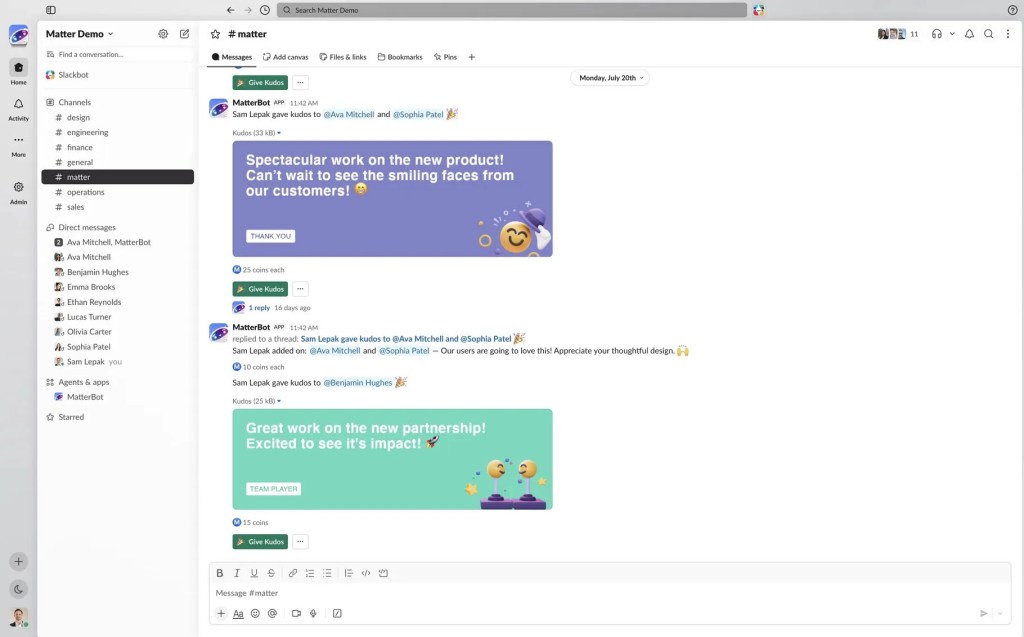
Matter is a recognition, rewards, and pulse survey platform that runs inside Slack and Microsoft Teams. Employees give peer-to-peer kudos tied to company values with no separate logins, and users sync automatically from the Slack/Teams channel, so teams can get started without an HRIS integration. Recognition can also run as a weekly habit with Feedback Friday™.
Highlights:
- Peer-to-peer kudos recognition tied to company values, given directly in Slack or Teams
- A weekly-reset rewards allowance that keeps giving steadily through the month instead of bunching up at month-end
- 10,000+ reward options across 200+ countries
- 250+ HRIS integrations, plus pulse surveys and eNPS
Rated 4.7/5 on G2 and 5.0 across 1,475 ratings in the Microsoft Teams app store. Matter offers a 14-day trial that rolls into a free plan, with paid plans listed at https://matterapp.com/pricing.
Best for: Teams that live in Slack or Microsoft Teams and want recognition, rewards, and pulse surveys in one place without extra logins, passwords, etc.
Pros: Native to Slack and Teams, brings recognition to where work already happens; recognition habit ritual with Feedback Friday™; a large global rewards catalog; a weekly allowance reset that keeps participation steady.
Con: Matter is built around Slack and Teams, so organizations that use neither as their main workplace tool get less value.
9. Vantage Circle — Best for Global Rewards
Vantage Circle is built for distributed and international teams, with a multi-currency rewards marketplace that delivers locally relevant rewards regardless of where an employee is based — a gap several competitors on this list don’t fully solve.
Highlights:
- Global rewards catalog spanning multiple currencies
- Points-based recognition system
- Automated milestone and anniversary recognition
Pricing is custom.
Best for: International or fully distributed teams where local reward relevance matters more than social feed depth.
Pros: Strong global reward catalog; affordable relative to other enterprise-grade options; solid milestone automation.
Con: Social, peer-to-peer recognition features are noticeably lighter than top-tier competitors like BRAVO or Bonusly.
10. Achievers — Best Enterprise Recognition Platform
Achievers is built for large, multinational organizations, with a rewards catalog spanning 190+ countries and multilingual recognition messaging so appreciation reads naturally regardless of an employee’s location or language.
Highlights:
- 190+ country global rewards catalog
- Multilingual recognition messaging
- Advanced, AI-supported engagement dashboards
Pricing is custom, enterprise-scale.
Best for: Large, distributed enterprises that need governance, scale, and multilingual support more than lightweight social features.
Pros: Extensive global catalog; strong multilingual support; advanced analytics built for enterprise reporting needs.
Con: Cost and implementation complexity make it a poor fit for smaller organizations.
Recognition Delivery for Deskless and Frontline Teams
Over 80% of the global workforce works in deskless, frontline roles — retail, healthcare, manufacturing, and similar industries — according to SHRM (2025).
Most recognition software is designed for people who check Slack all day. That assumption breaks down fast on a warehouse floor or a hospital unit.
A platform’s recognition feed is only as useful as the device a frontline employee actually carries. Text-based delivery, printable recognition cards, and QR-code redemption solve for that gap. The result: recognition reaches shift workers the same day it’s given, not the next time they log into a laptop.
BRAVO, Achievers, and Vantage Circle each support multi-channel delivery built for distributed and non-desk teams, while several lighter peer-recognition tools assume constant Slack or Teams access.
Before shortlisting a platform, confirm what percentage of your workforce is desk-based versus deskless. That single number decides whether mobile-first delivery is a top-3 evaluation criterion or a non-factor.
Free & Budget-Friendly Options
True free-forever employee recognition software is rare. Most vendors offer a free trial or a capped free tier rather than an unlimited one.
Free trials typically cap team size and strip out analytics and HRIS integration — the two features that matter most once a program scales past 50 people.
| Vendor | Free option | What’s included |
|---|---|---|
| BRAVO | Free tier, up to 10 employees | Full peer feed, points system, Slack/Teams integration |
| Bonusly | Free trial | Points-based recognition, limited redemption catalog |
| Nectar | Free trial | Peer recognition, milestone automation |
Under 100 employees, pricing models diverge more than the headline rate suggests. Bonusly charges a published per-seat rate from $3/user/month; Nectar quotes on request with a reported annual minimum.
BRAVO’s Free tier covers up to 10 employees at no cost, and the Growth tier scales to 200 employees at $3/user/month billed annually. Compare total monthly cost at your actual headcount — per-seat rates alone can mislead you at this size.
Do You Need a Dedicated Recognition App?
Not every team needs a standalone recognition app, and forcing one onto a Slack-native team adds friction instead of removing it.
If your employees already live in Slack or Microsoft Teams all day, a native integration delivers the same experience without another app to check.
A dedicated mobile app matters more when a meaningful share of the workforce is frontline or deskless — retail, warehouse, or field teams without a company laptop.
Recognition software adoption depends on meeting employees where they already are. A distributed sales team recognizes colleagues through Slack; a warehouse team needs a phone-based app.
Full Platform Comparison
| Platform | Core strength | Integrations | Pricing model |
|---|---|---|---|
| BRAVO | Recognition + rewards + peer feed + analytics + goals | Slack, Teams, HRIS | Flat monthly by team size, from $39/mo; ~$2/user/mo on annual enterprise plans |
| Bonusly | Social peer recognition + points | Slack, Teams, HRIS | Published per-seat, from $3/user/mo |
| Nectar | Peer recognition + wellness rewards | Slack, Teams, HRIS | Quote-based; reported annual minimum |
| WorkTango | Recognition + engagement surveys | HR suites, Slack, Teams | Custom, quoted per team size |
| Kudos | Values-based culture recognition | Multi-platform | Custom |
| Motivosity | Social feed + ThanksMatters card | Slack, Teams, HRIS | Custom quote |
| Reward Gateway | Behavior-linked programs + challenges | Enterprise HR suites | Custom, enterprise-weighted |
| Matter | Global reward and payout delivery | API into existing workflows | Transaction-based |
| Vantage Circle | Slack/Teams-native recognition + rewards | Slack, Teams, HRIS | Free plan + paid plans |
| Achievers | Enterprise global rewards | Global HR suites | Custom enterprise |
Public G2 and Capterra scores across this category cluster tightly between 4.6 and 4.9, so ratings won’t differentiate your shortlist. Check each vendor’s live profile before you decide — scores move week to week — and weight feature depth, integration fit, and total cost more heavily than star rating once you’re past the initial screen.
Questions to Ask Before You Buy
Every recognition software demo sounds good. These questions surface the details vendors don’t lead with.
What happens to unused points? Ask whether points expire, and on what schedule. Expiry quietly returns unspent budget to the vendor rather than your employees. Get the policy in writing before signing.
Are there hidden markups on gift cards or merchandise rewards? Ask for the redemption fee schedule and compare catalog face value against retail. A $50 reward that costs you more than $50 to deliver is a fee, whatever it’s called on the invoice.
How is HRIS and employee data secured? Recognition platforms sync with sensitive HR systems. Ask for SOC 2 (or equivalent) documentation before integration begins.
What’s the real implementation timeline? Vendor sales timelines and actual go-live dates often differ. Ask to speak with a reference customer who went live in the last six months.
If a vendor can’t answer these four questions clearly on a first call, treat that as a signal — not a formality.
How to Roll Out Employee Recognition Software in 30 Days
In our experience rolling out recognition programs, the most common failure point is launching before managers are trained.

Days 1–10: Preparation. Define the values recognition should reinforce. Import your org chart. Configure Slack, Teams, or HRIS integrations before anyone logs in.
Days 11–20: Manager enablement. Train managers first — they set the tone for adoption. Seed the first 10–15 recognitions yourself so the feed isn’t empty on day one. Set initial point budgets per team.
Days 21–30: Launch and monitor. Announce company-wide. Track week-one participation by team, not just company average. Adjust point budgets or communication cadence based on what the first week shows.
Programs that skip manager enablement lose participation fastest, because employees take their cue from whether their own manager is using the tool. The seeded early recognitions matter more than the launch announcement.
Conclusion
The best employee recognition software matches your specific recognition gap — frequency, visibility, or measurement — and integrates with tools your team already uses.
A 50-person team and a 5,000-person enterprise need different tools, even inside the same category. BRAVO covers the broadest range of mid-market needs: peer recognition, points rewards, engagement surveys, and goal tracking in one platform, integrated with Slack and Microsoft Teams.
If BRAVO is on your shortlist, book a free BRAVO demo and bring your team size and integration requirements — the session is built around your use case, not a generic walkthrough.
FAQs
For mid-market to enterprise teams, BRAVO combines peer recognition, points rewards, nomination programs, engagement surveys, and goal tracking with native Slack and Teams integration. Smaller teams often get better per-seat value from Bonusly or Nectar; large global enterprises tend to fit Achievers or Vantage Circle.
Motivosity pairs a monthly peer-giving allowance with behavioral analytics dashboards. Bonusly focuses on a lightweight, habit-forming points feed with a broad reward marketplace. Kudos leans hardest into values-based tagging and culture analytics — the right pick depends on whether you’re optimizing for habit, breadth, or culture measurement.
Enterprise organizations typically choose platforms with global, multi-currency reward catalogs and governance controls — BRAVO, Achievers, and Vantage Circle all serve this segment, each supporting reward delivery across dozens of countries and multiple languages.
Permanent free tiers are rare. BRAVO offers a free tier for up to 10 employees with full peer-feed and points functionality; Bonusly and Nectar offer free trials instead, typically capped on team size and missing analytics until you upgrade.
Recognition software focuses on acknowledging contribution through peer feeds, shoutouts, and nominations. A rewards platform focuses on the tangible benefit exchanged — points, gift cards, catalogs. Platforms including BRAVO, WorkTango, and Bonusly combine both in one system.
If your workforce is desk-based and already lives in Slack or Teams, integration alone covers most needs. A dedicated mobile app matters more for frontline or deskless teams without regular computer access.
A structured rollout typically runs 30 days: preparation and integration setup (days 1–10), manager training and seeded recognitions (days 11–20), and company-wide launch with monitoring (days 21–30). Skipping manager enablement is the most common cause of stalled adoption.

He is an SEO strategist and content writer focused on employee engagement and SaaS marketing. He creates data-driven content that ranks on Google and AI search while helping businesses improve motivation, productivity, and retention.


