

Most advice on how to recognize coworkers stops at “be specific and genuine.” That’s true, but it doesn’t tell you what to say, when to say it, or how to make it a habit instead of a once-a-quarter event.
According to Achievers’ 2025 State of Recognition Report, 90% of employees say they put in more effort when their work gets noticed. Most peer recognition still doesn’t happen that often.
This guide closes that gap. It covers a 7-step framework, categorized examples and scripts, recognition ideas beyond words, and when to use formal versus informal recognition — whether you’re a peer, a manager, or building this into a program for the whole team.
Why Coworker Recognition Actually Moves the Needle
Recognition isn’t a morale nice-to-have. It’s one of the more reliable predictors of who stays and who leaves.
Employees who don’t feel sufficiently recognized are twice as likely to say they’ll leave within the year, according to Achievers’ 2025 State of Recognition Report. Companies with strong recognition programs report 31% lower voluntary turnover.
Peer recognition specifically compounds this effect.
Employees who regularly give recognition are 26% more engaged, and peer recognition raises the odds of a strong team culture by 2.5x, per O.C. Tanner’s 2025 Global Culture Report.
Manager recognition matters, but it’s structurally limited — most managers have 8 to 15 direct reports and can’t see every contribution. Peers see the daily work managers miss: the debugging help, the late night before a launch, the person who kept morale up during a rough sprint.
When HR teams shift from manager-only recognition to peer-inclusive recognition, engagement scores typically move within one to two quarters. That’s not because of new software — it’s because more real moments get noticed.
Building that habit doesn’t require a budget overhaul. It requires structure, which is what BRAVO’s guide to employee turnover and retention breaks down in more depth.
Types of Contributions Worth Recognizing
Knowing what to recognize matters as much as knowing how. Contributions show up in three broad forms, and treating only the visible ones as worth noting is the fastest way to make recognition feel unfair.
Visible, tangible work — finished projects, hit targets, solved problems. Easy to see, easy to recognize publicly in a meeting or team channel.
Low-visibility effort — the coworker who helped someone else’s onboarding, kept a difficult meeting on track, or stepped in during a crunch without being asked. This is the work managers miss most and peers see most.
Growth and initiative — someone who learned a new tool, took on unfamiliar work, or improved a skill under pressure. Recognizing progress (not just output) reinforces the behavior that leads to it.
Recognizing quiet, unglamorous effort signals fairness. Employees who see all contribution types acknowledged — not just the loud wins — report higher trust in the team. The result: fewer people quietly disengaging because their kind of work “doesn’t count.”
Effective recognition for team members goes deeper on spotting contributions that don’t come with a built-in metric.
Recognition Ideas Beyond Words: For Individuals, Peers, and Whole Teams
Scripts tell you what to say. This section covers what to actually do, and it’s the gap most “how to recognize coworkers” advice skips.

For an individual coworker:
- A specific, handwritten note referencing the actual thing they did
- A spotlight shout-out in a team meeting or Slack channel
- A points-based reward tied to a specific action, not a general “good job”
For a peer relationship:
- A digital high-five or kudos post visible to the wider team
- Nominating them for a formal award, with specifics attached
- Publicly crediting their idea in the meeting where it gets discussed
For a whole team:
- A celebration calendar that marks project wins, not just birthdays
- A team lunch tied to a specific milestone, not a routine one
- A shared recap or “wall of wins” board updated weekly
For a recognition program:
- Monthly or quarterly awards with clear, published criteria
- Gamified badges tied to company values, not just tenure
- A peer-nomination system anyone can use, regardless of title
Creative employee recognition ideas and reward and recognition ideas go deeper on execution for each category.
How to Recognize a Coworker: A 7-Step Framework
Recognition without structure defaults to whoever is loudest getting noticed most. This framework keeps it consistent across seniority, communication style, and remote versus in-office setups.
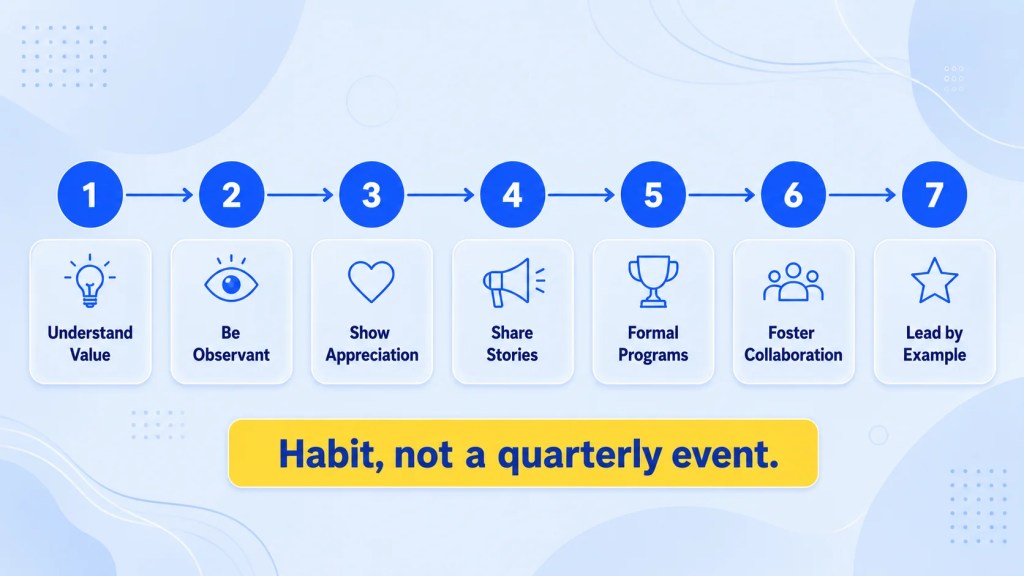
- Understand the value. Recognition should be regular, not rare — consistency is what makes a team feel valued, not one big annual gesture.
- Be observant. Keep a short “appreciation log” of moments worth noting. Specificity is impossible without it.
- Express genuine appreciation. Name the action and the impact. Skip generic praise like “great job.”
- Share success stories publicly. Public credit spreads the behavior — it shows the team what good work looks like.
- Use formal programs for milestones. Structure ensures recognition doesn’t depend on who’s popular or visible.
- Foster collaboration. Recognition is easier to give in a team that already shares credit and knowledge.
- Lead by example. Leaders who recognize consistently set the norm; employees follow what they see modeled.
Feature → How it works → Outcome: A shared appreciation log gives peers a place to note contributions as they happen. Each entry stays specific and timestamped instead of relying on memory at review time. Teams that keep one report recognizing 30–40% more of the “invisible” work that used to go unnoticed.
For the deeper version of this framework, see peer recognition in the workplace.
What to Say to Recognize a Coworker: Examples and Scripts by Scenario
The most-searched question in this space isn’t “why does recognition matter” — it’s “what do I actually say.” These are ready to adapt.
For project completion: “Taking ownership through three scope changes and a compressed timeline wasn’t easy. Keeping the team on track while maintaining quality is exactly what made this land well.”
For daily, consistent effort: “You show up for this team in a reliable, ‘I’ll handle it’ way that makes everyone’s work easier. That kind of dependability doesn’t go unnoticed.”
For going above and beyond: “You didn’t have to stay late to get this across the line, but you did. Treating someone else’s deadline as your own says a lot about you as a colleague.”
For cross-team collaboration: “Working across two teams with different priorities is never smooth, but you made this collaboration genuinely productive. Your communication prevented at least three miscommunications I can think of.”
For recognizing a whole team, not one person: “This shipped because everyone covered for each other when it mattered. No single person made this work — it was the group, and that’s worth saying clearly.”
For a remote or hybrid contributor: “Being remote doesn’t make your contributions less visible to me — it means I have to be more intentional about saying so. Your consistency has been constant regardless of where you’re logging in from.”
More message ideas by tone and occasion are in meaningful recognition at work.
How to Recognize a Coworker in Writing: Email, Slack, and Note Templates
Written recognition outlasts verbal recognition. It can be reread, referenced in a performance review, and pointed to as evidence that the work mattered.
Email — individual contribution:
Subject: Recognizing your work on [project name]
“Hi [Name],
I wanted to formally recognize your work on [specific task or project]. What stood out was [specific action they took] — it directly [describe the impact: saved the timeline, caught an error before launch, unblocked another team, etc.].
This kind of contribution doesn’t always get named, so I wanted to make sure it was.
Thank you for the work you put into this.
[Your name]”
Email — recognizing a whole team:
Subject: Great work from the [team name] team on [project/milestone]
“Hi team,
I wanted to send a note recognizing the work everyone put into [project or milestone]. [Specific detail: the deadline was compressed, the scope changed twice, the launch had zero critical bugs] — and that happened because the team covered for each other when it mattered.
A few specific things worth calling out: [1–2 concrete examples, e.g., ‘Priya caught the data issue before it reached the client’ / ‘the whole group turned around the revised deck overnight’].
Thank you all for how you handled this one.
[Your name]”
Email — nominating a coworker to a manager or recognition program:
Subject: Nominating [Name] for recognition — [award/program name]
“Hi [Manager’s name],
I wanted to nominate [Name] for [award or recognition program], based on their work over the past [timeframe].
Specifically:
- [Concrete example 1 — action + outcome]
- [Concrete example 2 — action + outcome]
- [Concrete example 3, if applicable]
I think this is exactly the kind of contribution the program is meant to recognize, and I wanted to make sure it didn’t go unnoticed.
[Your name]”
Slack or Teams message: “[Name] — quick note: what you did with [task] this week was excellent. [One sentence on why it mattered.] Wanted that on the record, even if just here.”
Handwritten or digital note: “[Name] — I don’t say this enough, but your work on [thing] made a real difference. Thank you for showing up the way you do.”
The same structure — specific action, observable impact, one sentence of genuine tone — is what BRAVO’s social recognition feature is built to capture and make visible to the whole team, not just the recipient.
Formal vs. Informal Recognition: When to Use Each
Formal recognition is structured and tied to milestones. Informal recognition is spontaneous. Organizations that rely on only one type consistently underperform on engagement compared to those using both.

| Type | Cadence | Best for | Examples |
|---|---|---|---|
| Informal | Weekly or more | Daily contributions, supportive actions | Thank-you notes, quick messages, shout-outs |
| Formal | Monthly to quarterly | Major achievements, milestones | Awards, certificates, points, nominations |
A useful rule: informal recognition is the habit; formal recognition is the amplifier, not the replacement. Structured programs also carry the retention benefit — companies with strong formal programs see 31% lower voluntary turnover, per Achievers’ 2025 State of Recognition Report.
BRAVO’s awards and nomination feature and the guide to creating an employee recognition program cover how to structure the formal side without slowing peer-to-peer recognition down.
Recognizing Remote and Hybrid Coworkers
Distance changes how recognition needs to work, not whether it matters.
Written-first recognition works better for distributed teams than verbal-only praise, since a Slack message or note survives time zone gaps that a passing comment in a hallway doesn’t.
Be more explicit than you would in person. “I noticed” carries more weight when the person can’t see your face while you say it.
Feature → How it works → Outcome: A shared, async recognition channel lets any teammate post a shout-out regardless of time zone. Every post stays visible for the whole team to see later, not just the moment it’s posted. Distributed teams using an always-on channel report fewer contributions going unnoticed compared to meeting-only recognition.
Engagement software built for remote and hybrid teams covers the tooling side of this in more depth.
Building a Consistent Recognition Habit with BRAVO
The most common failure in recognition programs isn’t bad intent — it’s inconsistency. Teams run a recognition push for a quarter, then participation drops once the novelty wears off.

BRAVO, an AI-powered employee recognition platform, addresses this structurally rather than motivationally — recognition sits inside the daily workflow instead of being a separate task someone has to remember to do.
Any employee can send a specific note, attach a reward point, and post it to the team board in under a minute. That speed is what makes it a habit instead of an event.
For HR teams, BRAVO’s reporting feature surfaces who’s being recognized, which teams have gaps, and how recognition activity tracks against engagement scores — turning what used to be anecdotal into something you can act on.
If your team currently relies on sporadic manager-driven shout-outs or a spreadsheet nomination process, BRAVO’s employee recognition platform is built to make peer recognition the default, not the exception.
Conclusion
Teams with high, sustained engagement aren’t the ones running a quarterly recognition event — they’re the ones where appreciation is a daily reflex.
That shift needs three things: language peers actually feel comfortable using, concrete ideas beyond a generic “thanks,” and enough structure that recognition doesn’t depend on who’s most visible. The scripts, ideas, and framework above give you all three.
If you’re ready to put this into practice as a team habit rather than a one-off effort, book a free BRAVO demo and see how peer recognition can run itself in the background of how your team already works.
FAQs
Name the specific action and its impact in one or two sentences, then say it where the person will see it — a direct message, a note, or a quick mention in a meeting. Specificity matters more than length.
“Taking ownership through three scope changes and a compressed timeline wasn’t easy — keeping the team on track while maintaining quality is exactly what made this land well” is a usable, specific example for project-based work.
Informal recognition is spontaneous and happens weekly or more — thank-you notes, shout-outs. Formal recognition is structured and milestone-based — awards, certificates, points, nominations. Effective programs use both, with informal as the daily habit and formal as the periodic amplifier.
Default to written recognition over verbal, since it survives time zone gaps. Be more explicit than you would in person, and use a shared channel so the recognition stays visible after the moment passes.
Team-level ideas include a celebration calendar tied to project milestones, a shared “wall of wins” updated weekly, and group lunches tied to specific achievements rather than routine schedules.
Informal recognition works best weekly or more often. Formal recognition — awards, milestones, nominations — fits a monthly or quarterly cadence. The two are complementary, not interchangeable.

He is an SEO strategist and content writer focused on employee engagement and SaaS marketing. He creates data-driven content that ranks on Google and AI search while helping businesses improve motivation, productivity, and retention.


