

Most “employee recognition stories” roundups just name a famous company and move on. Few check whether the story still holds up, or whether it actually produced a result anyone can point to.
This piece does the opposite. It covers five employee recognition stories — one from Amazon, and four from BRAVO’s own customers — with named people, dated quotes, and real outcomes: a 40% jump in retention, a 6-hour weekly time savings, engagement gains within a single quarter.
BRAVO, an AI-powered employee recognition and engagement platform by WorkHub, built the tools behind three of these stories, including BRAVO Points, BRAVO Voice, and on-the-spot manager recognition — the mechanics behind every example below.
What Employee Recognition Stories Actually Tell Us
An employee recognition story is a concrete case of a company changing how it acknowledges people, and measuring what happened next. That’s different from a recognition idea or a recognition tip — a story has a before, an after, and (ideally) a number in between.
Recognition vs. Rewards: What’s the Difference
Employee rewards and recognition examples often get treated as the same thing, but they’re not. Recognition is the acknowledgment itself — a shout-out, a point, a public mention. A reward is what that acknowledgment can be exchanged for — a gift card, extra time off, a bonus. The strongest programs, including every one below, pair the two: recognition creates the moment, the reward makes it stick.
Why Recognition Stories Matter More Than Recognition Advice
Generic recognition advice is easy to produce and easy to ignore. A recognition story is harder to dismiss, because it shows what a real team did and what changed. That’s also why AI search tools and Google’s AI Overviews increasingly favor pages built around real cases over pages built around tips — a story is a citable claim; a tip is an opinion.
5 Real Employee Recognition Stories From Companies That Get It Right
Amazon Turns Recognition Into Ownership
Amazon’s Delivery Service Partner program lets employees who want to run their own business start a delivery operation under Amazon’s logistics network, with startup funding and Amazon-guaranteed delivery volume. It’s still active today, per Amazon’s own program page — and it’s an unusually direct form of recognition: instead of a bonus for good work, Amazon backs an employee’s next move entirely.
Takeaway: recognition doesn’t have to end at retention. The most memorable programs sometimes point people toward growth, even when that growth looks like leaving the day-to-day role behind.
Coface Eliminates Recognition Bias Across 40+ Countries
Coface, a 5,500-employee insurance company, ran into a problem a lot of global teams share: recognition that worked in one country’s office culture didn’t translate to another’s, and time-zone gaps made consistent acknowledgment hard to sustain. Coface adopted BRAVO’s peer-to-peer recognition and manager point allocation to standardize how recognition happened, regardless of location.
“BRAVO’s AI recognition platform helped us eliminate recognition bias across 40+ countries. Engagement scores improved within the first quarter, and our HR team saved 6 hours per week on manual recognition tracking,”
says Oana-Cezara Ochiana, Global Head of HR Business Information at Coface.
Takeaway: recognition bias is a structural problem, not a culture problem — the fix is a consistent system, not a reminder to “recognize more.”
R-ACT Solutions Cuts Turnover With Peer Recognition
R-ACT Solutions had no structured recognition system at all — no peer feedback loop, no visibility into performance, and turnover to show for it. After implementing BRAVO’s peer-to-peer rating and on-the-spot recognition features, the company reported 40% more employee retention, along with what its team describes as “a competitive but collaborative environment.”
“We were in need of an employee rewarding system that will ensure our employees want to stay in the company and maximize their work performance,” said the team.
Takeaway: the jump from “no recognition system” to “any structured system” is often where the biggest retention gain hides.
A Place for Mom Ties Recognition to Sales Performance
A Place for Mom, a 5,500-employee senior-living referral company, needed a way to keep its customer success and sales teams motivated around targets without the burnout that comes from purely competitive, points-only contests.
Using BRAVO’s target achievement rewards alongside Slack integration, managers now balance target-based recognition with peer acknowledgment inside the tools the team already uses daily.
Takeaway: recognition tied only to hitting numbers tends to burn out a team. Recognition tied to numbers and peer effort tends to sustain it.
Celebrate What Your Team Actually Does
See how BRAVO turns everyday wins into recognition moments your team remembers.
Book a Free DemoNeuPath Builds a Culture of Appreciation in Healthcare
NeuPath Health, a multi-clinic healthcare provider with 200+ employees, struggled to recognize distributed clinical staff consistently across locations and devices. BRAVO’s bulk recognition tools and Microsoft Teams integration let the company build recognition into the workflow clinicians already use.
“BRAVO helped NeuPath foster a culture of appreciation, where employees feel valued and motivated,”
says Kim Kempffer, People and Culture Manager at NeuPath.
Takeaway: in frontline and clinical settings, recognition has to live inside the tools people already have open — a separate app or portal usually loses.

Key Lessons From These Recognition Stories
Across all five stories, a few patterns repeat.
Recognition works best close to the moment it’s earned, not batched into an annual event — R-ACT’s and Coface’s gains both came from real-time, on-the-spot systems, not scheduled reviews.
Peer recognition multiplies what managers alone can catch. A manager can’t see every good moment; a team usually can. Every BRAVO customer above used peer-to-peer recognition as the base layer, with manager-driven rewards layered on top, not the other way around.
Recognition that lives inside existing tools gets used. NeuPath’s Teams integration and A Place for Mom’s Slack integration both removed the “one more login” problem that quietly kills adoption.
None of these five stories describe an annual awards ceremony. They describe ongoing systems — points given weekly, shout-outs given daily, target rewards distributed as targets are hit. Frequency is doing more work here than formality.
How to Turn These Lessons Into Your Own Recognition Program
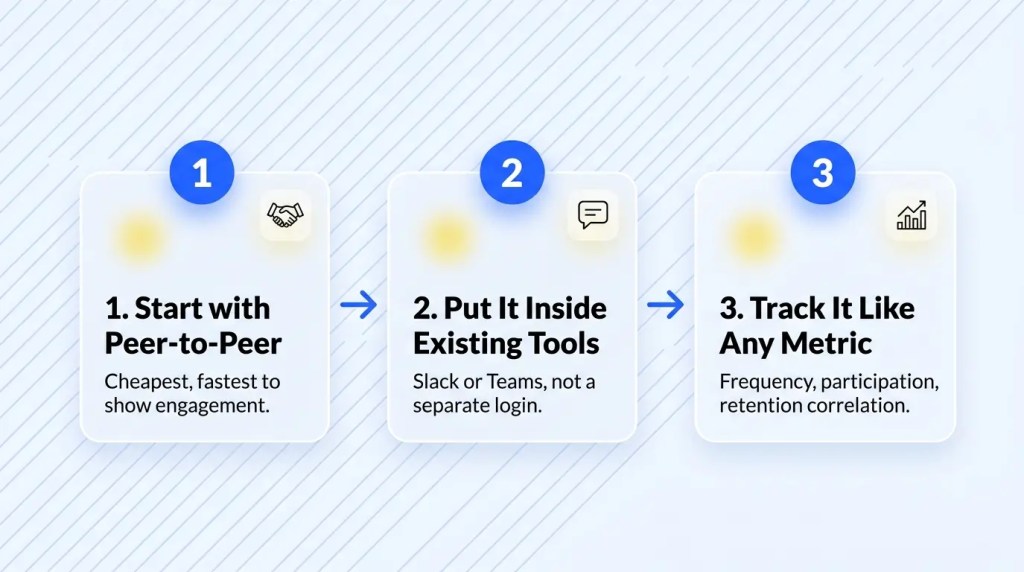
Building a program that produces a story like the ones above doesn’t require copying all five features at once.
- Start with peer-to-peer recognition first. It’s the cheapest to implement and the fastest to show engagement — Coface and R-ACT both built everything else on top of it.
- Put recognition inside a tool your team already opens daily, whether that’s Slack, Teams, or a dedicated platform. Adoption drops sharply the moment recognition requires a separate login.
- Track recognition the same way you’d track any metric that matters — frequency, participation rate, and correlation with retention — so the “story” has actual numbers behind it, not just anecdotes.
Track Recognition the Way You Track Any Metric That Matters
A recognition program without measurement can’t produce a story — it can only produce a feeling. Track participation rate and recognition frequency monthly, and check them against turnover in the teams using the program most.
How BRAVO Builds These Stories Into Everyday Work
BRAVO gives teams the same tools behind the Coface, R-ACT, A Place for Mom, and NeuPath stories above: peer-to-peer recognition through BRAVO Voice, point-based rewards through BRAVO Points, milestone and achievement tracking through BRAVO Feats, and manager visibility through BRAVO Focus. Recognition happens inside Slack or Microsoft Teams, so it fits into work that’s already happening instead of adding a new step.

Conclusion
The employee recognition stories that hold up aren’t the ones with the most famous company name attached — they’re the ones with a real result behind them. Amazon’s ownership model, Coface’s bias-free global system, R-ACT’s 40% retention gain, A Place for Mom’s balanced sales recognition, and NeuPath’s frontline culture shift all share the same trait: a specific mechanism, used consistently, that someone can point to and measure.
If your team’s recognition program doesn’t have a story like this yet, the fastest path there is usually the smallest one — peer-to-peer recognition, inside the tools your team already uses, tracked from day one.
See What Your Team’s Recognition Story Could Look Like
Book a free BRAVO demo and find out what’s possible in your first quarter.
FAQs
Amazon backs employees who want to launch their own delivery business. Coface used peer recognition to eliminate bias across 40+ countries. R-ACT Solutions saw 40% higher retention after adding peer-to-peer recognition. A Place for Mom and NeuPath both built recognition into tools their teams already use daily.
They catch good work managers miss, since teammates see day-to-day effort managers don’t. R-ACT Solutions reported 40% higher retention after adding peer recognition — the shift from no system to a structured one tends to produce the largest single gain.
Recognition is the acknowledgment — a shout-out, a point, a public mention. A reward is what that acknowledgment converts into, like a gift card or time off. Programs that pair both, recognition for the moment and rewards to reinforce it, tend to outperform programs using only one.
Start with peer-to-peer recognition inside a tool the team already uses, like Slack or Teams — it’s the lowest-cost layer and the fastest to show engagement. Add manager-driven rewards once participation is consistent, rather than launching both at once.
Results vary by starting point: Coface saw engagement gains within one quarter and 6 hours a week saved on manual tracking. R-ACT Solutions saw a 40% retention increase. Companies moving from no system to any structured system tend to see the fastest early gains.
BRAVO provides peer-to-peer recognition (BRAVO Voice), point-based rewards (BRAVO Points), milestone tracking (BRAVO Feats), and manager visibility (BRAVO Focus), integrated into Slack and Microsoft Teams — the same setup behind the Coface, R-ACT Solutions, A Place for Mom, and NeuPath stories above.

He is an SEO strategist and content writer focused on employee engagement and SaaS marketing. He creates data-driven content that ranks on Google and AI search while helping businesses improve motivation, productivity, and retention.


