

The benefits of employee recognition and rewards show up where engagement is weakest. Gallup’s 2026 State of the Global Workplace report found only 20% of employees worldwide are engaged. That is down from 21% a year earlier.
Short answer: recognition and rewards lift engagement, retention, performance, trust and collaboration. Below are 10 benefits, each tied to 2026 research, plus how to measure them.
BRAVO, an AI-powered employee recognition and engagement platform by WorkHub, is built around these ideas. BRAVO Points turns appreciation into redeemable rewards.
BRAVO Voice prompts recognition while the work is fresh. BRAVO Feats marks milestones and appreciation streaks, and BRAVO Focus ties each recognition to a goal.
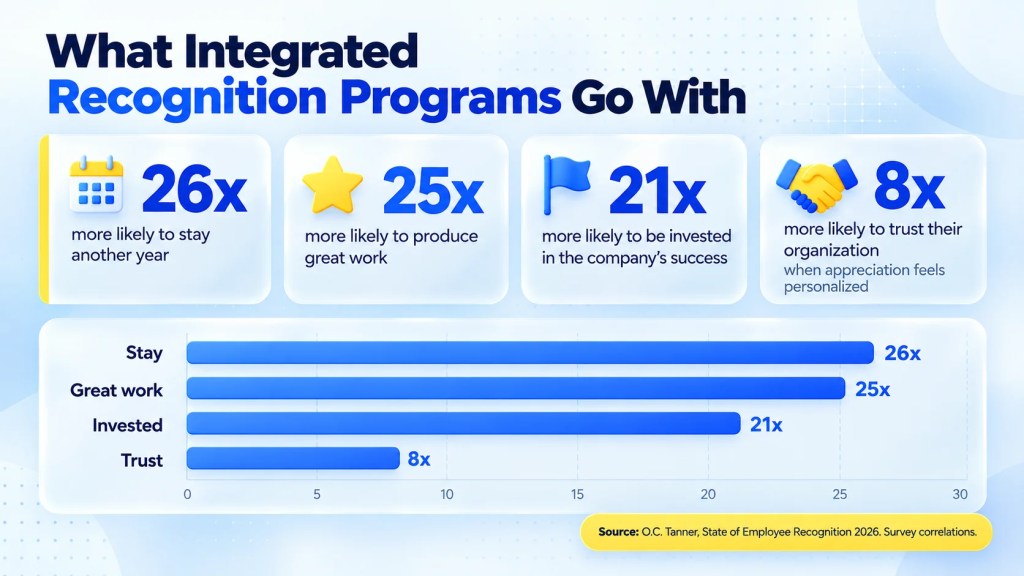
- Employees with integrated recognition programs are 26x more likely to work at their organization another year (O.C. Tanner, 2026).
- Employees with integrated recognition programs are 25x more likely to produce great work (O.C. Tanner, 2026).
- Employees regularly recognized by their managers are 19x more likely to trust those managers (Achievers, 2025).
What Are Employee Recognition and Rewards?
Employee recognition and rewards are two linked practices. Recognition acknowledges effort in words. Rewards attach something tangible to it.
A shout-out for a fixed bug is recognition. Points redeemable for a gift card are a reward. Together, employee rewards and recognition show people what good work looks like.
The mechanism is behavioral reinforcement. Behavior followed by a positive outcome tends to repeat. Specific, timely recognition makes that link visible.
Self-determination theory adds a second layer. People stay motivated when they feel competent and connected. Recognition feeds both, which pay alone rarely does.

Types of Recognition and Rewards
Six types of recognition and rewards for employees cover most programs. Most workplaces use two or three at once.
| Type | Example | Best for |
|---|---|---|
| Peer-to-peer recognition | A public shout-out in Slack or Microsoft Teams | Daily effort and collaboration |
| Manager recognition | A one-on-one thank-you tied to a specific result | Performance and trust |
| Milestone recognition | Work anniversary or project launch | Loyalty and belonging |
| Points-based rewards | Points redeemed for gift cards or merchandise | Flexible choice |
| Time and experience rewards | An extra day off or a team lunch | Wellbeing |
| Formal awards | Employee of the month or nominated awards | Peak performance |
BRAVO’s rewards catalog lists 200+ options, including gift cards, merchandise and donations to 1,000+ charities.
10 Benefits of Employee Recognition and Rewards (With 2026 Evidence)
Each of these employee recognition benefits carries a sourced number. Most come from O.C. Tanner’s 2026 State of Employee Recognition report. It surveyed 4,243 employees at organizations with 500+ employees across 10 countries.
A note on the numbers: these are survey correlations, not controlled trials. Read the multipliers as direction, not as a promise.
1. Higher Employee Engagement
Employee recognition raises engagement by showing people their work is seen and valued.
O.C. Tanner’s 2026 report found a strong link. Employees with integrated recognition programs are 21x more likely to be personally invested in their organization’s success.
Coface, an insurer with 5,500+ employees, says engagement scores improved within the first quarter on BRAVO. Its Coface case study has the details.
The mechanism is feedback. A specific thank-you tells people their discretionary effort registered, so they repeat it. For the wider case, read why recognition matters at work.
2. Better Employee Retention
Recognition makes employees more likely to stay.
O.C. Tanner’s 2026 report found employees with integrated recognition programs are 26x more likely to stay another year.
Achievers’ 2025 State of Recognition report surveyed 3,600 employees. It found weekly recognition makes employees 6x more likely to see a long-term career, yet only 19% are recognized weekly.
That gap is the retention opportunity. For the full picture on exits, see this guide to employee turnover and retention.
3. Stronger Performance and Productivity
Recognition improves performance because people repeat what gets noticed.
O.C. Tanner’s 2026 report found employees with integrated recognition programs are 25x more likely to produce great work. Achievers’ 2025 report found employees recognized regularly by managers are 3.2x more likely to be productive than unrecognized peers.
Specific praise works because it names the behavior. “Great job” teaches nothing. For example, “You rewrote the onboarding guide, and new hires stopped asking for setup help” does.
4. More Trust in Leaders and the Organization
Personalized recognition builds trust in the organization.
O.C. Tanner’s 2026 report found employees are 8x more likely to trust their organization when appreciation feels personalized. Achievers’ 2025 report found employees regularly recognized by their managers are 19x more likely to trust those managers.
Trust also underpins psychological safety, the sense that speaking up carries no penalty. Recognition from a manager is one of the fastest ways to build it.
5. Better Wellbeing and Lower Stress
Recognition supports wellbeing by making people feel seen at work.
Gallup’s 2026 State of the Global Workplace report counts 34% of employees as thriving. It also finds daily stress, anger and sadness remain above pre-pandemic levels.
O.C. Tanner’s 2026 report found thriving odds fall 89% when employees feel leaders do not know their recognition preferences.
Recognition does not fix an unmanageable workload. It does make effort visible while you fix it.
6. Stronger Collaboration, Especially in Dispersed Teams
Recognition strengthens collaboration by rewarding the people who help others.
O.C. Tanner’s 2026 report found geographically dispersed teams with connection-building programs are 51x more likely to excel at collaboration.
Peer-to-peer recognition makes invisible help visible. For example, the colleague who unblocks three teammates gets thanked in a public Slack or Microsoft Teams channel.
Remote and hybrid teams lose the casual praise of a shared office. A shared channel does the work hallway thanks used to do.
7. Reinforced Values and Goal-Aligned Behavior
Recognition reinforces company values when each award names the value it honors.
O.C. Tanner’s 2025 State of Employee Recognition report found awards linked to company purpose are 10x more meaningful.
Name the value in every message, such as ownership or customer focus. Employees then learn what the company rewards.
BRAVO Focus lets teams tag a recognition to an OKR, department goal or project milestone. A thank-you then shows which behaviors move a goal.
8. Fairer, More Consistent Recognition
A shared recognition system reduces bias because every team uses the same way to say thanks.
Manager-only recognition can favor the most visible people. A shared system spreads appreciation across locations and roles.
Oana-Cezara Ochiana, Global Head of HR Business Information at Coface, said BRAVO “helped us eliminate recognition bias across 40+ countries.” She also reported that her HR team saved 6 hours per week on manual recognition tracking.
Coface used peer-to-peer recognition, manager point allocation and leaderboards, per its Coface case study.
9. Stronger Employer Brand and Referrals
Recognition strengthens employer brand because valued employees recommend their employer.
O.C. Tanner’s 2026 report found employees with integrated programs are 13x more likely to give a high Net Promoter Score. That score measures willingness to recommend.
Recommendations travel through employee reviews and referrals. Employees who feel recognized have better things to say when a friend asks about their employer.
10. Motivation That Pay Alone Does Not Sustain
Recognition sustains motivation because pay sets expectations while recognition adds meaning.
O.C. Tanner’s 2025 report found 74% of employees say personalized messages of appreciation make recognition more valuable.
The benefits of rewarding employees depend on that pairing. Rewards work best as proof of appreciation, not as the message.
That balance protects intrinsic motivation, the drive to do work for its own sake. It also gives each reward a clear purpose.
Recognition, Rewards and Employee Benefits: What Is the Difference?
Recognition, rewards and employee benefits solve different problems. Recognition acknowledges specific effort. Rewards attach something tangible to that acknowledgment.
Benefits are the standing package, such as health insurance, paid leave and retirement plans. Compensation is the pay itself.
| Tool | Triggered by | How often | Example | Main effect |
|---|---|---|---|---|
| Recognition | A specific action | Continuous | “Thanks for fixing the billing bug” | Motivation and belonging |
| Rewards | Recognition or a goal | Frequent | Points redeemed for a gift card | Tangible proof of appreciation |
| Benefits package | Role or eligibility | Annual | Health insurance and paid leave | Security and attraction |
| Compensation | The job itself | Periodic | Salary and bonus | Baseline expectations |
Many HR teams group pay, benefits, development and recognition under total rewards. Searches for “rewards and benefits” usually mean the benefits package. This article covers the recognition side.

How to Measure the Benefits of Employee Recognition and Rewards
Five metrics measure the benefits of employee recognition and rewards. They are participation, frequency, engagement, voluntary turnover and eNPS.
| Metric | How to calculate | Data source |
|---|---|---|
| Participation rate | Employees who sent or received at least one recognition, divided by total employees, times 100 | Recognition platform |
| Recognition frequency | Recognitions sent per employee per month | Recognition platform |
| Engagement score | Average pulse-survey score before and after launch | Pulse survey |
| Voluntary turnover rate | Voluntary exits divided by average headcount, times 100 | HRIS |
| eNPS | Percent promoters (scores 9 to 10) minus percent detractors (scores 0 to 6) | Employee survey |
Set a 90-day baseline before launch. Without it, you cannot tell a real shift from normal drift.
Watch participation first. A program nobody uses cannot move the other four metrics.
Compare your frequency against a public benchmark. Achievers’ 2025 survey found only 19% of employees are recognized weekly.
Compare teams with similar workloads. Correlation is not causation, and a busy quarter can mask a real gain.
Common Mistakes That Cancel the Benefits
Five mistakes cancel most of the gains from recognition and rewards. Each has the same fix: be specific, be timely and be visible.
- Generic praise. O.C. Tanner’s 2026 report found thriving odds fall 89% when employees feel leaders do not know their recognition preferences. Ask people how they like to be recognized.
- Rare recognition. Achievers’ 2025 survey found only 19% of employees are recognized weekly and 23% are never recognized. Set a weekly floor.
- Late recognition. Reinforcement weakens as days pass between the work and the thanks. BRAVO Voice prompts recognition while the work is fresh.
- Manager-only recognition. O.C. Tanner’s 2026 report found employees are twice as likely to use recognition tools when peers use them consistently. Peer-to-peer recognition spreads the habit.
- Rewards without a message. A gift card with no reason attached reads as a transaction. Always name the behavior.
How to Get Started With Employee Recognition and Rewards
Five steps get a recognition and rewards program running in a quarter.
- Pull a 90-day baseline for engagement, voluntary turnover and eNPS.
- Pick four to six behaviors or values to recognize, and tie them to goals with BRAVO Focus.
- Run recognition where work happens. BRAVO in Slack and Microsoft Teams keep it inside daily workflow.
- Offer small, flexible rewards through BRAVO Points, and let people choose.
- Have leaders recognize first, then review participation, frequency, engagement, turnover and eNPS monthly.
NeuPath Health, a healthcare provider with 200+ employees, uses BRAVO for bulk recognition and gamified engagement. It also runs recognition through the Microsoft Teams integration.
People and Culture Manager Kim Kempffer says BRAVO helped build a culture where employees feel valued and motivated. Read the NeuPath story.
For program design, tooling and ROI, read the benefits of an employee rewards and recognition program. To see the structure behind it, explore the BRAVO employee recognition program.
The Bottom Line
The benefits of employee recognition and rewards are real, but they depend on execution. Specific, frequent and visible recognition moves engagement, retention and trust. Generic or rare recognition does not.
Start small. Measure five numbers against a 90-day baseline. Keep what moves them and drop what does not.
If your baseline shows a gap, book a free BRAVO demo and plan your first recognition rollout with the team.
Frequently Asked Questions
The main benefits are higher engagement, better retention, stronger performance, more trust and better collaboration. In O.C. Tanner’s 2026 survey, employees with integrated recognition programs were 26x more likely to stay another year. They were also 25x more likely to produce great work.
Recognition improves retention by making people feel their work registers. O.C. Tanner’s 2026 report found employees with integrated programs are 26x more likely to stay another year. Achievers’ 2025 survey found weekly recognition makes employees 6x more likely to see a long-term career.
Recognition acknowledges specific effort. A reward attaches something tangible to it, such as points, a gift card or time off.
Recognition works without a reward. A reward without recognition reads as a transaction, so the strongest programs pair the two.
Weekly is a sound starting point. Achievers’ 2025 survey of 3,600 employees found only 19% are recognized weekly. Weekly recognition also makes employees 6x more likely to see a long-term career.
Pair manager recognition with peer-to-peer recognition so appreciation does not depend on one person.
Yes. Recognition costs nothing to start, since specific, timely praise needs no budget. O.C. Tanner’s 2026 data covers organizations with 500+ employees, so evidence for small teams is thinner.
The mechanism does not depend on size: people repeat behavior that is noticed.
Salary sets the baseline. It does not tell people which work mattered. O.C. Tanner’s 2025 report found 74% of employees say personalized messages of appreciation make recognition more valuable.
Rewards work best as proof of that message, not a substitute for it.

He is an SEO strategist and content writer focused on employee engagement and SaaS marketing. He creates data-driven content that ranks on Google and AI search while helping businesses improve motivation, productivity, and retention.


