

Employee service awards recognize workers for the time they have stayed with a company. Most programs start at year five. The Bureau of Labor Statistics (BLS) reports a median employee tenure of 4.1 years in January 2026.
That means a program built around year five skips most of the workforce. Summing the BLS tenure bands under five years gives about 53% of wage and salary workers.
BRAVO, an AI-powered employee recognition and engagement platform by WorkHub, tracks anniversaries and delivers recognition in Slack and Microsoft Teams. BRAVO Points carries the reward. BRAVO Voice can survey employees on which rewards they want.
This guide shows how to build employee service awards that start earlier, follow IRS rules, and fit a real budget.
What Are Employee Service Awards?
Employee service awards are formal recognitions given at tenure milestones, such as one, five, or ten years of service. They are also called years of service awards, length-of-service awards, or service recognition. Unlike a spot bonus, a service award honors time and commitment, not a single result.
A complete program sits inside a wider employee recognition program. It has three parts:
- Defined milestones with clear eligibility rules
- A reward the employee actually wants
- A recognition moment that names what the person contributed
A gift without a story is just an item. Common formats include gift catalogs, experiences, points, extra paid time off, keepsakes, and donations in the employee’s name.
How Do Service Awards Differ From Work Anniversaries?
A work anniversary is the yearly date an employee joined the company. A service award is the formal recognition attached to selected anniversaries.
Most companies mark every anniversary with a message. They reserve awards for milestone years such as 1, 3, 5, and 10. The lighter years still matter, because a skipped anniversary is noticed.
BRAVO supports both layers. Its milestone feature sends personalized anniversary messages and awards BRAVO Points automatically. That keeps the lighter years from slipping, even when managers are busy.
How Do Service Awards Differ From Performance and Customer Service Awards?
Service awards recognize tenure. Performance awards recognize a result, such as a sales target or a project launch. Customer service team awards recognize support quality and have no link to length of service.
BRAVO’s awards and nomination feature handles that performance side.
The difference matters for tax and budget. Under IRS Publication 15-B (2026), only length-of-service and safety awards can qualify for the achievement award exclusion.
Other awards are taxable unless they qualify as de minimis. That is why the two award types need separate rules and budgets.
Traditional vs. Modern Employee Service Awards
Traditional service awards start at year five and arrive as a plaque or pin. Modern programs start at year one, let employees choose, and automate tracking. The table shows the structural differences.
| Dimension | Traditional program | Modern program |
|---|---|---|
| Milestone frequency | 5-year and 10-year only | 1-year, 3-year, 5-year, and beyond |
| Award format | Plaques and certificates | Chosen gifts, digital badges, points, keepsakes |
| Delivery | In-person ceremony only | In-person, virtual, and mailed kits |
| Recognition scope | Manager only | Manager, peers, and public posts |
| Tracking | HR calendar reminders | Automated through HRIS or a recognition platform |
| Remote inclusion | Often excluded | Designed for distributed teams |
![Chart of US worker tenure bands showing about 53% under five years for employee service awards]](https://i0.wp.com/getbravo.io/wp-content/uploads/2021/08/Year-Five-Program-Reach-Infographic.webp?resize=1024%2C576&ssl=1)
The BLS data shows why the start year matters. Median tenure was 4.1 years in January 2026, and 20.6% of workers had a year or less (BLS, September 2026). In leisure and hospitality, the median was 2.4 years.
A year-five program rarely reaches those workers. A year-one milestone reaches them while they are still deciding whether to stay. HR sees the result in coverage: more employees recognized before their third anniversary.
Why Do Employee Service Awards Matter for Retention and Engagement?
Employee service awards support retention by making tenure visible. Visibility tells every employee that the company notices who stays. That signal is the mechanism, and the gift is only its carrier.
Three things make the signal work:
- Timing: recognition lands on the anniversary, not weeks later.
- Specificity: the message names real contributions from the past year.
- Audience: peers and leaders see it, not just the employee.
Early tenure is where the pool is largest. In January 2026, 20.6% of U.S. wage and salary workers had been with their employer a year or less (BLS). A first-anniversary award reaches the people most likely to be new.
A missed milestone does the opposite. When a third anniversary passes unmarked, the employee reads it as a sign that nobody is tracking their tenure. The cost is invisible in the budget, but it shows up in how the person talks about the company.
No award replaces fair pay, good management, or room to grow. A service award works when it sits on top of those basics. Measure its effect with cohort retention instead of assuming it.
How to Design an Employee Service Award Program
An employee service award program needs five decisions: milestones, award weight, personalization, tracking, and visibility. Each takes one working session. For the general build process that applies to every recognition type, see BRAVO’s guide to creating an employee recognition program.
Step 1: Set Your Milestone Tiers
Set formal milestones at 1, 3, 5, 10, 15, and 20-plus years. Add a lighter yearly acknowledgment between them. Start from your own attrition data.
If a department averages under three years of tenure, a year-five program recognizes few of its people. Add a six-month mark where early attrition is the problem. Then check the milestone list against actual hire dates, so every tier has real recipients.
Step 2: Scale Award Weight to the Milestone
Award weight should rise with tenure in three ways: gift value, audience size, and the seniority of the person presenting. A first anniversary says the company noticed the employee stayed. A tenth anniversary says the employee built a career here.
A manager presents at year one. A senior leader presents at year ten. If a 20-year award feels like a 3-year award, the program loses its motivational ladder.
Step 3: Personalize Within Each Tier
Personalization means giving managers the employee’s team history, contributions, and interests before the milestone. A handwritten note beside a standard gift changes how the award lands. Generic gifts at every tier signal process compliance.
Survey employees every year on reward preferences. BRAVO Voice, the survey tool inside BRAVO, can run that survey. Preferences differ by career stage, so one catalog rarely fits everyone.
Step 4: Automate Milestone Tracking
Automated tracking removes the most common failure, the missed milestone. A third anniversary passes because HR was busy. The employee concludes that nobody tracks tenure.
BRAVO syncs with your HRIS and calendar to import employee dates. It triggers recognition and BRAVO Points on the exact day. Managers can schedule recognitions weeks ahead from the milestone calendar.
Step 5: Make Recognition Visible
Visible recognition does two jobs. It makes the recipient feel valued, and it shows everyone else that tenure counts. Post milestones in team channels, in meetings, or on the intranet.
Offer a private option for employees who dislike public praise. The goal is that the right people see the moment, not the most people. A short note from a respected peer often lands better than a company-wide blast.
Employee Service Award Ideas by Milestone
Service award ideas should rise in value and visibility with each milestone. From year five, choose tangible items for tax reasons. The table pairs ideas with the recognition moment and the 2026 U.S. tax treatment.
| Milestone | Award ideas | Recognition moment | U.S. tax treatment |
|---|---|---|---|
| 1 year | Manager letter, shareable digital badge, learning credit, quality branded item | Team shout-out in Slack or Teams | No exclusion. Small non-cash gifts may be de minimis |
| 3 years | Points redemption, development stipend, team lunch, contribution spotlight | Peer messages and team acknowledgment | No exclusion. Same de minimis test |
| 5 years | Tangible gift from a preapproved catalog, such as tech or wellness items | Department celebration with leadership | Tangible property can qualify within limits |
| 10 years | Premium tangible keepsake, executive acknowledgment, company-wide story | Senior leader presents | Tangible property can qualify within limits |
| 15 to 20 years | Co-created reward, named recognition, peer tribute book | Leadership dinner or team event | Tangible property can qualify. Experiences and time off cannot |
| 25 years and up | Bespoke keepsake, charity donation in the employee’s name, legacy entry | Company-wide communication | Tangible property can qualify. Charity donations are not tangible property |
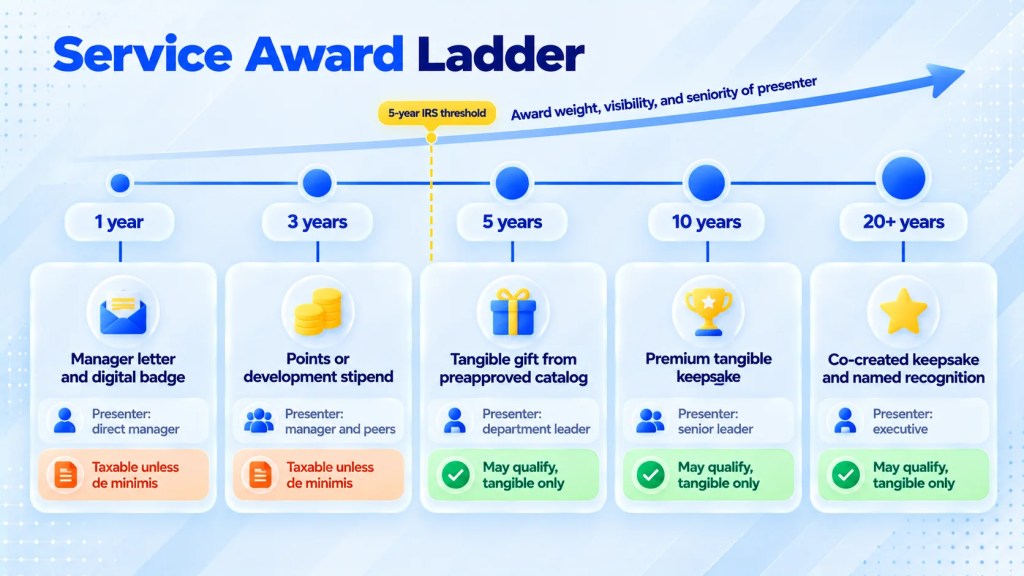
Match the award to the milestone’s meaning, not just its price. Experiences and points are still good ideas. They are taxable, so decide up front who bears that cost.
Low-Cost Additions That Raise Any Award
Small additions often matter more than the gift itself. These four cost little and work at every tier:
- A peer tribute book with written memories
- A short video message from a senior leader
- A named mention in the next all-hands
- A handwritten note from the direct manager
Together they supply the recognition moment that a catalog gift cannot. They also scale. A one-year employee and a twenty-year employee can both receive them, with the leader’s message growing with tenure.
Automate Every Service Milestone
See how BRAVO tracks anniversaries and sends recognition in Slack and Teams.
Book a Free DemoAre Employee Service Awards Taxable?
Employee service awards are taxable wages unless they meet the IRS achievement award rules. In 2026, the IRS lets employers exclude up to $1,600 per employee in qualified achievement awards. Awards outside a qualified plan top out at $400 (IRS Publication 15-B, 2026).
This section is general information, not tax advice. Confirm your program with a tax advisor.

Which Awards Qualify for the IRS Exclusion?
The exclusion covers tangible personal property given for length of service or safety achievement. IRS Publication 15-B (2026) excludes cash, cash equivalents, gift cards, gift certificates, vacations, meals, lodging, event tickets, and securities. One exception exists: a certificate that lets the employee pick from a limited, preapproved assortment of tangible items.
Every qualifying award must meet three tests:
- It is given for length of service or safety
- It is awarded as part of a meaningful presentation
- It does not create a significant likelihood of disguised pay
What Are the $400 and $1,600 Limits?
The excludable amount is $1,600 per employee per year. For awards outside a qualified plan, it is $400 (IRS Publication 15-B, 2026).
A qualified plan award comes from an established written plan that does not favor highly compensated employees. For 2026, treat anyone paid over $160,000 in 2025 as highly compensated.
The plan also has an average-cost test. If the average cost of all achievement awards in the year exceeds $400, the awards are not qualified plan awards. Awards of nominal value are ignored in that average.
What Is the Five-Year Timing Rule?
A length-of-service award qualifies only after the employee’s first five years of service. It also fails if the employee received another length-of-service award in the current year or the prior four. Secondary sources describe this rule, and a tax advisor should confirm it against IRC section 274(j).
The rule shapes your calendar. Years 1 and 3 can still be celebrated, but the gift is treated as pay unless it is de minimis. Cash and cash equivalents are never de minimis (IRS Publication 15-B, 2026).
What Stays Taxable?
Several common awards stay taxable under the same IRS publication:
- Cash and gift cards, at any amount
- Vacations, lodging, meals, and event tickets given as service awards (only occasional, low-value items can be de minimis)
- Performance awards outside the length-of-service exclusion
- Any value above the $400 or $1,600 limit
Taxable awards are wages. Employers may withhold federal income tax on them at the flat 22% supplemental wage rate (IRS Publication 15-B, 2026). Plan for that cost when you choose award types, because employees notice a smaller paycheck after a celebration.
How Much Should You Budget for Employee Service Awards?
An employee service awards budget is award cost times recipients, plus ceremony, shipping, and administration. Build it from HRIS data, not a per-head guess. Follow four steps:
- Export hire dates and count employees reaching each milestone in the next 12 months.
- Assign a cost per award to each tier.
- Add ceremony, shipping, and administration costs.
- Check the IRS average-cost test if you want qualified plan treatment.
The average-cost test shapes how you spread money: suppose a company gives 100 awards at $150 and five at $1,500.
The average is about $214, under the $400 test. These figures are illustrative, not benchmarks.
A simple worksheet keeps the math visible:
| Tier | Recipients (from HRIS) | Cost per award | Subtotal |
|---|---|---|---|
| 1 year | Count of first anniversaries | Your figure | Recipients times cost |
| 3 years | Count of third anniversaries | Your figure | Recipients times cost |
| 5 years and up | Count per milestone | Your figure | Recipients times cost |
| Ceremony and shipping | Count of events | Your figure | Events times cost |
Give early tiers a real share of the budget. In January 2026, 20.6% of workers had a year or less of tenure (BLS). A small gift for that large group reaches more people than one premium award.
Ceremony costs belong in the same line, including catering, printed tribute materials, and a small event for a 25-year milestone. Add platform fees too. BRAVO’s current plans are on its pricing page.
How to Deliver Employee Service Awards to Remote and Hybrid Teams
Remote service award delivery works when the gift arrives before the milestone and a live moment surrounds it. A parcel with no context is a transaction, not recognition. Distributed employees need the same ceremony weight as office-based colleagues.
Before the Milestone
Start planning four to six weeks ahead, and earlier for international shipping, since delivery times vary by country. Confirm the delivery address and date first. Ask the employee’s manager and close peers for short messages, then choose a mailed kit that lands by the anniversary.
BRAVO’s milestone calendar lets managers schedule recognition weeks in advance. That lead time turns a last-minute scramble into a planned moment.
On the Day
Hold a short video call with the team and one senior leader present. Read two or three peer messages aloud. Name specific contributions, not just the number of years.
Keep the call under ten minutes so it fits busy calendars. Record it so teammates in other time zones can watch later. The goal is a moment the employee remembers, not a meeting they sit through.
After the Milestone
Share the recognition in Slack, Microsoft Teams, or the intranet. BRAVO delivers milestone recognition inside Slack, Teams, and Outlook, where employees already work. Peers can add congratulations without opening another tool.
A public thread also gives colleagues one more chance to reply. Those replies are often what the employee keeps and rereads. Archive them with the award so the record outlasts the day.
How to Choose a Service Awards Platform or Provider
A service awards platform should sync hire dates, remind managers in advance, and deliver recognition where employees work. Providers fall into three types: award and keepsake suppliers, gift-of-choice vendors, and recognition platforms. Many programs combine two of them.
Use these questions to compare any provider:
| Question | Why it matters |
|---|---|
| Does it sync hire dates from your HRIS? | Manual tracking causes missed milestones |
| Does it remind managers in advance? | Lead time makes a real celebration possible |
| Does it deliver in Slack, Teams, or email? | Recognition in the flow of work gets used |
| Can it fulfill tangible awards globally? | Remote employees need delivery to home addresses |
| How does it track the IRS five-year rule? | Tax compliance is your risk, not the vendor’s |
| What reporting does it provide? | HR needs coverage and participation data |
How BRAVO Handles Service Milestones
BRAVO’s employee milestone feature automates work anniversaries, birthdays, promotions, onboarding, retirements, and custom milestones. It imports dates from your HRIS and calendar. It generates a personalized message for each milestone, and managers can add BRAVO Points, notes, or GIFs before delivery.

Ask every vendor, BRAVO included, how it handles tangible award fulfillment and the five-year rule. The answers decide whether a platform fits a tax-qualified plan. Explore BRAVO’s employee milestones feature and its Slack and Teams integrations.
How to Measure the ROI of Employee Service Awards
Measure employee service awards with five metrics, each calculated from data you already hold. Without measurement, the program is a budget line with no accountability. Track these, and pair the engagement score with your employee engagement software data:
- Milestone coverage rate: milestones acknowledged on time divided by eligible milestones, from HRIS dates.
- Cohort retention: voluntary turnover among recognized employees compared with similar unrecognized groups.
- Engagement change: eNPS or survey scores before and after launch.
- Manager completion rate: milestones completed by managers divided by milestones assigned.
- Cost per recognized milestone: total program spend divided by milestones delivered.
For financial return, multiply retained employees by your finance team’s replacement-cost estimate. Use your own figure, because replacement cost varies by role and company. Compare that total against program spend.
Set a baseline before launch. Record last year’s turnover by tenure band and your current milestone coverage. Then compare the same figures after 12 months.
Review the numbers by tier. A weak result at year three points to the award, the timing, or the manager. A weak result at year ten points to ceremony weight.
Build Employee Service Awards Around Real Tenure
Employee service awards work when they match how long people actually stay. With median tenure at 4.1 years, a program that begins at year five misses most employees. Start at year one, respect the IRS rules from year five, and automate the tracking.
Your next step is small. Export hire dates from your HRIS and count how many employees pass a milestone in the next 12 months. That number sets your budget and shows how many moments you would have missed.
If you want the calendar to run without spreadsheets, book a free BRAVO demo and see it in action.
Employee Service Awards FAQs
Yes, but the award is usually taxable. The IRS exclusion applies after five years, so earlier gifts are wages unless they are low-value, non-cash de minimis items. Cash and gift cards are never de minimis, at any amount, so choose small tangible items instead.
BRAVO automates service milestones by syncing hire dates from your HRIS and calendar. It delivers recognition in Slack, Microsoft Teams, and Outlook, with a milestone calendar for scheduling ahead. Compare any platform on HRIS sync, manager reminders, award fulfillment, and reporting.
A work anniversary is the yearly date an employee joined. A service award is the formal recognition tied to selected anniversaries, such as 5, 10, or 25 years. Many companies celebrate every anniversary with a message and reserve awards, gifts, and ceremony for milestone years.
Acknowledge every anniversary lightly and give formal awards at 1, 3, 5, 10, 15, and 20 years. For tax-qualified awards, the IRS timing rule requires at least five years between length-of-service awards. Confirm that rule with a tax advisor before setting your calendar.
A complete budget includes the award, shipping, ceremony costs, printed tribute materials, platform fees, and administration time. Build it from HRIS data on how many employees reach each milestone. Keep the average qualified award at or under $400 for qualified plan treatment.
No. Employee service awards recognize length of service, and customer service team awards recognize support results such as satisfaction scores. Rules, budgets, and tax treatment differ, so companies usually run them as separate programs with separate owners.

He is an SEO strategist and content writer focused on employee engagement and SaaS marketing. He creates data-driven content that ranks on Google and AI search while helping businesses improve motivation, productivity, and retention.


