

Global employee engagement fell to 20% in 2025, its lowest level since 2020, according to Gallup’s 2026 State of the Global Workplace report (Gallup, 2026). Humor won’t fix disengagement on its own, but it’s one of the fastest, lowest-cost ways teams can build trust day to day.
This guide has 75+ employee puns and jokes organized by use case — appreciation messages, “great job” recognition, quick one-liners, and Slack-ready jokes — plus the research on why workplace humor actually works, and how to use it without it landing flat.
Why Humor Actually Works in the Workplace
Workplace humor isn’t just a mood booster. It’s a trust signal.
When a manager shares an appropriate joke, teams read it as permission to relax and speak up. A 2025 peer-reviewed study in Frontiers in Psychology found that leader humor is directly linked to higher team trust and more employee-driven innovation (Frontiers in Psychology, 2025).
Leader humor builds team trust. When leaders use appropriate humor consistently, employees feel safer admitting mistakes and sharing new ideas. The result, per the 2025 study, is measurably higher innovative behavior across the team.
Harvard Business Review’s March 2025 research review found that leaders known for humor are seen as 27% more motivating, and that top-performing executives use humor roughly twice as often as average ones (HBR, 2025). The same research is a useful caution too: forced or poorly timed humor backfires, pushing employees into “surface acting” that increases exhaustion. Humor works best when it’s optional and genuine — never a mandated icebreaker.
The stakes for getting culture right are real:
- Global employee engagement: 20% in 2025, down from 21% in 2024 (Gallup, 2026)
- Manager engagement: 22% in 2025, down from 27% in 2024 (Gallup, 2026)
- Employees who get recognition right are 45% less likely to have changed jobs within two years (Gallup, updated 2025)
- 1 in 3 employees say recognition gaps make them feel like “just another number” (SHRM/Nectar 2025 State of Company Culture Report)

Puns and jokes won’t move these numbers by themselves. Consistent recognition does — and humor is one of the easiest entry points into it.
One-Liners and Quick Wit for the Office
Short, punchy lines work anywhere — Slack, standups, or a quick aside in a meeting.
They’re the easiest employee puns to use because they don’t need setup or a punchline delivery. Drop one in naturally and move on.
Quick one-liners anyone can use:
- I told my boss I needed a raise. He told me to rise to the occasion.
- I love deadlines. I like the whooshing sound they make as they fly by.
- I’m not lazy — I’m on energy-saving mode.
- My job is secure. Nobody else wants it.
- I work well under pressure, especially coffee pressure.
- Meetings: where minutes are kept and hours are lost.
- I thought about working late. Then I thought again.
- Hard work never killed anyone, but why risk it?
Witty one-liners for a drier sense of humor (what most people mean by “work jokes one-liners for adults” — sharper, deadpan delivery, still fully workplace-safe):
- My calendar and my sanity broke up months ago.
- I’m fluent in sarcasm and passive-aggressive email signatures.
- “Quick sync” is corporate for “this could’ve been one message.”
- My inbox and I have an understanding: mutual avoidance.
- I don’t multitask. I just fail at several things simultaneously.
- Reply-all is a weapon and should be treated as one.
- I’ve mastered the art of looking busy in back-to-back meetings.
- My productivity peaks exactly one hour before I clock out.

One-liners like these are useful in team recognition messages — a short, well-timed joke in a shoutout gets read, remembered, and often reused by the team.
Employee Appreciation Puns
“Good job” gets stale fast. A pun makes appreciation land differently — it shows someone actually thought about the message instead of copy-pasting a template.
These work best in thank-you cards, appreciation emails, or a quick note attached to a small reward.
- Thanks for going above and beyond — you’re a real over-achiever.
- You’re impastable to replace.
- Your work ethic is un-latte-able.
- We’re grateful you’re on this team — no pun intended, actually all intended.
- You rose to every challenge this quarter.
- Consider this your official thanks-a-latte card.
- You didn’t just meet expectations, you exceeded-ingly crushed them.
- Your effort has been outstanding — literally, we noticed it from across the office.
If you want appreciation messages with a bit more range than puns alone, these employee appreciation quotes pair well with a card or a shoutout post.

Great Job and Well-Done Puns for Recognition Messages
“Great job” puns work best when tied to a specific result — finishing a project, hitting a number, solving a problem nobody else could.
- You nailed it — hammer emoji optional, but earned.
- That project didn’t stand a chance against you.
- You crushed that deadline like it owed you money.
- Well done is an understatement — well overdone, in the best way.
- You turned a mess into a masterpiece.
- That was a win for the record books.
- You sealed the deal and then some.
- Success looks good on you — wear it well.
Generic praise gets skimmed. A recognition message with a specific pun tied to a specific win gets remembered — and it’s the kind of detail that shows up in exit interviews as “why I stayed,” not just “why I left.”
Team Chat and Slack-Ready Puns
Some jokes are built for a quick reaction in a group chat, not a formal card. These are for standups, Slack channels, or a Friday afternoon wind-down message.
- Teamwork makes the dream work — unless the dream is sleeping.
- I’m multitasking: I can listen, ignore, and forget, all at once.
- Office rule: if it works, don’t touch it. If it doesn’t, call IT.
- Our team doesn’t do drama — we do dashboards.
- We don’t have problems, we have backlogs.
- Coffee: the original team-building exercise.
- We’re not behind schedule, we’re aggressively on time for later.
- This team runs on caffeine and shared calendars.

Puns like these work especially well as the caption on a quick team trivia round or a Friday wind-down post — see team engagement trivia questions for ready-made prompts to pair with them.
Clean, Family-Friendly Office Jokes and Puns
Not every audience wants wordplay — sometimes a straightforward, safe joke lands better, especially in mixed or newer teams still getting comfortable with each other.
- Why did the employee bring a ladder to work? To reach the next level.
- Why don’t office chairs ever get lost? They always know their seat.
- What do you call a printer that sings? A Dell.
- Why was the calendar always stressed? It had too many dates.
- What did the stapler say to the paper? You’re bound to succeed.
- Why did the spreadsheet break up with the calculator? It found someone who added up better.
- What’s an employee’s favorite type of weather? A raise.
- Why did the coffee file a police report? It got mugged.
These land safely across almost any team and are the easiest employee jokes to hand to a new manager who wants to try humor without overthinking it.
How to Use Employee Puns at Work Without Killing the Mood
Humor at work has an easy way to go wrong: timing.
The same joke that gets a laugh in a Friday Slack channel can land badly in a serious 1:1 or right after a layoff announcement. Context decides whether a pun builds trust or looks tone-deaf.
Recognition messages are where puns work best. A pun attached to a specific, genuine “thank you” or “great job” gives the humor a job to do beyond just being funny. Teams that pair humor with specific recognition — not generic praise — see messages read, reacted to, and remembered far more than plain text alone.
A quick check before you send it:
| Do | Don’t |
|---|---|
| Use puns in casual chats, recognition posts, and low-stakes moments | Use humor right after bad news, layoffs, or serious feedback |
| Keep jokes inclusive and workplace-safe | Reference personal traits, culture, or anything sensitive |
| Pair a pun with a specific, genuine “thank you” | Use humor as a substitute for real recognition |
| Let people opt out of the joke without awkwardness | Force humor into every message as a habit |
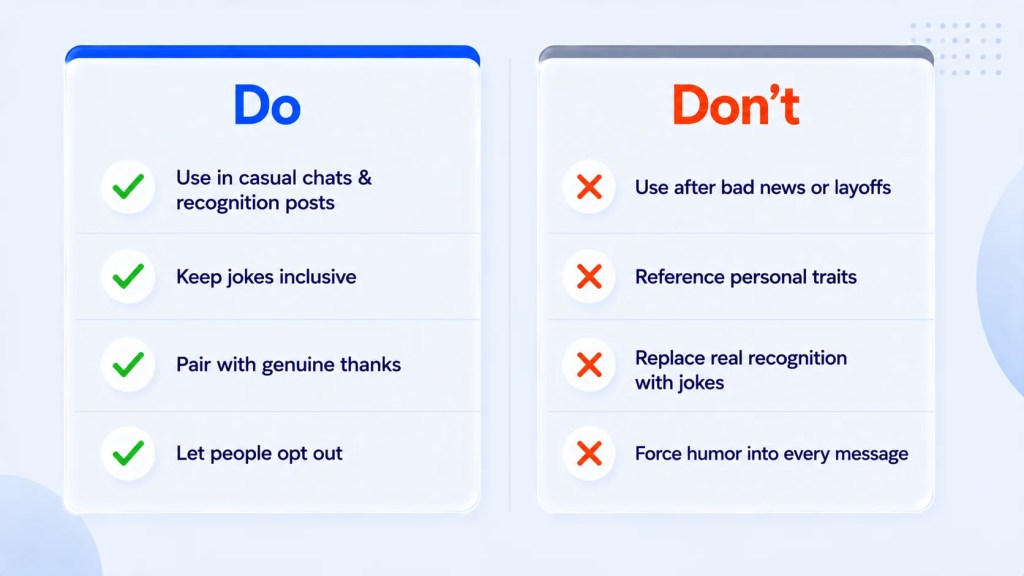
When HR teams introduce humor through recognition messages instead of as a standalone “joke of the day,” it tends to stick — the humor rides along with something the employee already values, instead of competing for attention on its own.
Turning Fun Moments Into Real Employee Engagement
Puns and jokes are a good start. They’re not a retention strategy on their own.
The gap between “we had a fun Friday” and “our team feels genuinely recognized” is consistency — and that’s where most humor-only efforts run out of steam after a few weeks.
Recognition software gives humor a permanent home instead of a one-off post. Platforms like BRAVO’s social recognition feature let employees send peer shoutouts — puns included — that stay visible to the whole team instead of scrolling away in Slack. The result is recognition that compounds over time instead of resetting every Monday.
BRAVO, an AI-powered employee recognition platform, is built around exactly this problem: making appreciation — funny or serious — something teams do consistently, not sporadically. If your team already has good instincts around humor and recognition, BRAVO’s employee recognition platform gives those instincts a structure that survives beyond one good week. For more ideas on keeping recognition creative long after the puns run out, see creative employee recognition ideas.
Conclusion
Employee puns work because they’re low-stakes and easy to personalize — a quick way to make recognition feel human instead of templated.
But humor alone won’t move engagement numbers that are, per Gallup’s 2026 data, at their lowest point since 2020. It has to be paired with recognition that’s specific, consistent, and genuinely felt.
Use the puns above where they fit naturally — a Slack message, a thank-you card, a shoutout after a big win. If you’re ready to build that habit into something that lasts, book a free BRAVO demo and see how your team can start recognizing wins, funny or serious, in minutes.
FAQs
Good employee puns for work are short, inclusive, and tied to a real moment — a finished project, a thank-you note, or a quick Slack message. Lines like “you’re impasta-ble to replace” or “you nailed it” work because they attach humor to genuine recognition, not a generic joke.
Yes, when they’re inclusive, avoid sensitive topics, and match the moment. Puns work well in casual chats, recognition messages, and team celebrations. They’re not appropriate right after serious feedback, layoffs, or bad news.
Employee puns rely on wordplay — using double meanings of work-related terms. Employee jokes are broader and include one-liners, observational humor, and short stories that don’t require wordplay. Most workplaces use both interchangeably.
Puns make recognition messages more memorable by adding personality to a “thank you” or “great job” note. A 2025 Frontiers in Psychology study found that leader humor builds team trust and encourages more open collaboration, which supports recognition efforts.
Humor supports engagement but doesn’t replace it. Gallup’s 2026 data shows global engagement at 20%, its lowest level since 2020, while consistent recognition makes employees 45% less likely to leave within two years. Humor works best as part of a recognition habit, not a substitute for one.
Simple, specific puns work best: “you nailed it,” “that was a win for the record books,” or “you crushed that deadline.” Tying the pun to the actual achievement makes it land better than a generic joke would.

He is an SEO strategist and content writer focused on employee engagement and SaaS marketing. He creates data-driven content that ranks on Google and AI search while helping businesses improve motivation, productivity, and retention.


