

Most companies think they have a recognition problem. What they usually have is a consistency problem — some people get recognized often, most don’t, and nobody could tell you why.
Employee recognition is the practice of acknowledging what someone did and telling them, specifically, that it mattered. That’s it at its core. What separates a workplace where recognition actually works from one where it doesn’t isn’t budget or software — it’s whether recognition happens often enough, specifically enough, and fairly enough to mean something.
This guide covers what employee recognition is, how it differs from appreciation and rewards, the types worth building into a program, what effective recognition looks like in practice, how to build and measure one, and where software fits in — including how BRAVO, an AI-powered employee recognition platform by WorkHub, supports each piece.
What Is Employee Recognition?
Employee recognition is acknowledging a specific action, effort, or achievement in a way that tells the person it was noticed and it mattered.
Here’s what that looks like in practice: a support engineer resolves a client escalation late on a Friday, outside their normal scope. The following Monday, their manager opens the team meeting by naming exactly what happened and why it mattered to the client relationship. That’s recognition — specific, timely, and tied to something the person actually did.
Recognition can be as small as a Slack message or as structured as a formal awards ceremony. What makes it recognition, rather than just a compliment, is the specificity: it names the action and connects it to an outcome.
Employee Recognition vs. Employee Appreciation
The two get used interchangeably, and the distinction doesn’t need to be complicated.
Recognition is earned — tied to something specific someone did. Appreciation is given — it acknowledges someone’s value as a person or teammate, independent of a specific achievement. “Thanks for catching that error before it reached the client” is recognition. “I’m glad you’re on this team” is appreciation.
Neither replaces the other. Recognition without appreciation can start to feel transactional, like a scorecard. Appreciation without recognition can feel vague, like it isn’t really about anything the person did. Programs that only do one tend to feel incomplete after a while.
Employee Recognition vs. Employee Rewards
Recognition and rewards get bundled together constantly, but they’re doing different jobs.
| Employee Recognition | Employee Rewards | |
|---|---|---|
| What it does | Acknowledges a contribution | Provides something of value |
| Form | Can be entirely non-monetary | Usually tangible (points, gift cards, time off) |
| Timing | Can happen immediately | Often tied to a threshold or milestone |
| Example | A manager publicly naming what someone did well | A gift card or bonus for hitting a target |
A reward without recognition attached — a bonus that shows up with no explanation — tends to feel transactional. Recognition without any reward option can start to feel like all talk, no follow-through, especially for larger achievements. The strongest programs use recognition as the constant (frequent, specific, often free) and rewards as the periodic reinforcement (tied to bigger milestones or sustained performance).
Why Is Employee Recognition Important?
Recognition affects how people feel about their work day to day, and that shows up in outcomes companies already track.
Improves Employee Engagement
Global employee engagement fell to 20% in 2025, down from a peak of 23% in 2022, according to Gallup’s State of the Global Workplace: 2026 report. The steepest decline came from managers, whose engagement dropped five points in a single year — from 27% to 22%.
That matters here because managers are the delivery mechanism for most recognition. A disengaged manager is not a manager who notices good work.
Recognition is one of the few engagement levers a manager can pull the same day. It requires no compensation review, no reorg, and no budget line — only noticing something specific and saying so.
Supports Retention
Gallup tracked roughly 3,500 employees from 2022 to 2024 and found that well-recognised employees were 45% less likely to have left their organisation two years later. Employees receiving high-quality recognition were 65% less likely to be actively watching or applying for other roles.
The gap is wide because most recognition does not clear the quality bar. Gallup found only 22% of employees say they receive the right amount of recognition, and 55% receive either none at all or recognition that meets none of the five quality criteria.
That is the lever: not more recognition volume, but recognition specific and timely enough to register.
Strengthens Workplace Culture
Recognition is one of the few practices that’s visible to everyone, not just the person receiving it. When a team sees a specific contribution get named and valued, it signals what the organization actually rewards — separate from what’s written in a values statement.
Improves Employee Experience
Recognition shapes how people experience their day-to-day work, not just their annual review. A team where effort routinely goes unnoticed feels different to work on than one where it doesn’t, even if the underlying job is identical.
Reinforces Company Values
Recognition tied explicitly to a value — collaboration, customer focus, ownership — does double duty: it acknowledges the person and teaches everyone watching what “living the values” actually looks like in a specific, observable action. This is what actually builds a company recognition culture, rather than a set of values printed on a wall. For a broader look at how recognition ties back to loyalty and retention, see BRAVO’s guide to the benefits of employee recognition and rewards.

Types of Employee Recognition
Recognition programs work best when they combine more than one type. Below are the ones worth understanding, grouped by what distinguishes them rather than treated as nine unrelated categories. For a wider library of formats and ideas, see BRAVO’s workplace recognition guide.
Peer-to-Peer Recognition
Colleagues recognizing colleagues, without a manager initiating it. This matters because peers see things managers structurally can’t — the person who covered a shift, debugged a teammate’s problem, or kept morale up during a rough sprint. It works best when it’s low-friction enough that sending it takes less time than a Slack message.
Manager Recognition
Recognition from a direct manager or leader. It carries more formal weight, particularly when tied to performance reviews or promotions, and it’s the type most likely to influence how an employee sees their standing and trajectory at the company.
Formal and Informal Recognition
Formal recognition is structured and criteria-based — nomination programs, quarterly awards, documented service milestones. Informal recognition is spontaneous — a comment in a meeting, a quick message. Both matter: informal recognition should happen weekly or more; formal recognition works as the periodic amplifier for bigger achievements, not a replacement for the daily habit.
Public and Private Recognition
Public recognition — shared in a team channel or meeting — reinforces behavior for everyone watching, not just the recipient. Private recognition — a direct message or one-on-one comment — matters for employees who find public praise uncomfortable, or for feedback that’s more personal in nature. Neither is universally better; knowing which an employee prefers is part of doing this well.
Monetary and Non-Monetary Recognition
Monetary recognition includes bonuses, gift cards, and points redeemable for rewards. Non-monetary recognition includes public praise, extra flexibility, or a handwritten note. Non-monetary recognition scales more easily and doesn’t require budget approval, which is why it should form the daily backbone of a program, with monetary recognition reserved for larger or sustained contributions. If points are part of your reward mix, BRAVO’s employee recognition points system guide walks through how to structure one.
Performance-Based Recognition
Recognition tied directly to a measurable result — hitting a target, closing a deal, shipping on time. It works best when the criteria are clear in advance, so recognition doesn’t look like it’s chasing favorites after the fact.
Values-Based Recognition
Recognition tied to a behavior that reflects a stated company value, independent of a specific measurable outcome. An employee who mentors a struggling teammate might not move a KPI, but recognizing that action reinforces exactly the behavior a “we support each other” value statement is trying to describe.
Milestone Recognition
Recognition tied to a point in time rather than a specific action — a work anniversary, a promotion, a certification earned. It rewards sustained commitment rather than a single achievement, and it’s often the recognition type most likely to be automated, since the trigger date is known in advance.
Team Recognition
Recognition aimed at a group rather than an individual — a team that shipped a hard project, a department that hit a shared goal. This matters because not every win has a single owner, and over-indexing on individual recognition can quietly discourage collaboration.

Employee Recognition Examples
Generic praise (“Great job!”) doesn’t function as recognition — it doesn’t name what happened, so it doesn’t reinforce anything specific. The examples below show what specific recognition actually sounds like, grouped by scenario, including how they’d read as a BRAVO recognition post.
Everyday Recognition
Day-to-day contributions are the most common recognition opportunity and the easiest to let slide.
“Thanks for catching the reporting issue before it reached the client. Your attention to detail saved the team a lot of rework.”
“You’ve stepped in to cover onboarding calls twice this month without being asked. That’s made a real difference for the new hires.”
For more scripts and message templates by scenario, see how to recognize coworkers.
Performance Recognition
Tied to a measurable result or a specific piece of work.
“Closing the Meridian account after three stalled quarters wasn’t luck — you rebuilt the relationship from scratch. That’s exactly the kind of persistence this team needs more of.”
“The dashboard rebuild you shipped cut our reporting time from two days to two hours. That’s a direct, measurable win.”
Team Recognition
Aimed at a group, not an individual, and useful for cross-functional work where no single person owns the outcome.
“This launch had three teams working against a compressed timeline, and none of the handoffs got dropped. That doesn’t happen without everyone covering for each other — well done.”
Milestone Recognition
Covers anniversaries, promotions, certifications, and project or launch completions.
“Five years in, and you’re still the person new hires get pointed to when they have questions. That kind of institutional knowledge doesn’t show up on a scorecard, but it’s why this team runs as smoothly as it does.”
“Congratulations on the PMP certification — that’s a significant time investment on top of a full workload, and it shows in how you’ve been running the Atlas project.”
Values-Based Recognition
Ties directly back to a stated company value rather than a measurable outcome.
“You spent an hour walking a new teammate through the deployment process even though it wasn’t your job to onboard them. That’s exactly the ‘we win together’ value we talk about — thank you for actually living it.”
Remote Employee Recognition
Written recognition matters more for distributed teams, since it’s often the only visible record of a contribution that happened off-camera.
“Being remote doesn’t make your work less visible to me — it just means I have to be more deliberate about saying so. Your response times and the quality of your async updates have been consistent for months, and I wanted that said clearly.”
What Makes Employee Recognition Effective?
Not all recognition lands the same way. The characteristics below separate recognition that actually reinforces behavior from recognition that gets ignored — and if you want the practical version of this, BRAVO’s guide to personalized ways to recognize employees breaks each of these down with more examples.
| Characteristic | Why it matters |
|---|---|
| Timely | Recognition loses impact the longer it’s separated from the action. Praise for something that happened two months ago reads as an afterthought. |
| Specific | Naming the exact behavior is what makes recognition reinforce anything. Vague praise doesn’t tell the person what to repeat. |
| Authentic | Recognition that reads as performative or templated is often worse than no recognition — it signals the program is a checkbox exercise. |
| Personal | Personalisation is one of the five quality criteria in Gallup’s recognition framework. Recognition that meets four or five criteria produces 90% engagement, against 10% for recognition meeting none (Gallup, 2024). |
| Meaningful | Recognition needs to matter to the recipient specifically — a public shout-out is meaningful to some employees and uncomfortable for others. |
| Consistent | One-off recognition efforts fade. Consistency is what turns recognition into a cultural expectation rather than a campaign. |
| Inclusive | Recognition concentrated among the same handful of visible employees signals favoritism, even unintentionally, and erodes trust in the whole program. |
| Visible when appropriate | Public recognition reinforces behavior for the whole team, not just the recipient — but only when the recipient is comfortable with that visibility. |
| Aligned with values | Recognition tied to a stated value does double duty, reinforcing both the individual behavior and what the organization says it stands for. |
| Connected to real behavior | Recognition disconnected from an actual action or outcome reads as arbitrary, which undermines trust in the criteria behind it. |

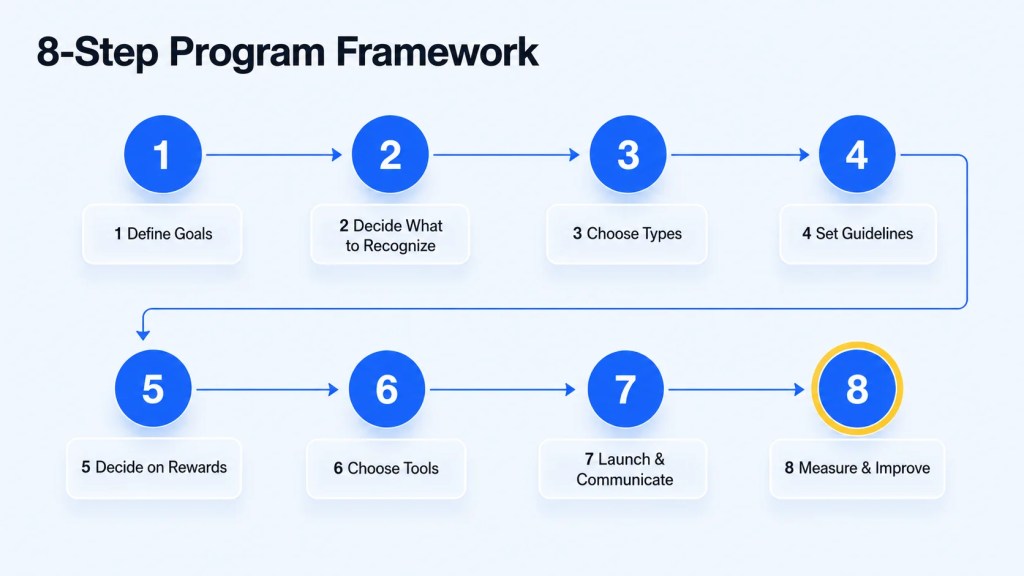
How to Build an Employee Recognition Program
A recognition program built without a sequence tends to launch, get attention for a month, and quietly fade. The framework below is meant to be a starting point an HR manager can act on directly.
Step 1: Define Your Goals
Decide upfront what the program is meant to accomplish — improving engagement, strengthening culture, reinforcing specific values, improving retention, or increasing manager participation in recognition. The goal shapes every decision after this one, including what gets measured.
Step 2: Decide What to Recognize
Set concrete criteria: hitting a target, living a specific value, supporting a teammate, reaching a tenure milestone. Vague criteria produce vague recognition, which is the fastest way for a program to feel arbitrary.
Step 3: Choose Recognition Types
Select a mix from the types above rather than relying on one — most programs combine peer-to-peer, manager-led, and milestone recognition at minimum, since each captures contributions the others miss. For a full walkthrough of structuring this, see BRAVO’s guide to employee recognition programs.
Step 4: Set Recognition Guidelines
Document who can give recognition, how often, and what the criteria are. Guidelines don’t need to be rigid, but employees should be able to answer “how does this actually work?” without guessing.
Step 5: Decide on Rewards
Determine whether recognition should carry a tangible reward attached, and if so, what kind — points, gift cards, extra time off — and at what threshold. Not every recognition moment needs a reward attached; reserve tangible rewards for larger or sustained contributions.
Step 6: Choose the Right Tools
Decide whether a spreadsheet and manual process is sufficient (viable for very small teams) or whether the volume and distribution of your team requires software. This is where the Employee Recognition Software section below becomes relevant.
Step 7: Launch and Communicate
Introduce the program with a clear explanation of how it works, and get managers recognizing early — teams follow what leaders visibly do more than what a launch email says. A rushed launch without manager buy-in is one of the more common reasons participation stalls in the first quarter.
Step 8: Measure and Improve
Track participation, distribution, and engagement signals on a regular cadence (quarterly is reasonable for most teams), and adjust criteria, guidelines, or reward structure based on what the data shows. See How to Measure Employee Recognition for the specific metrics worth tracking.
Employee Recognition Ideas
Ideas work best grouped by how they fit into daily operations, rather than as an undifferentiated list.
Built into daily workflow: peer shout-outs in Slack or Microsoft Teams, a dedicated recognition channel or feed, quick manager acknowledgments during standups.
Team-level: team celebrations for shared wins, cross-team recognition for collaborative projects, a recognition wall (physical or digital) visible to the whole office or org.
Structured and periodic: monthly recognition themes, values-based awards tied to a nomination process, milestone recognition for anniversaries and certifications.
Reward-attached: recognition points redeemable for a rewards catalog, personalized rewards based on individual preference rather than a one-size-fits-all gift, customer-praise recognition that routes external compliments back to the employee who earned them.
The common thread across programs that sustain participation: employees have more than one way to give and receive recognition, so it doesn’t depend entirely on one channel or one person remembering.
For a wider library of formats, see BRAVO’s creative employee recognition ideas.
Employee Recognition for Remote and Hybrid Teams
Remote employees get overlooked in recognition not out of neglect, but because the informal visibility that happens naturally in an office — a manager overhearing a call, noticing someone stay late — doesn’t happen the same way over a screen.
Digital recognition closes that gap. A shared recognition feed makes contributions visible to the whole team regardless of location, which matters most for the employees whose work would otherwise go unseen.
Async recognition matters for cross-time-zone teams. Not every recognition moment can happen live in a meeting. Written recognition — a message, a post — works across time zones in a way that a verbal shout-out in a synchronous meeting doesn’t.
Visibility doesn’t have to mean forced publicity. Some remote employees are just as uncomfortable with public recognition as their in-office peers. The fix isn’t defaulting to public recognition for remote workers — it’s asking what they prefer, the same as anyone else.
Fairness between office and remote employees requires deliberate tracking. Left unmanaged, recognition tends to concentrate around whoever is physically visible to a manager. Reviewing recognition distribution by location periodically catches this before it becomes a pattern employees notice themselves.
What Separates Programs That Last From Programs That Stall
Recognition programs rarely collapse outright. They fade — participation drifts down, the same names keep appearing, and eighteen months later nobody renews.
The effectiveness characteristics above describe individual recognition moments. This describes the program around them.
| Programs that last | Programs that stall |
|---|---|
| Recognition within days of the action | Recognition batched into review cycles |
| Peer-to-peer alongside manager-led | Manager-led only, capped at what one person notices |
| Published criteria, known in advance | Criteria decided case by case, after the fact |
| Distribution tracked by team and manager | Only total volume tracked |
| Milestones automated from HRIS dates | Milestones dependent on someone remembering |
| Recognition preference asked, not assumed | Everyone defaulted to public recognition |
| Behaviours recognised, not only outcomes | Only measurable wins acknowledged |
Three failure modes are worth naming directly, because they are the ones that survive a well-designed launch.
Recognition concentrates and nobody notices. If 10% of employees receive 60% of recognition, the program is amplifying an existing visibility hierarchy rather than surfacing hidden contribution. Distribution data catches this. Participation data does not.
Managers are told to recognise more, not how. Most managers were never taught this. “Recognise your team regularly” produces either silence or performative volume. “Name the specific action and why it mattered” is a teachable skill with a worked example attached.
The platform gets treated as the program. Software removes friction; it does not create intent. A recognition tool deployed without manager expectations produces a well-instrumented silence.
For tactics on turning these into a repeatable process, see BRAVO’s employee recognition strategies guide and best practices for peer-to-peer recognition.

How to Measure Employee Recognition
Measurement is what separates a recognition program from a recognition initiative that quietly stops after a quarter.
Recognition participation rate — the percentage of employees who have given or received recognition in a given period. Low participation, even with good total volume, signals the program isn’t reaching everyone.
Recognition frequency — how often recognition happens per employee or per team. This tells you whether recognition is a habit or an occasional event.
Percentage of employees recognized — distinct from frequency, this tells you whether recognition is broad-based or concentrated in a small group.
Manager participation — the share of managers actively giving recognition. A program can have strong peer participation and still fail if managers aren’t modeling it.
Peer-to-peer participation — tracked separately from manager-led recognition, since the two often move independently.
Recognition distribution by team and department — surfaces gaps that an org-wide average would hide. A healthy overall number can mask one department where recognition never happens.
Recognition tied to company values — the share of recognition explicitly connected to a stated value, useful for confirming the program is reinforcing culture, not just activity.
Employee engagement and sentiment — typically gathered through a separate engagement survey, and useful as a directional signal alongside recognition data, not a metric recognition data replaces.
Retention and turnover — worth tracking over time, but treat any correlation with recognition data as directional. Recognition is one input among many into retention, and claiming it as the sole cause of a turnover change isn’t something the data usually supports.
The metric most programs skip is the one that predicts failure: the share of employees who received no recognition at all in the last 30 days.
Volume and average frequency both look healthy when recognition concentrates in a visible minority. A team can post strong total numbers while a third of the organisation receives nothing — and that third is where regretted attrition comes from.
Gallup’s data gives the reference point. Across US employees, 55% receive either no recognition or recognition that meets none of the five quality criteria, and only 22% say they get the right amount. If your internal numbers look dramatically better than that, check the distribution before celebrating.
Set the review cadence before launch. Monthly for distribution and zero-recognition cohort. Quarterly for engagement correlation. Annually for retention. Reviewing retention monthly produces noise, not signal.
Employee Recognition Software
Employee recognition software centralizes recognition — giving, tracking, and (often) rewarding it — into one platform, rather than relying on scattered emails, spreadsheets, or manager memory.
When a simple process is enough: very small teams, where a manager can realistically track and initiate recognition manually without anything falling through the cracks.
When software becomes worth it: once a team grows past the point where one person can reliably notice everything, spans multiple locations or time zones, or needs recognition data to report on participation and ROI. Manual tracking doesn’t scale past that point — it depends entirely on someone remembering to log it.
Problems software solves specifically: inconsistent recognition (some employees get noticed, most don’t), no visibility into participation gaps, recognition that only flows top-down because there’s no easy peer channel, and no way to report on whether the program is actually working.
Features worth evaluating:
- Peer-to-peer and manager recognition, both supported natively
- A recognition feed or shared visibility layer
- Points or rewards functionality, if tangible rewards are part of the program
- Awards and nomination workflows for formal recognition
- Milestone automation for anniversaries and tenure
- Analytics and reporting on participation and distribution
- Integrations with tools the team already uses — Slack, Microsoft Teams, the company HRIS
- Support for values-tagging, if values-based recognition is part of the strategy
For a deeper comparison of specific platforms and pricing, see BRAVO’s employee recognition software guide.
How BRAVO Supports Employee Recognition
BRAVO is an AI-powered employee recognition platform built by WorkHub. It is designed around the principles above — recognition that is frequent, specific, and reaches the whole organisation rather than the employees who happen to be most visible.
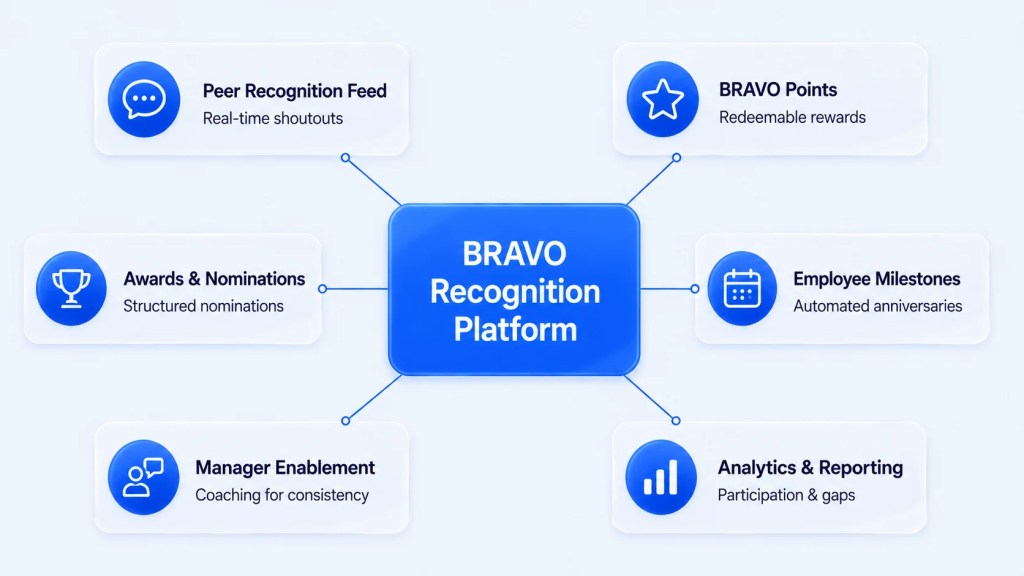
Peer recognition and points. Recognition runs through a shared feed, so employees can recognise each other directly without waiting on a manager to notice. BRAVO Points attach redeemable value when a tangible reward makes sense — without requiring one for every acknowledgment. Rewards redeem from a global catalogue rather than a single-market gift card list.
Formal recognition. Awards and Nomination workflows handle the structured side — criteria-based, auditable, and trackable for HR reporting. That auditability is what defends formal awards against the favouritism perception.
Milestones. Employee Milestones automates anniversary and tenure recognition from HRIS date fields, so those moments never depend on someone remembering.
Performance and goals. BRAVO Feats covers team challenges and goal-linked achievements, making performance recognition visible as it happens. BRAVO Focus handles OKR and goal tracking, which is what lets performance recognition tie to something more specific than a manager’s impression.
Feedback and measurement. BRAVO Voice gives employees a channel for sentiment and feedback alongside recognition activity, connecting the two datasets rather than treating them separately. Analytics surface participation, distribution, and gaps — the metrics from the measurement section above.
Manager support. Manager Enablement tools help managers who were never naturally strong at recognition build the habit, rather than assuming it arrives on its own.
BRAVO runs inside Slack, Microsoft Teams, and common HR systems, so recognition happens in the tools teams already use. No integration is gated behind a higher tier.
Full capability breakdown: BRAVO employee recognition platform. Plans and setup costs: BRAVO pricing.
Conclusion
Effective employee recognition comes down to four things: it’s specific, it’s timely, it’s authentic, and it happens consistently — not once a year, but as a normal part of how a team operates.
The programs that sustain this over time aren’t the ones with the biggest budget. They’re the ones where recognition is built into daily workflow, reaches the whole team rather than a visible few, and gets measured well enough to improve rather than quietly fade after the first quarter.
If you want to see how this maps to your own headcount and program goals, book a free BRAVO demo.
Frequently Asked Question
Recognition is earned and tied to a specific action — “thanks for catching that error before it reached the client.” Appreciation is given and acknowledges someone’s value as a person, independent of any achievement. Programs running only one feel incomplete: recognition alone turns transactional, appreciation alone feels vague.
No, and doing so is counterproductive. Recognition works as the constant — frequent, specific, and usually free. Rewards work as periodic reinforcement for larger milestones or sustained performance. A reward with no explanation attached reads as transactional; recognition with no reward option can feel like all talk on bigger achievements.
Use a shared digital feed so contributions are visible regardless of location, and rely on written recognition so it works across time zones. Do not default remote employees to public recognition to compensate for distance — ask their preference, same as anyone. Review distribution by location quarterly to catch fairness gaps.
Set a floor, not a target. Frequent informal recognition — weekly or more — paired with periodic formal recognition for larger milestones outperforms infrequent, high-value-only recognition. The more useful discipline is checking who received nothing in the last 30 days, since that cohort is where programs quietly fail.
Track three numbers monthly: participation rate, distribution across teams and managers, and the percentage of employees with zero recognition in 30 days. Pair these with engagement survey movement quarterly. Total volume tells you nothing about reach — a strong top-line number can hide a department where recognition never happens.
Once a team grows past the point where one person can reliably notice everything, spans multiple locations or time zones, or needs participation data to report on. Manual tracking depends entirely on someone remembering to log it, which is the failure mode software exists to remove.
Most established recognition platforms offer native Slack and Teams apps, BRAVO included. The differentiators worth checking: whether integrations are gated behind higher pricing tiers, whether HRIS data drives milestone automation, and whether recognition can be sent without leaving the chat window.

He is an SEO strategist and content writer focused on employee engagement and SaaS marketing. He creates data-driven content that ranks on Google and AI search while helping businesses improve motivation, productivity, and retention.


